Blood Type Calculator
Free Blood Type Calculator: predict possible child blood types from parent ABO & Rh types using Mendelian genetics. Includes blood type compatibility chart...
Formula used
How to Use the Blood Type Calculator
Select the ABO blood type of Parent 1 and Parent 2 from the dropdown menus, then choose each parent's Rh factor (Positive or Negative). Click Calculate to instantly see all possible child blood types with their probability percentages, a detailed Punnett square breakdown, and compatibility guides for blood transfusion and organ donation.
Before using this tool, note that the ABO blood type system uses a person's known blood type — not their genotype. Because some blood types can result from more than one genetic combination (for example, Type A can be genotype IAIA or IAi), the calculator provides all statistically possible outcomes based on both possible genotypes for each blood group. This means the percentages represent population-level probabilities, not certainties for any individual family.
Step-by-Step Instructions
- Select Parent 1 ABO Type — choose from A, B, AB, or O based on a blood test, medical record, or identification card.
- Select Parent 2 ABO Type — enter the second parent's blood type.
- Select Rh Factors — choose Positive (+) or Negative (−) for each parent. Rh status is equally important for pregnancy compatibility.
- Click Calculate — results appear instantly with a probability table, Punnett square, and compatibility assessment.
- Review the Compatibility Section — understand which blood types can donate to and receive from which blood groups.
The ABO Blood Type System Explained
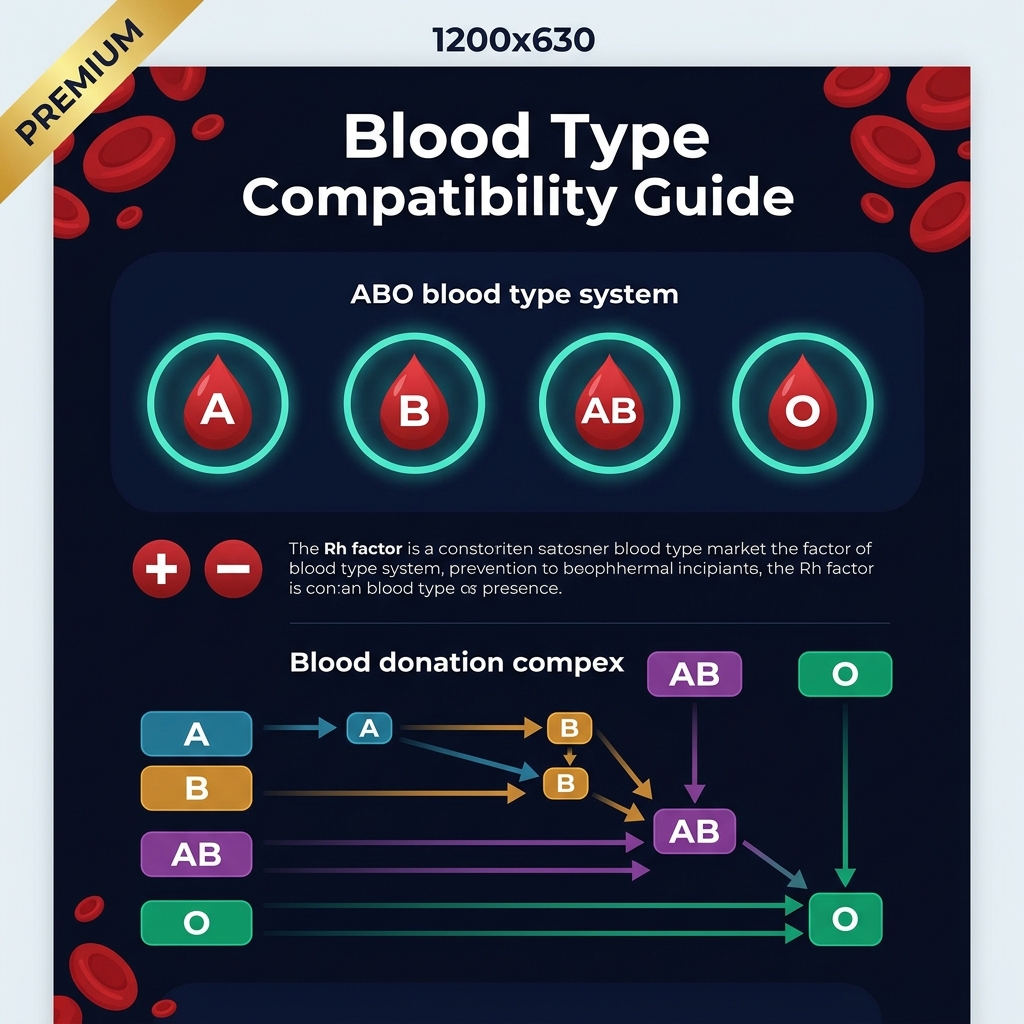
The ABO blood type system — discovered by Austrian scientist Karl Landsteiner in 1901, for which he received the Nobel Prize in Physiology or Medicine — is the most clinically important blood classification system in transfusion medicine. It divides human blood into four major groups based on the presence or absence of two surface antigens on red blood cells: antigen A and antigen B.
The Four ABO Blood Groups
- Type A: Red blood cells carry the A antigen; plasma contains anti-B antibodies. Can donate to A and AB. Can receive from A and O.
- Type B: Red blood cells carry the B antigen; plasma contains anti-A antibodies. Can donate to B and AB. Can receive from B and O.
- Type AB: Red blood cells carry both A and B antigens; plasma has no ABO antibodies. Universal recipient for red blood cells — can receive from A, B, AB, or O. Can donate only to AB (for red cells).
- Type O: Red blood cells carry neither A nor B antigen; plasma contains both anti-A and anti-B antibodies. Universal donor for red blood cells — can donate to A, B, AB, or O. Can receive only from O.
Why ABO Compatibility Matters
When incompatible blood is transfused, the recipient's pre-formed antibodies recognize the foreign antigens on the donor red blood cells and trigger a severe immune reaction called a hemolytic transfusion reaction. This causes the immune system to destroy the donated red blood cells, potentially leading to acute kidney failure, shock, disseminated intravascular coagulation (DIC), and death. This is why ABO typing is the most critical step in pre-transfusion compatibility testing — performed in all blood banks worldwide before every transfusion.
The Rhesus (Rh) Factor System
The Rh factor (also called the Rh antigen or D antigen) is a protein expressed on the surface of red blood cells. Approximately 85% of the population is Rh-positive (Rh+), meaning they have this protein; the remaining 15% are Rh-negative (Rh−) and do not. Unlike the ABO system, people do not naturally have anti-Rh antibodies — they only develop them after exposure to Rh-positive blood through transfusion or pregnancy.
Rh Compatibility in Transfusion
- Rh-positive patients can receive Rh-positive or Rh-negative blood safely.
- Rh-negative patients should receive Rh-negative blood to avoid sensitization. If an Rh-negative patient receives Rh-positive blood, they may form anti-D antibodies — posing a risk in future transfusions or pregnancies.
- O− (O negative) is the universal donor blood type for red blood cells — safe for all ABO and Rh combinations. It is used in emergency situations when there is no time for blood typing. O− is in high demand and represents only ~7% of donors.
- AB+ (AB positive) is the universal recipient — matching all red cell donations. AB plasma is also the universal plasma donor, usable by all blood types.
Rh Factor in Pregnancy
Rh incompatibility is especially critical in pregnancy. If an Rh-negative mother carries an Rh-positive fetus (inherited from an Rh-positive father), fetal red blood cells can cross the placenta during delivery or trauma, sensitizing the mother to produce anti-D antibodies. In subsequent pregnancies with Rh-positive fetuses, these antibodies can cross the placenta and destroy the fetal red blood cells — a condition called hemolytic disease of the fetus and newborn (HDFN), which can be severe or fatal. This is prevented with Rh immunoglobulin (RhIg / RhoGAM) given at 28 weeks and after delivery. Use our Age Calculator to track pregnancy progress and monitor gestational milestones.
Blood Type Inheritance: Mendelian Genetics
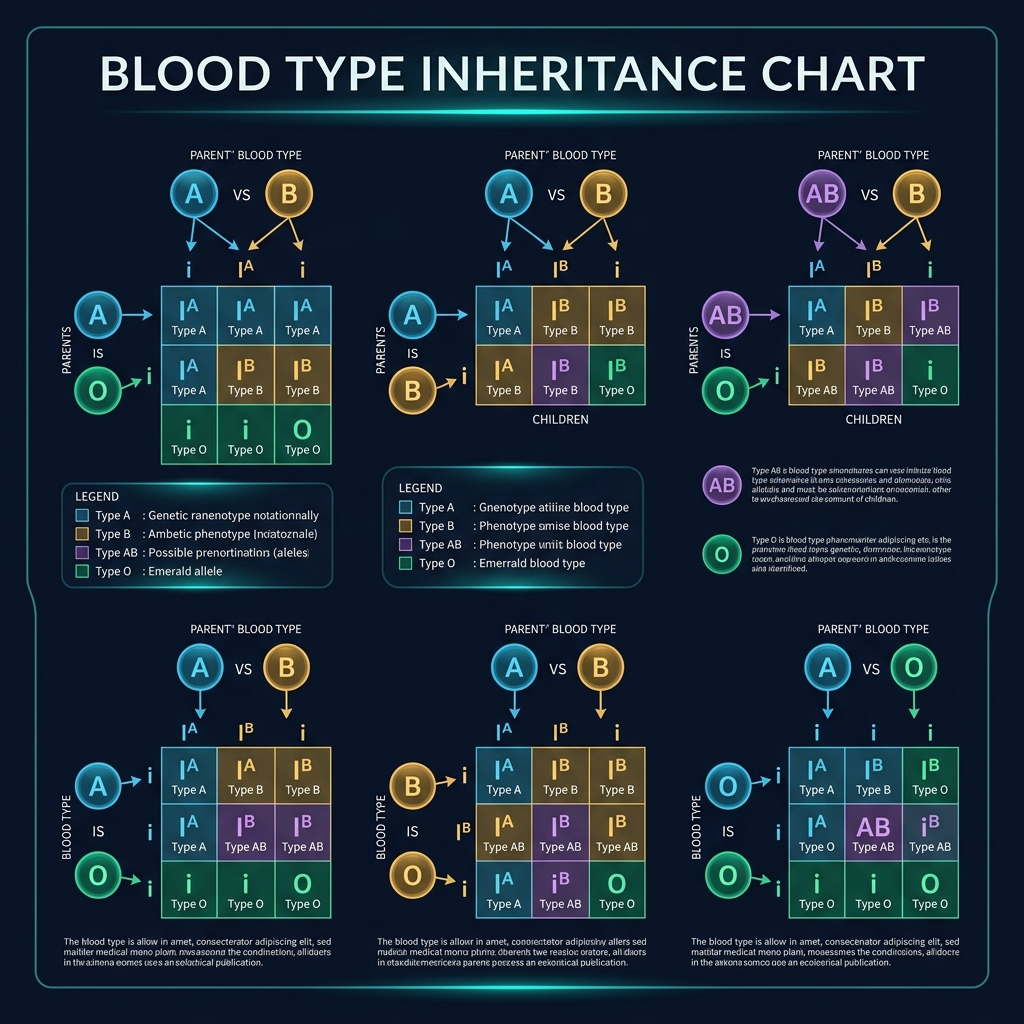
Blood type is inherited through Mendelian genetics via the ABO gene locus on chromosome 9. The ABO gene has three principal alleles:
- IA — codes for the A antigen (co-dominant with IB)
- IB — codes for the B antigen (co-dominant with IA)
- i — produces no antigen (recessive to both IA and IB)
Genotype to Phenotype Mapping
- Type A: Genotype IAIA (homozygous A) or IAi (heterozygous A)
- Type B: Genotype IBIB (homozygous B) or IBi (heterozygous B)
- Type AB: Genotype IAIB (only one genotype possible — both A and B alleles expressed)
- Type O: Genotype ii (only one genotype possible — no functional A or B alleles)
The Rh factor is inherited independently through the RHD gene on chromosome 1. Rh-positive (D+) is dominant over Rh-negative (d−). An Rh-positive parent can be either Dd (heterozygous, will pass Rh+ or Rh− to children equally) or DD (homozygous, all children receive D allele). An Rh-negative parent must be dd.
Key Blood Type Inheritance Facts
- Two O-type parents will always have O-type children (both parents are ii × ii = all ii offspring).
- Two A-type parents can have an O-type child if both parents are IAi — with a 25% probability per child.
- One AB parent and one O parent cannot have an A or B child; all children will be either A or B.
- Two Rh-negative parents will always have Rh-negative children. Track family health metrics with our BMI Calculator and Body Fat Calculator.
Complete Blood Type Compatibility Chart
The following compatibility rules apply for red blood cell transfusions. Note that platelet, plasma, and whole blood compatibility rules differ from red cell compatibility. Always follow your healthcare provider's guidance for specific clinical situations.
- O− Universal Donor: Donates red cells to O−, O+, A−, A+, B−, B+, AB−, AB+. Receives only O−.
- O+ Common Donor: Donates red cells to O+, A+, B+, AB+. Receives O− and O+.
- A−: Donates to A−, A+, AB−, AB+. Receives O− and A−.
- A+: Donates to A+, AB+. Receives O−, O+, A−, A+.
- B−: Donates to B−, B+, AB−, AB+. Receives O− and B−.
- B+: Donates to B+, AB+. Receives O−, O+, B−, B+.
- AB−: Donates to AB−, AB+. Receives O−, A−, B−, AB−.
- AB+ Universal Recipient: Donates only to AB+. Receives from all blood types.
For holistic cardiovascular health monitoring alongside knowing your blood type, track key health metrics using our Blood Sugar Converter and Cholesterol Ratio Calculator.
Blood Type Distribution Worldwide
Blood type frequencies vary significantly by geographic region and ethnic background — a result of evolutionary pressures, migration patterns, and founder effects across human history:
- O is the most common blood type globally (~44% worldwide) and is most prevalent in Central and South America, where O+ approaches 70–80% in some populations.
- A is common in Europe, particularly Scandinavia (where A+ reaches 45%) and Eastern Europe.
- B is most prevalent in Central Asia, South Asia, and certain African populations (15–25%).
- AB is the rarest ABO type globally (~4%), found in highest frequencies in East Asian populations (10-12% in Japan and Korea).
- Rh-negative is most common among people of Basque ancestry (~35%) and Europeans generally (~15%). It is very rare in East Asian populations (~0.3% in China and Japan).
Blood Type and Health: What Research Says
Scientific research has identified associations between blood type and certain health conditions, though these are population-level statistical trends — not individual destiny. Blood type should never be used to make clinical decisions without established medical evidence:
- Cardiovascular disease: Meta-analyses published in peer-reviewed journals have found that Type A and Type B individuals have slightly higher risk of coronary artery disease compared to Type O, possibly due to higher von Willebrand factor (a clotting protein) levels. Monitor heart health metrics with our Cholesterol Ratio Calculator.
- Cognitive decline: Research from UCSF (2014) found that people with blood type AB had an approximately 82% higher risk of developing cognitive impairment compared to other blood types.
- Pancreatic cancer: Non-O blood types (particularly Type B) have been associated with modestly elevated pancreatic cancer risk in several large cohort studies.
- Infectious disease susceptibility: During the COVID-19 pandemic, early research suggested Type O individuals had a slightly lower risk of severe infection, while Type A had modestly higher risk — though this finding was debated in subsequent literature. Historical evidence also shows Type O confers relative protection against malaria and cholera.
- Blood type diet claims: Popular claims about blood-type-specific diets (the "Blood Type Diet" by D'Adamo) are not supported by randomized controlled trial evidence. A large study published in PLOS ONE (2013) found that while the Type A diet correlated with favorable health outcomes, this applied equally regardless of ABO blood type.
Maintain comprehensive health monitoring with our BMI Calculator, Maintenance Calorie Calculator, and Harris-Benedict Calculator for a complete picture of your metabolic health alongside your blood type knowledge.
Related Health Calculators
Understanding your blood type is one component of comprehensive health awareness. Use these complementary tools for a full health assessment:
- BMI Calculator — Body mass index is a key cardiovascular health indicator that complements blood type risk knowledge
- Body Fat Calculator — Body composition assessment for overall health monitoring beyond BMI alone
- Cholesterol Ratio Calculator — Blood lipid ratios that interact with blood type-associated cardiovascular risk factors
- Blood Sugar Converter — Convert glucose values between mg/dL and mmol/L, monitor diabetes-related blood biomarkers
- Age Calculator — Precise age calculation for Rh factor pregnancy timeline planning and risk assessment
- Harris-Benedict Calculator — Basal metabolic rate needed for personalized nutrition planning
- Ideal Weight Calculator — Five-formula consensus ideal weight range for comprehensive health target setting