Circumference Calculator
Free Circumference Calculator: find circle circumference, diameter, radius, area, arc length, and sector area from any known value. Supports 8 units (mm,...
Formula used
How to Use the Circumference Calculator
Choose an input mode using the tabs — From Radius, From Diameter, or From Circumference. Enter the known value, choose your unit, and click Calculate. The tool instantly computes all related circle properties: circumference, diameter, radius, area, arc length (for a given angle), and sector area. Results are displayed with a live SVG circle diagram that updates to show your measurement in context.
The Circumference Formula Explained
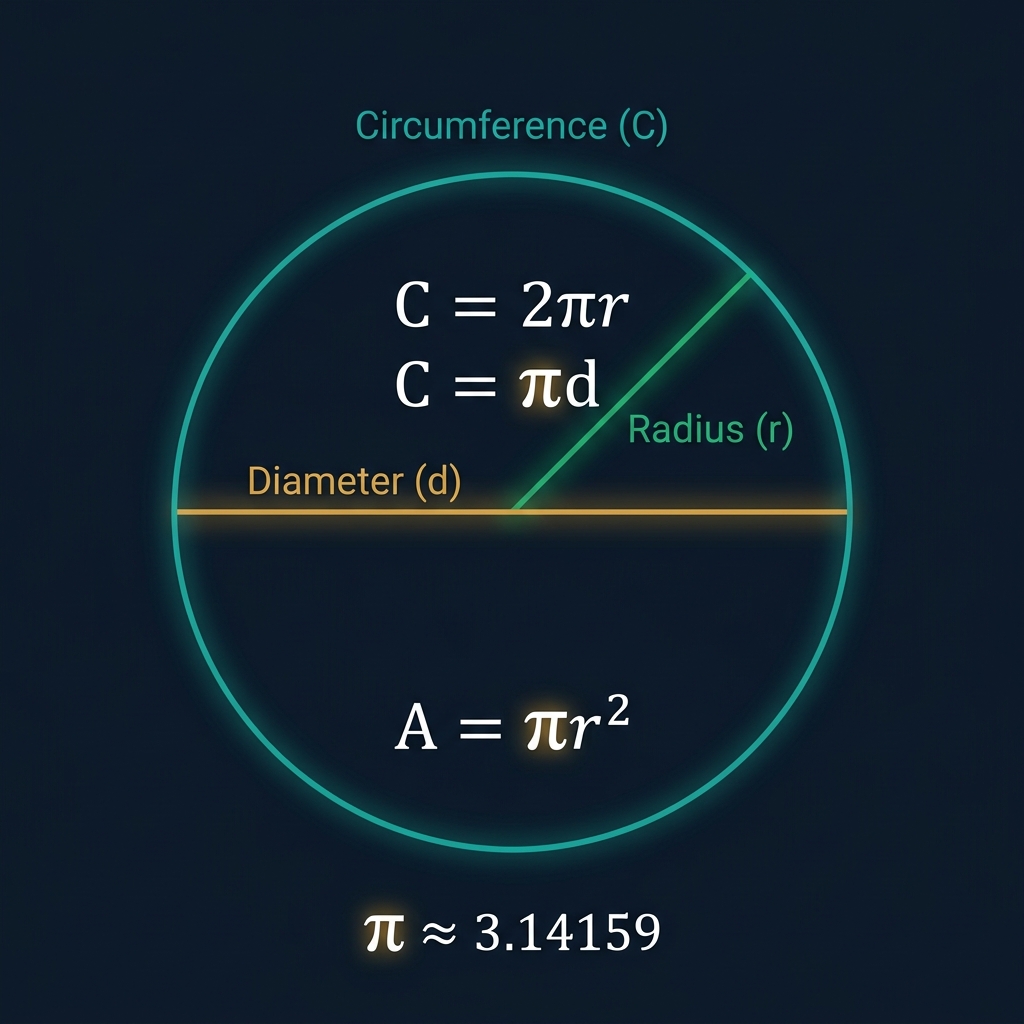
The circumference of a circle is the distance around its outer edge — analogous to the perimeter of a polygon. It is defined by two equivalent formulas:
- C = 2πr — Two times pi times the radius. This is the most fundamental form, derived directly from the definition of π as the ratio of circumference to diameter.
- C = πd — Pi times the diameter. Since the diameter d = 2r, these formulas are equivalent.
The constant π (pi) is irrational and transcendental: its decimal expansion never repeats or terminates. It begins: 3.14159265358979323846… For practical calculations, this tool uses JavaScript's built-in Math.PI constant, which provides 15–16 significant digits.
Circle Parts: Radius, Diameter, Chord, Arc, Sector
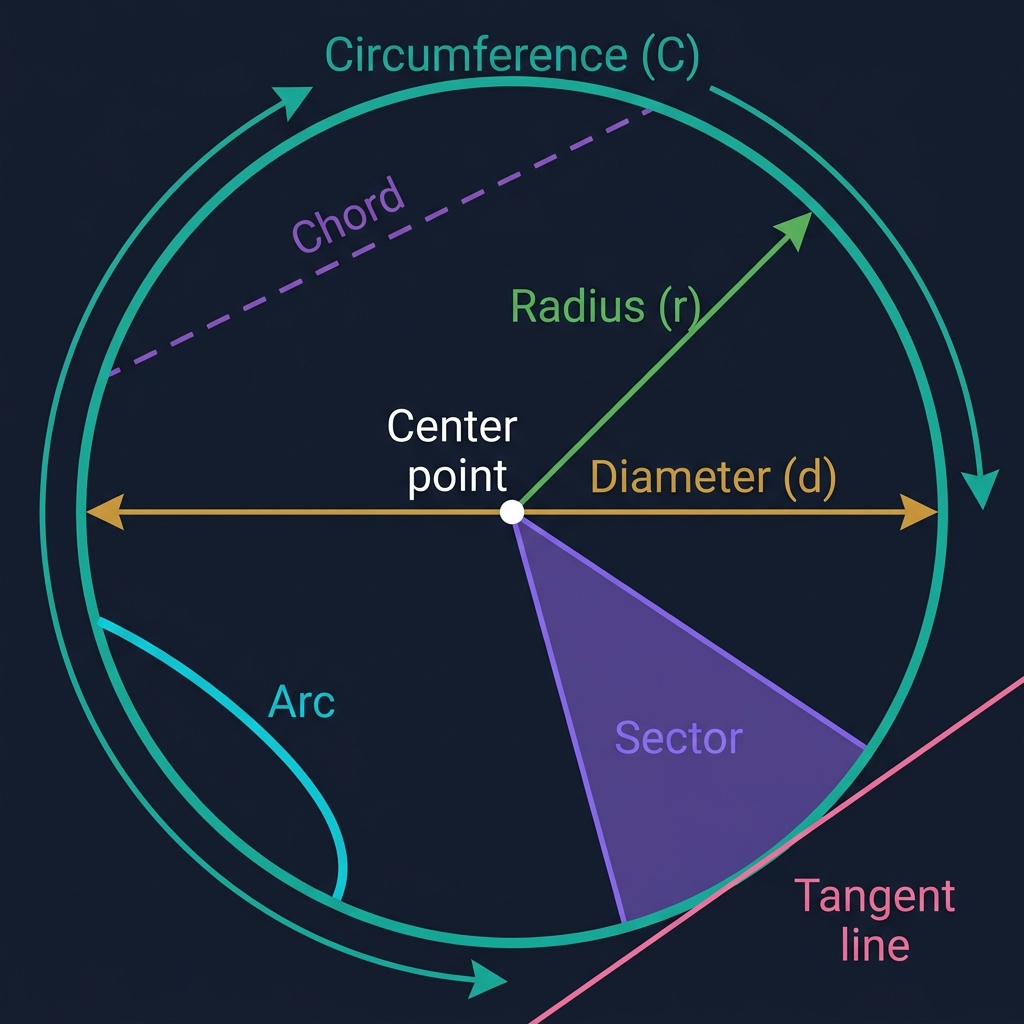
Understanding the vocabulary of circle geometry is essential before working with circumference formulas:
- Center: The fixed equidistant point from which all radii extend.
- Radius (r): The distance from the center to any point on the circle. All radii of a circle are equal.
- Diameter (d): The longest chord, passing through the center. d = 2r.
- Circumference (C): The total distance around the circle. C = 2πr = πd.
- Chord: Any line segment with both endpoints on the circle. The diameter is the longest possible chord.
- Arc: A portion of the circumference. Arc length = (θ/360°) × C, where θ is the central angle in degrees.
- Sector: A "pie slice" region bounded by two radii and an arc. Sector area = (θ/360°) × πr².
- Tangent: A line that touches the circle at exactly one point, perpendicular to the radius at that point.
Circle Area and Its Relationship to Circumference
The area enclosed by a circle is A = πr². This is related to the circumference through the radius. Key relationships:
- Given circumference C: r = C / (2π), so A = C² / (4π)
- Given diameter d: r = d/2, so A = π(d/2)² = πd²/4
- The ratio of area to the square of circumference: A/C² = 1/(4π) — a constant for all circles
This is why a circle encloses the most area for a given perimeter — among all closed curves. This isoperimetric inequality states: for any closed curve of length L, the area A enclosed satisfies A ≤ L²/(4π), with equality for circles.
Unit Conversion for Circumference
Circumference is a length, so it can be expressed in any linear unit. This calculator supports 8 units and displays results in all of them simultaneously:
- Metric: millimeters (mm), centimeters (cm), meters (m), kilometers (km)
- Imperial: inches (in), feet (ft), yards (yd), miles (mi)
Real-World Applications of Circumference
- Engineering & manufacturing: Calculating belt lengths for pulleys, pipe circumferences for material estimation, gear tooth spacing.
- Tire and wheel sizing: Tire circumference determines how far a vehicle travels per wheel rotation, directly affecting speedometer accuracy and gear ratios. A tire's circumference is the distance it rolls per revolution.
- Construction & architecture: Circular columns, arches, domes, and towers. Estimating rebar for circular footings uses circumference times the number of loops.
- Astronomy: Earth's equatorial circumference is approximately 40,075 km (24,901 miles). The Moon's circumference is about 10,917 km. Orbital circumferences determine travel distances and flight times for satellites.
- Sports tracks and running: A standard 400-meter athletics track has a 400 m circumference on lane 1. Accurate lane circumferences are calculated using the radius of each lane's arc.
- Fabric and sewing: Hat brims, skirt hems, circular tablecloths — calculating how much fabric is needed for a circular edge requires the circumference.
The History and Significance of Pi (π)
The ratio C/d = π has been known since ancient times. The Babylonians used π ≈ 3.125 around 1900 BCE. Archimedes of Syracuse (c. 287–212 BCE) proved that 3 10/71 < π < 3 1/7 using inscribed and circumscribed polygons with 96 sides. By the 15th century, Madhava of Sangamagrama computed π to 11 decimal places using an infinite series. Today, π has been computed to over 100 trillion decimal places.
Pi is not just a mathematical curiosity — it appears in probability (Buffon's needle problem), statistics (the normal distribution formula contains π), quantum mechanics (Heisenberg's uncertainty principle), and signal processing (the Fourier transform). The Average Calculator uses statistical formulas that also involve the normal distribution, where π appears in the denominator.
Related Math Calculators
- Percentage Calculator — Calculate what percentage of a circle's circumference is covered by an arc: arc percentage = (θ/360°) × 100%.
- Slope Calculator — The tangent line to a circle at any point has a slope equal to the negative reciprocal of the radius direction. Slope and circle geometry are tightly connected in analytic geometry.
- Average Calculator — Statistical analysis often uses circular distributions (e.g., directional statistics for wind directions), where circular mean and standard deviation are computed using the circumference concept.