Percentage Increase Calculator
Free Percentage Increase Calculator: instantly find the percentage increase or decrease between two numbers, the final value after a % change, or the...
Formula used
How to Use the Percentage Increase Calculator
This calculator solves all four core percentage change problems from a single, intuitive interface. Select the calculation mode that matches what you know and what you want to find:
- Find % Change: Enter the original value and the new value — the calculator tells you the exact percentage increase or decrease, step by step.
- Find New Value: Enter the original value and the percentage change (positive = increase, negative = decrease) — get the resulting new value.
- Find Original Value: Enter the new (final) value and the known percentage change — work backwards to recover the value before the change.
- Repeated % Growth: Enter a starting value, a percentage rate, and a number of periods — compute compounded growth like compound interest without a finance formula.
Click Calculate after entering your values, or press Enter. Results appear instantly with color-coded increase/decrease indicators, a step-by-step formula breakdown, and a mini visualizer showing how the value changed on a bar scale.
The Percentage Increase Formula Explained
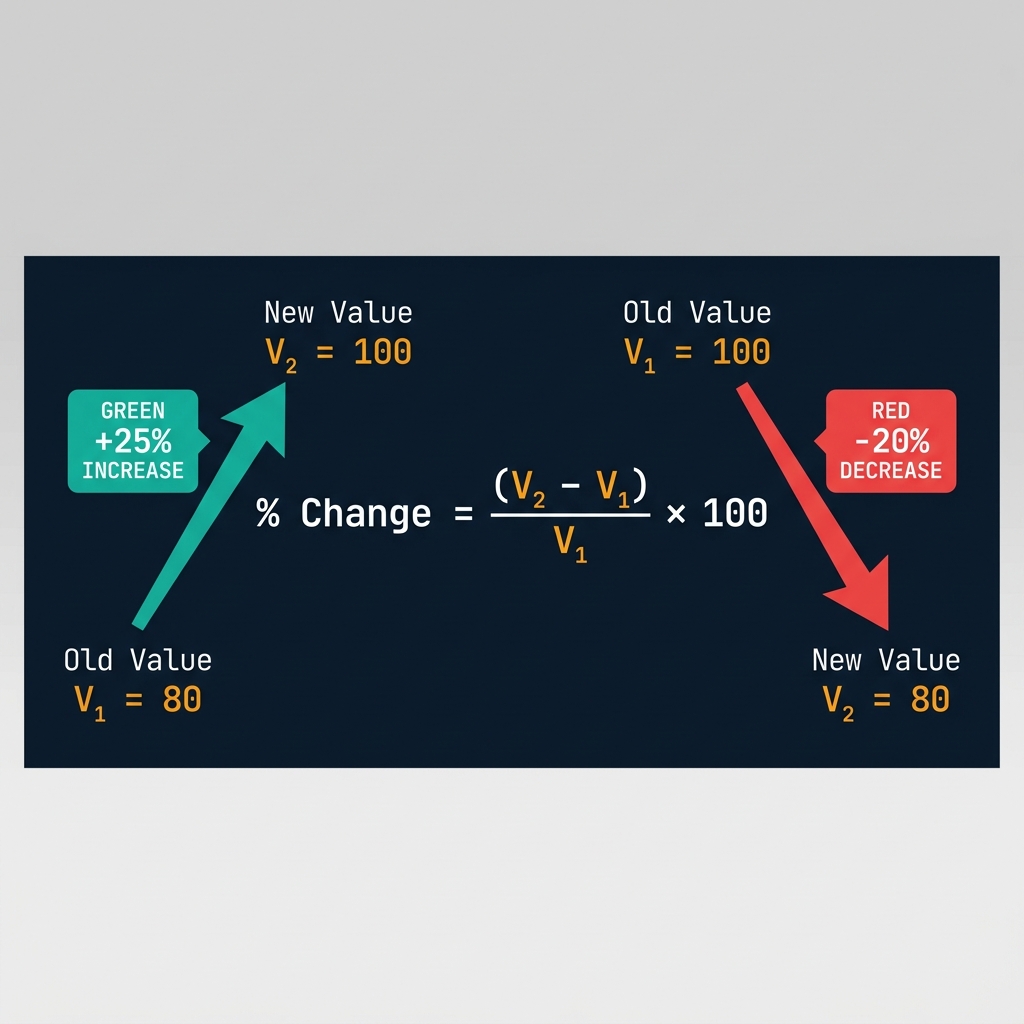
The fundamental formula for percentage change is:
- % Change = ((New Value − Old Value) / |Old Value|) × 100
Breaking this down step by step:
- Step 1: Subtract the original (old) value from the new value: New − Old = absolute change.
- Step 2: Divide by the absolute value of the original: (New − Old) / |Old|.
- Step 3: Multiply by 100 to express as a percentage.
- If the result is positive: the value increased (percentage increase).
- If the result is negative: the value decreased (percentage decrease).
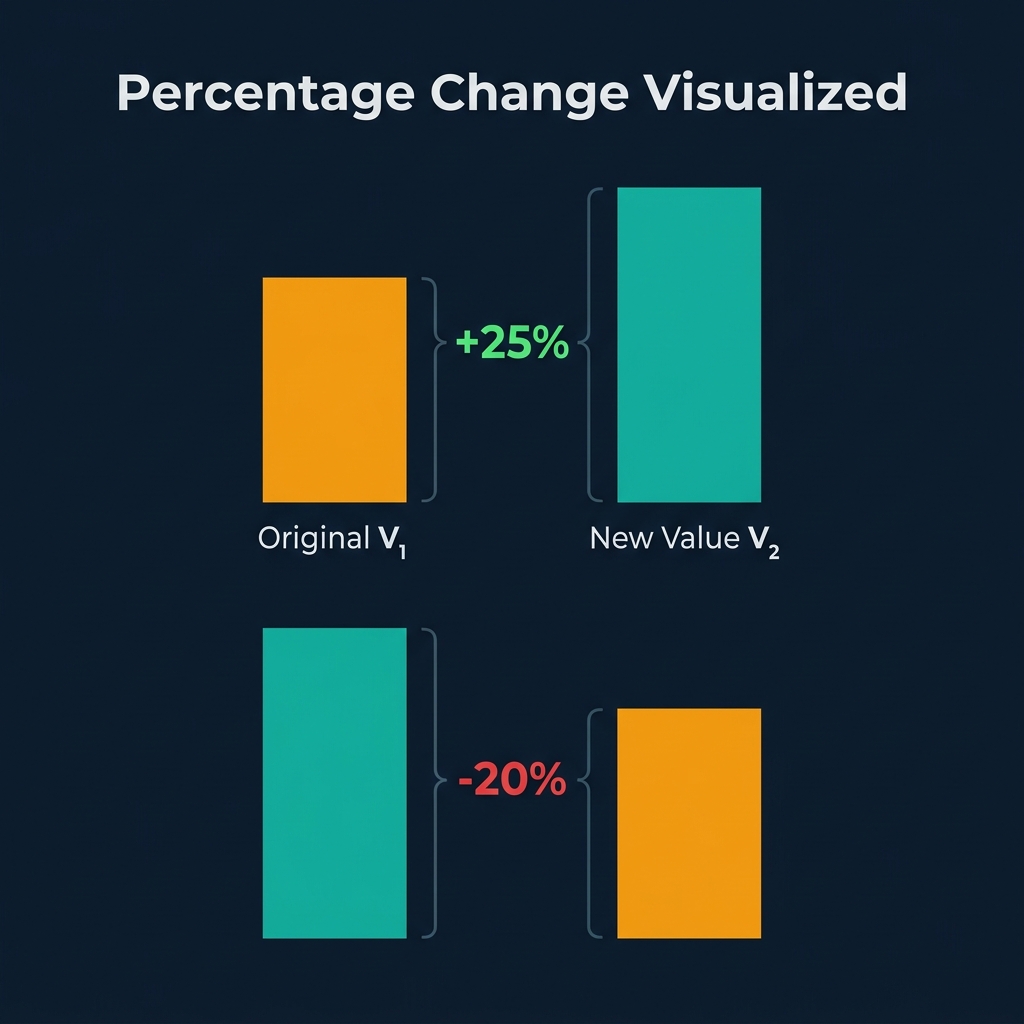
Example 1 — Price increase: A product costs $80 and now costs $100. Change = (100 − 80) / 80 × 100 = 25%. It increased by 25%.
Example 2 — Price decrease (discount): A product drops from $100 to $80. Change = (80 − 100) / 100 × 100 = −20%. It decreased by 20%.
Note: a 25% increase followed by a 20% decrease returns to the original value (100 × 1.25 × 0.80 = 100), which demonstrates why percentage changes are not symmetric.
Reverse Percentage: Finding the Original Value
A common real-world problem is knowing the final value after a percentage change and needing to recover the original. The formula is:
- Original = New Value / (1 + % Change / 100)
Example: A salary after a 15% raise is $57,500. What was the original salary? Original = 57,500 / (1 + 15/100) = 57,500 / 1.15 = $50,000.
This is critically important for tax calculations, price-before-VAT problems, and salary negotiation. Many people erroneously try to subtract the percentage directly (e.g., $57,500 − 15% = $48,875), which is incorrect. The reverse-percentage formula gives the mathematically correct answer.
Repeated Percentage Growth & Compound Effect
When a percentage change applies multiple times, the effects compound. The formula for final value after n periods at rate r% is:
- Final Value = Starting Value × (1 + r/100)ⁿ
This is the compound growth formula and underlies compound interest, population growth, inflation, and investment returns. Key insights:
- The rule of 70: To estimate how many periods it takes to double a value at r% per period, divide 70 by r. At 7% annual growth, doubling time ≈ 70/7 = 10 years.
- Asymmetric compounding: A 50% gain followed by a 50% loss gives 75% of the original (1.5 × 0.5 = 0.75). Gains and losses of equal percentage are not equal in absolute impact.
- Small rates compound significantly: 1% monthly growth = (1.01)¹² − 1 = 12.68% annual growth, not 12%.
Common Percentage Mistakes to Avoid
- Adding percentages directly: A 25% increase followed by a 25% decrease is not 0%. It is −6.25% (1.25 × 0.75 = 0.9375). You cannot add successive percentage changes.
- Using the wrong base: Percentage change is always relative to the original (starting) value, not the new value. Using the new value as the base is a common error that understates the true change.
- Confusing percentage points with percent: If interest rates rise from 2% to 3%, that is a 1 percentage point increase, but a 50% increase in the rate (1/2 × 100 = 50%). Basis points (1 bp = 0.01%) are used in finance to avoid this ambiguity.
- Percentage vs. percentage of: "20% more than X" means X × 1.20. "20% of X" means X × 0.20. These are very different quantities that are frequently confused.
Real-World Applications
- Finance & investing: Stock price changes, portfolio returns, earnings growth (YoY), revenue growth rate, profit margin changes, and inflation-adjusted returns all require percentage change calculations. The S&P 500's total return is meaningless without compounded percentage growth.
- Retail & e-commerce: Discount pricing (percent off), markup from cost to retail price, sales tax percentage, and cashback percentage rebates. A "50% off, then an extra 20% off" deal equals 60% off total (0.50 × 0.80 = 0.40, so 60% off), not 70% off.
- Science & engineering: Experimental error percentage, efficiency improvement measurements, signal gain in decibels (which is logarithmic, not linear percentage), concentration changes, and population ecology models.
- Salary & HR: Pay raise percentage, wage gap percentages, bonus as a percentage of base, and cost-of-living adjustment calculations all depend on accurate percentage change arithmetic.
- Sports & analytics: Win rate improvement, scoring efficiency changes, attendance growth, and performance metrics are all tracked as percentage changes against previous benchmarks.
Percentage Points vs. Percent Change
This distinction matters enormously in analytics, finance, and journalism:
- Percentage point (pp) change: The arithmetic difference between two percentages. If market share rises from 20% to 25%, it rose by 5 percentage points.
- Percent change in the percentage: The relative change. 20% to 25% is a (25−20)/20 × 100 = 25% increase in market share percentage.
- Why it matters: A drug reducing mortality from 2% to 1% is a 1 percentage point reduction but a 50% relative reduction. Both are accurate, but they create very different impressions. Always specify which you mean.
Related Math & Finance Calculators
- Percentage Calculator — Find what percent X is of Y, calculate X% of a number, or find what number results from applying a percentage. Complements the percentage change calculation perfectly.
- Percentage Discount Calculator — Calculate the final price after a percentage discount, the discount amount, or the discount percentage from original and sale price. Uses the same percentage decrease formula.
- Discount Calculator — Applied discount calculations with tax integration for retail pricing, markdown analysis, and net savings computation.
- Profit Margin Calculator — Calculate gross profit margin, net profit margin, and markup percentage. All profitability metrics are fundamentally percentage change calculations on cost vs. revenue.
- Right Triangle Calculator — Trigonometric ratios like sin, cos, and tan are essentially percentage-like ratios between sides. Explore the geometric side of ratio mathematics.