Maintenance Calorie Calculator
Calculate your exact maintenance calories (TDEE) using the Mifflin-St Jeor or Harris-Benedict formula. Get BMR, daily calorie targets for weight loss,...
F�rmula utilizada
How to Use the Maintenance Calorie Calculator
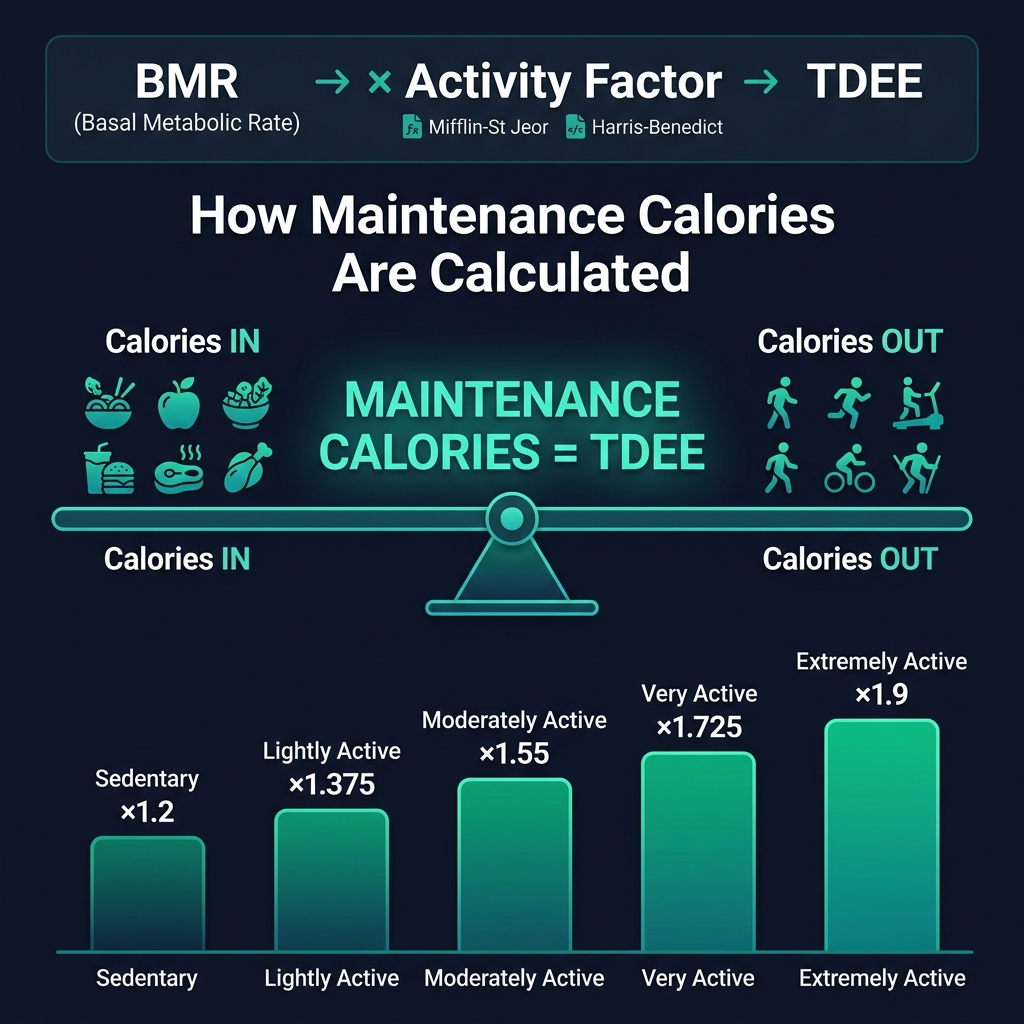
Your maintenance calories — also called your Total Daily Energy Expenditure (TDEE) — is the number of calories your body needs each day to maintain your current weight. Eating at this exact number results in neither weight gain nor weight loss. Our calculator determines your TDEE in two steps: first computing your Basal Metabolic Rate (BMR), then multiplying by your daily activity level. For a detailed breakdown of the underlying equations, our Harris-Benedict Calculator goes deeper into both the original and revised formulas.
Step-by-Step Input Guide
- Select your sex — Male and female BMR formulas use different constants because of average differences in lean mass and hormonal composition. Always select your biological sex for formula accuracy.
- Choose your unit system — Imperial uses pounds (lbs) for weight and total inches for height. Metric uses kilograms (kg) and centimeters (cm). All conversions are handled automatically.
- Enter your age — Metabolism slows with age. Each decade after 30 typically reduces BMR by 1–3%. Accurate age entry is critical for a precise result.
- Enter your weight — Use your current body weight measured first thing in the morning, after using the bathroom but before eating. This is the most consistent measurement point.
- Enter your height — Use your standing height without shoes. For Imperial, enter total inches (e.g., 5 ft 10 in = 70 inches). For accuracy, see the tip in our Height Calculator about morning-vs-evening height variation.
- Select your activity level — Choose the level that honestly describes your typical week including structured exercise, daily movement (steps), and occupational activity. See the activity level guide below.
- Choose your formula — Mifflin-St Jeor is the default and recommended for most people; Original Harris-Benedict is included for comparison and clinical reference.
- Click Calculate — Your BMR, maintenance TDEE, and six goal-specific calorie targets appear immediately with macronutrient breakdowns.
Understanding BMR: Your Metabolic Foundation
Your Basal Metabolic Rate (BMR) represents the calories your body burns at complete rest — breathing, circulation, organ function, and cellular maintenance. It accounts for approximately 60–70% of your total daily calorie expenditure. Before adjusting calories for any goal, knowing your BMI from the BMI Calculator alongside your BMR gives important context: two people with identical BMRs may have very different body composition ratios of fat to lean muscle, which affects how aggressively they should approach a calorie deficit or surplus.
Mifflin-St Jeor Formula (Recommended)
Developed in 1990 and validated in multiple large studies, the Mifflin-St Jeor equation is the current standard recommended by the Academy of Nutrition and Dietetics. Its typical error rate is ±5% for normal-weight adults:
- Male: BMR = (10 × weight_kg) + (6.25 × height_cm) − (5 × age) + 5
- Female: BMR = (10 × weight_kg) + (6.25 × height_cm) − (5 × age) − 161
Original Harris-Benedict Formula
The Harris-Benedict equation was first published in 1919 and revised in 1984. While slightly less accurate for modern populations (±8% error), it remains widely referenced in clinical and research contexts:
- Male: BMR = 88.362 + (13.397 × weight_kg) + (4.799 × height_cm) − (5.677 × age)
- Female: BMR = 447.593 + (9.247 × weight_kg) + (3.098 × height_cm) − (4.330 × age)
Factors That Affect Your BMR
- Lean muscle mass: Muscle tissue burns ~13 kcal/kg/day at rest versus ~4.5 kcal/kg/day for fat. Higher muscle mass means a higher BMR at any given weight.
- Age: After 30, BMR declines roughly 1–3% per decade due to natural loss of lean mass (sarcopenia) and hormonal changes.
- Sex: Males typically have 5–10% higher BMR than females of the same size due to greater average lean mass.
- Hormonal health: Thyroid function, cortisol, insulin sensitivity, and sex hormones all modulate resting metabolism. Clinical conditions like hypothyroidism can reduce BMR by 15–40%.
- Genetics: Studies on identical twins suggest genetic factors explain 40–70% of BMR variation between individuals of similar size.
Activity Levels: Choosing the Right Multiplier
The activity multiplier is the greatest source of error in TDEE calculations. Most people underestimate their sedentary time and overestimate their exercise intensity. Use the guide below carefully — accurate activity assessment can mean a difference of 400–700 kcal/day in your TDEE. Understanding your overall body composition and fitness level using the Body Shape Calculator can help contextualize which activity tier honestly reflects your physique and lifestyle.
- Sedentary (×1.2): Desk job, no structured exercise, fewer than 5,000 steps/day. Example: mostly sitting at work and sitting at home.
- Lightly Active (×1.375): Light exercise 1–3 days per week, or a job with some standing and walking. Example: casual walks 3×/week, kitchen/retail worker.
- Moderately Active (×1.55): Structured cardio or strength training 3–5 days per week with moderate intensity. Example: gym 4×/week, 7,000–10,000 steps/day.
- Very Active (×1.725): Hard training or sport 6–7 days per week, or physically demanding job plus exercise. Example: construction worker who also trains daily.
- Extremely Active (×1.9): Twice-daily training, elite athlete in competition phase, or military-level physical demands. Example: competitive swimmers, professional cyclists in training blocks.
Pro tip: If you are unsure, start one level lower than you think you are. Track your weight for 2–3 weeks at the calculated TDEE. If you gain weight, your actual TDEE is lower; if you lose weight, it's higher. Adjust by ±100–200 kcal based on real results.
Calorie Targets for Every Goal
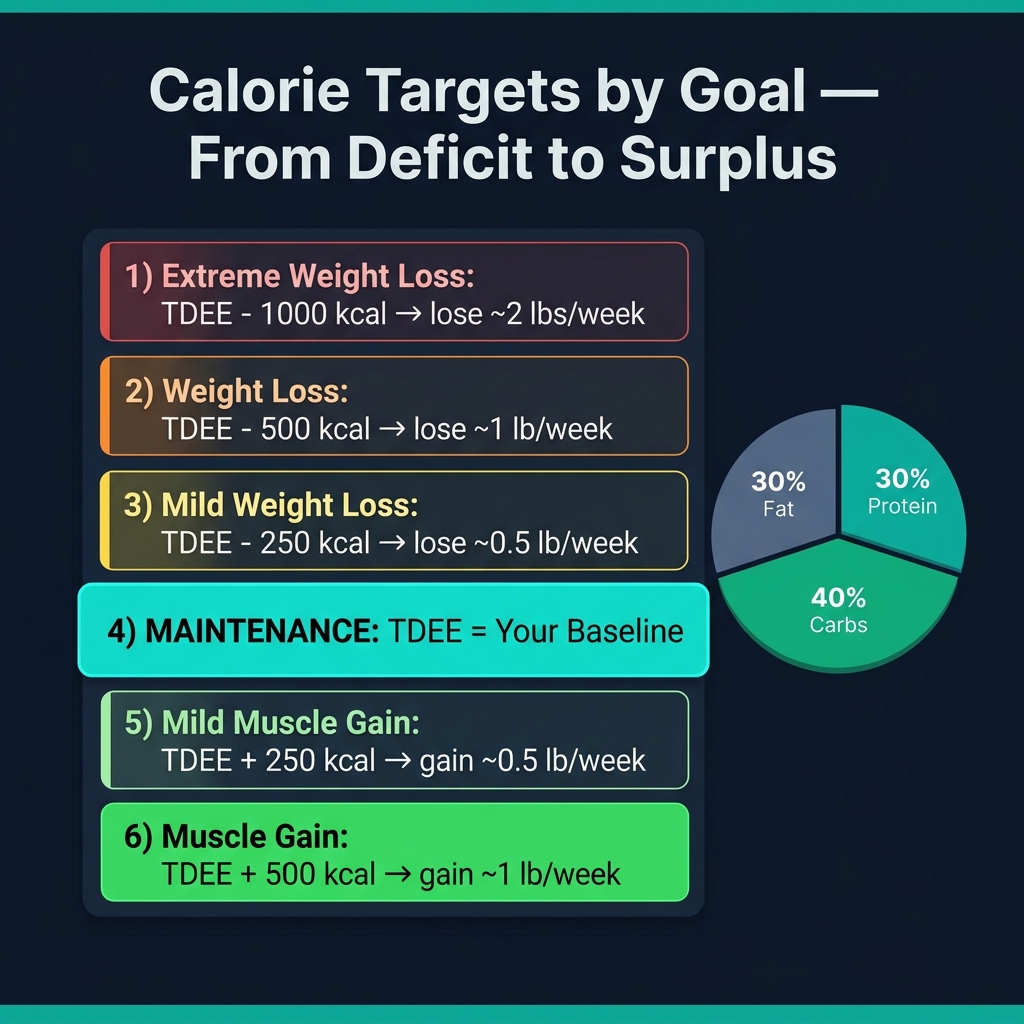
Once you know your maintenance TDEE, adjusting calories for specific goals is straightforward. Knowing your precise birth date and calculating your exact age with the Age Calculator ensures your BMR is as accurate as possible — even a 5-year error in age input can shift your TDEE estimate by 30–60 kcal/day.
Weight Loss Goals
- Extreme Weight Loss (TDEE − 1,000 kcal): Creates approximately 1 kg (2 lbs) of fat loss per week. Recommended only under medical supervision. Risk of muscle loss and nutrient deficiencies increases significantly below 1,200 kcal/day for women and 1,500 kcal/day for men.
- Weight Loss (TDEE − 500 kcal): Creates approximately 0.5 kg (1 lb) fat loss per week — the most widely cited safe and sustainable rate. Preserves muscle mass when protein intake is sufficient.
- Mild Weight Loss (TDEE − 250 kcal): Creates approximately 0.25 kg (0.5 lb) fat loss per week. The most comfortable and sustainable approach, especially for those close to their goal.
Weight Gain Goals
- Mild Muscle Gain (TDEE + 250 kcal): A "lean bulk" surplus — promotes muscle growth while minimizing fat gain. Best for experienced lifters who want to stay lean during a gaining phase.
- Muscle Gain (TDEE + 500 kcal): Standard surplus for muscle building. Produces approximately 0.5 kg per week of combined muscle and fat gain during resistance training.
Macronutrient Strategy by Goal
Total calorie intake sets the direction (loss or gain), but macronutrient distribution determines body composition outcomes. Accurate height measurement — which you can verify using the Height Calculator — feeds directly into your BMR calculations, which in turn determines both your calorie target and your protein intake based on body weight.
Protein: The Priority Macro
For body composition, protein is the most important macronutrient. It preserves muscle during deficits and supports new tissue growth during surpluses. General guidelines per body weight:
- Weight loss: 1.8–2.7 g per kg of body weight (higher end preserves more muscle in a deficit)
- Maintenance: 1.6–2.2 g per kg of body weight
- Muscle gain: 1.6–2.2 g per kg (additional protein above this level shows diminishing returns)
Carbohydrates: Energy and Performance
Carbohydrates are the primary fuel source for high-intensity exercise and brain function. After protein is set, carbohydrates should fill the majority of remaining calories. Active individuals performing resistance training or cardio benefit from 40–60% of total calories from carbohydrates.
Dietary Fat: Hormones and Satiety
Fat is essential for hormone production (testosterone, estrogen), fat-soluble vitamin absorption (A, D, E, K), and long-term satiety. Minimum fat intake is generally 0.7–1.0 g per kg of body weight. Dropping fat below this threshold can disrupt hormonal health and immune function.
Recommended Macro Splits by Goal
- Weight loss: Protein 35% · Carbs 35% · Fat 30%
- Maintenance: Protein 30% · Carbs 40% · Fat 30%
- Muscle gain: Protein 25% · Carbs 50% · Fat 25%
Improving the Accuracy of Your TDEE Estimate
All formula-based TDEE calculators are estimates. They provide an excellent starting point, but individual metabolism varies due to genetics, gut microbiome, non-exercise activity thermogenesis (NEAT), and adaptive thermogenesis. Use these strategies to calibrate your actual TDEE:
- Track calories consistently for 2–3 weeks: Log everything you eat using a food tracking app. Compare your average weekly calorie intake against your weight trend. If weight is stable, your logged average is your actual TDEE.
- Weigh yourself under consistent conditions: Same time, same conditions (morning, after toileting, before eating). Daily weight fluctuates 1–2 kg from water, food, and hormones. Use a 7-day rolling average.
- Adjust by 100–200 kcal increments: Make small adjustments every 2–3 weeks based on results. Large sudden changes disrupt adherence and confuse data.
- Re-calculate every 5–10 lbs of weight change: TDEE changes as body weight changes. Use this calculator regularly as a reference point.
For a complete metabolic health picture, pair this tool with the BMI Calculator to monitor your weight-to-height ratio, the Body Shape Calculator for your body proportion profile, and the Harris-Benedict Calculator for a side-by-side formula comparison with full macronutrient detail.