Triangle Area Calculator
Free Triangle Area Calculator with 6 formulas: ½bh (base & height), Heron's formula (3 sides), SAS (2 sides + angle), SSS, coordinate/shoelace method, and...
F�rmula utilizada
b, h=b, h — Base and perpendicular height. h must be the altitude from the opposite vertex, perpendicular to base b. A = ½ × b × h.
a,b,c=a, b, c — The three side lengths. Must satisfy triangle inequality: a+b>c, a+c>b, b+c>a. Used in Heron's formula.
s=s — Semi-perimeter: s = (a+b+c)/2. Intermediate value in Heron's formula A = √[s(s-a)(s-b)(s-c)].
C=C — Included angle (in degrees) between sides a and b. Used in SAS formula: A = ½ab·sin(C). Must be 0° < C < 180°.
Triangle Area Calculator
6 Methods · Heron's · SAS · Coordinate · Equilateral · Right Triangle
Enter all three side lengths a, b, c. Uses Heron's formula: s=(a+b+c)/2, A=√[s(s-a)(s-b)(s-c)]. Also computes all angles, altitudes, inradius, circumradius, and validates the triangle inequality.
a
b
c
Triangle Area Formula Reference
Base & Height
A = ½ × b × h
h ⊥ to base b
Heron's Formula
s=(a+b+c)/2
A=√[s(s-a)(s-b)(s-c)]
SAS (2 Sides)
A = ½ab·sin(C)
C = included angle
Coordinate
A=½|x₁(y₂-y₃)
+x₂(y₃-y₁)+x₃(y₁-y₂)|
Equilateral
A = (√3/4)a²
all sides equal, 60°
Right Triangle
A = ½ × l₁ × l₂
l₁,l₂ = legs (90° angle)
Inradius
r = Area / s
s = semi-perimeter
Circumradius
R = abc / (4A)
R = c/2 (right triangle)
Altitude h_a
h_a = 2A / a
from A to side a
Angle (Cosine)
cos(A)=(b²+c²-a²)
÷(2bc)
Median
m_a=½√(2b²+2c²-a²)
Triangle Inequal.
a+b>c, a+c>b
b+c>a (all must hold)
How to Use the Triangle Area Calculator
This calculator provides six methods to compute the area of any triangle — choose the one that matches the data you already have:
- Mode 1 — Base & Height (½bh): The most direct formula. Enter the base length b and the perpendicular height h (altitude). Works for any triangle regardless of type — scalene, isosceles, equilateral, right, obtuse. The height must be perpendicular to the base, not a slant side.
- Mode 2 — Three Sides (Heron's Formula): Enter all three side lengths a, b, c. The calculator computes the semi-perimeter s=(a+b+c)/2, then area A=√[s(s-a)(s-b)(s-c)]. Also validates the triangle inequality (each side must be less than the sum of the other two) and automatically computes all three angles, altitudes, inradius, and circumradius.
- Mode 3 — Two Sides & Included Angle (SAS): Enter two sides and the angle between them in degrees. Area A=½ab·sin(C). Also computes the third side via the Law of Cosines: c²=a²+b²−2ab·cos(C), then all remaining angles via Law of Sines.
- Mode 4 — Three Vertices (Coordinate/Shoelace): Enter the (x,y) coordinates of all three vertices. Uses the shoelace formula A=½|x₁(y₂−y₃)+x₂(y₃−y₁)+x₃(y₁−y₂)|. Also computes all three side lengths, perimeter, centroid, and circumcenter. The SVG graph plots the triangle in the coordinate plane.
- Mode 5 — Equilateral Triangle: Enter one side length a. Area A=(√3/4)a². Also computes height, perimeter, inradius, circumradius, and all properties of a 60-60-60 triangle.
- Mode 6 — Right Triangle: Enter both legs. Area A=½×leg1×leg2. Also computes the hypotenuse via the Pythagorean theorem and all angles. Quick link to our Pythagorean Theorem Calculator for related calculations.
All Triangle Area Formulas Explained
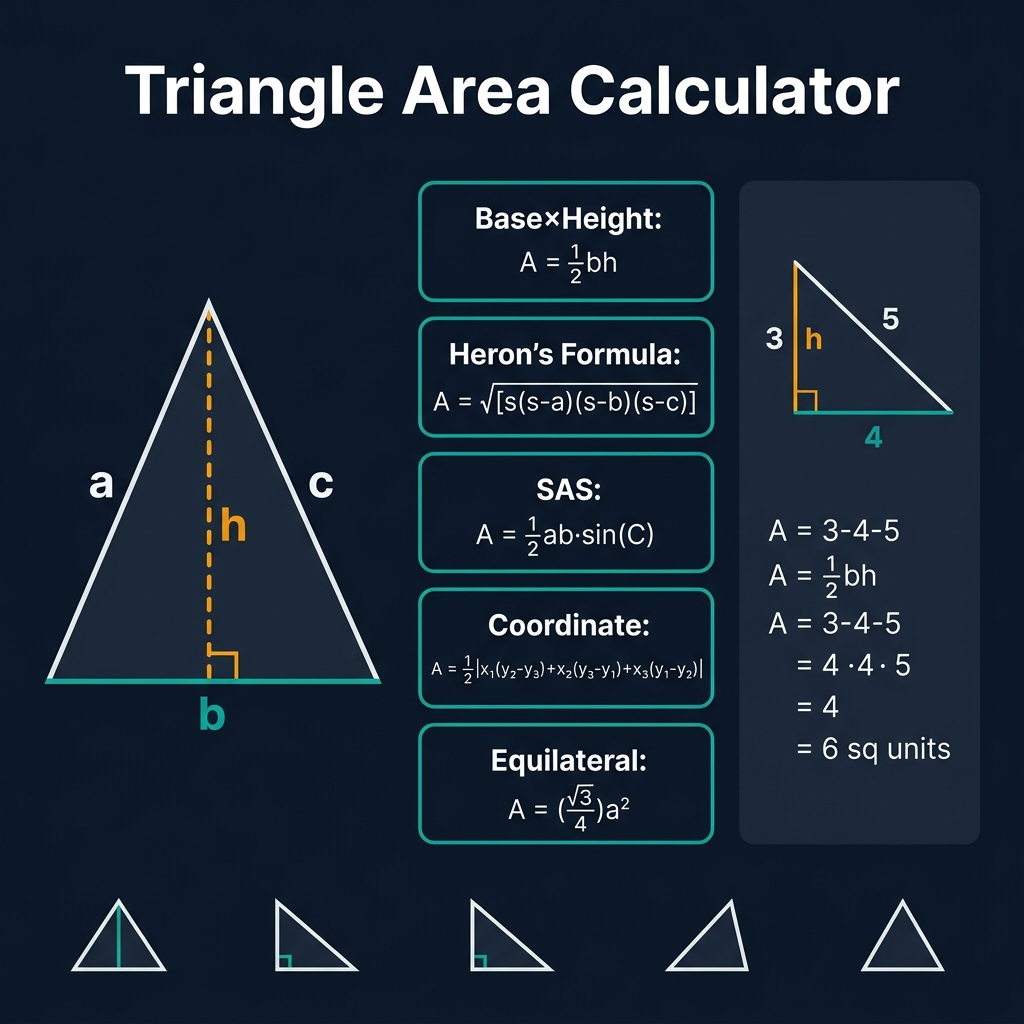
The area of a triangle — the amount of 2D space it encloses — can be computed in many ways depending on what measurements you know:
- Formula 1: A = ½ × base × height (½bh): The foundational formula. Any side can serve as the "base"; the corresponding height is the perpendicular distance from that base to the opposite vertex. Example: triangle with base 10 and height 6: A = ½ × 10 × 6 = 30 sq units. Why ½? A triangle is exactly half of a parallelogram with the same base and height. This is the geometric proof: any triangle can be doubled (by rotation or reflection) to form a parallelogram, which has area b×h, so the triangle has ½b×h. For a right triangle: the two legs are the base and height, so A = ½ × leg1 × leg2 — directly from the ½bh formula with no need for perpendicular projection.
- Formula 2: Heron's Formula A = √[s(s-a)(s-b)(s-c)]: Named after Hero of Alexandria (≈60 CE), this formula computes area purely from the three side lengths a, b, c. First compute the semi-perimeter s = (a+b+c)/2, then A = √[s(s-a)(s-b)(s-c)]. Example: triangle with sides 5, 6, 7. s = (5+6+7)/2 = 9. A = √(9×4×3×2) = √216 = 6√6 ≈ 14.697 sq units. Heron's formula is equivalent to ½bh but avoids needing to compute the height. It can also be expressed as: 16A² = 2a²b² + 2b²c² + 2c²a² − a⁴ − b⁴ − c⁴ (Brahmagupta-Fibonacci identity). A degenerate triangle (zero area) occurs when one side equals the sum of the other two (collinear points).
- Formula 3: SAS — A = ½ab·sin(C): When you know two sides a, b and the included angle C (the angle between them), area = ½ab·sin(C). This comes from the fact that the height h (from the vertex opposite side c) equals a·sin(C), so A = ½b × (a·sin(C)) = ½ab·sin(C). Example: sides 8 and 5, included angle 60°: A = ½ × 8 × 5 × sin(60°) = 20 × (√3/2) = 10√3 ≈ 17.321 sq units. For a right triangle (C=90°): sin(90°)=1, so A = ½ab — matching the leg formula. For an equilateral triangle (C=60°, a=b): A = ½a²·sin(60°) = ½a² × √3/2 = (√3/4)a².
- Formula 4: Coordinate (Shoelace) Formula: For a triangle with vertices (x₁,y₁), (x₂,y₂), (x₃,y₃): A = ½|x₁(y₂−y₃) + x₂(y₃−y₁) + x₃(y₁−y₂)|. The absolute value ensures positive area regardless of vertex order. This is the shoelace (or surveyor's) formula — sum of cross products of consecutive vertex coordinates, giving the signed area of the polygon. Example: (0,0), (4,0), (0,3): A = ½|0(0−3)+4(3−0)+0(0−0)| = ½|0+12+0| = 6. Verify: right triangle with legs 4 and 3, A = ½×4×3 = 6 ✓. The signed area is positive if vertices are listed counter-clockwise, negative if clockwise — the absolute value gives unsigned area.
- Formula 5: Equilateral Triangle A = (√3/4)a²: For a triangle with all three sides equal (a=b=c), all angles are 60°. The height = a·sin(60°) = a√3/2. A = ½ × a × a√3/2 = (√3/4)a². Example: equilateral triangle with side 10: A = (√3/4) × 100 = 25√3 ≈ 43.301 sq units. This is the maximum area for a given perimeter among all triangles (isoperimetric inequality for triangles).
Triangle Properties: Angles, Altitudes, Inradius, Circumradius
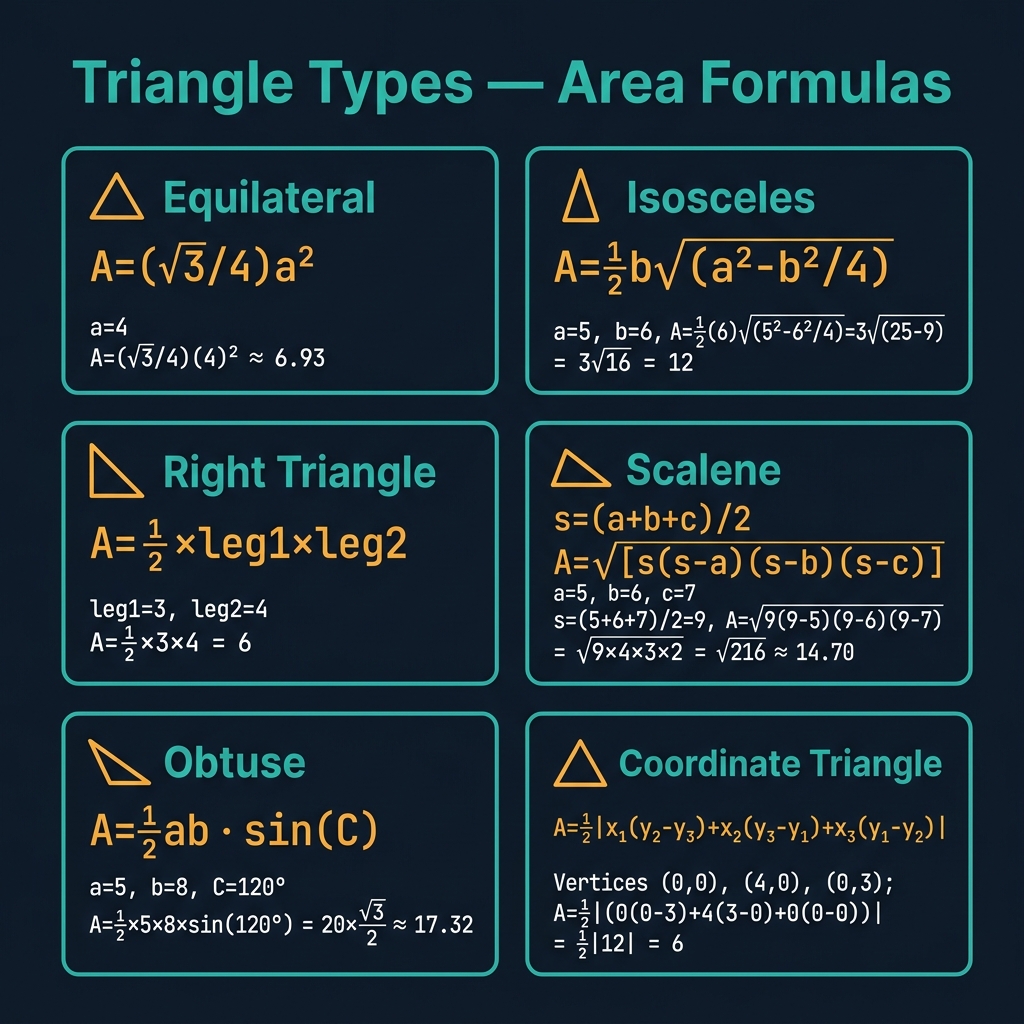
Beyond area, a triangle has a rich set of derived properties:
- Angles from three sides (Law of Cosines): cos(A) = (b²+c²−a²)/(2bc), cos(B) = (a²+c²−b²)/(2ac), cos(C) = (a²+b²−c²)/(2ab). Example: sides (3,4,5): cos(C) = (9+16−25)/(2×3×4) = 0/(24) = 0 → C = 90°. Then cos(A) = (16+25−9)/(40) = 32/40 = 0.8 → A ≈ 36.87°. cos(B) = 0.6 → B ≈ 53.13°. Sum: 36.87+53.13+90 = 180° ✓. Use our Trigonometry Calculator to confirm individual angle values.
- Altitudes (heights) from area: Once you have the area A and all three sides, each altitude can be found: h_a = 2A/a, h_b = 2A/b, h_c = 2A/c. Example: (3,4,5) triangle, A=6: h_a = 12/3 = 4, h_b = 12/4 = 3, h_c = 12/5 = 2.4. These are the perpendicular heights from vertices A, B, C to the opposite sides. Note h_c (altitude to the hypotenuse) = 2.4 for the 3-4-5 triangle — a key result also derived in our Pythagorean Theorem Calculator.
- Inradius r (inscribed circle radius): r = A/s where A is area and s is semi-perimeter. The incircle touches all three sides. Example: (3,4,5): s=6, A=6, r=6/6=1. For an equilateral triangle with side a: r = a/(2√3) = a√3/6. The inradius is related to area by A = r×s (useful identity). See also: Pythagorean Theorem Calculator which independently derives r=(a+b−c)/2 for right triangles.
- Circumradius R (circumscribed circle radius): R = abc/(4A). The circumcircle passes through all three vertices. Example: (3,4,5): R = 3×4×5/(4×6) = 60/24 = 2.5. For an equilateral triangle: R = a/√3. By the extended Law of Sines: a/sin(A) = b/sin(B) = c/sin(C) = 2R — so the circumradius determines the "size" of the triangle relative to its angles. The circumcenter is the midpoint of the hypotenuse for right triangles (Thales' theorem).
- Medians: The median from vertex A to the midpoint of side a has length m_a = ½√(2b²+2c²−a²). The three medians intersect at the centroid G, which divides each median in ratio 2:1 from the vertex. Centroid coordinates: G = ((x₁+x₂+x₃)/3, (y₁+y₂+y₃)/3). The centroid is the center of mass of the triangle. Use our Midpoint Calculator to find the midpoint of each side (the endpoint of each median).
- Triangle inequality: Any valid triangle must satisfy: a+b > c, a+c > b, b+c > a (each side strictly less than the sum of the other two). If any condition fails, the three sides cannot form a triangle. A degenerate triangle (a+b=c) has zero area — the three "vertices" are collinear. Our calculator validates all inputs against the triangle inequality before computing.
Triangle Classification by Sides and Angles
- By sides — Equilateral: All three sides equal (a=b=c), all angles 60°. Most symmetric triangle. Area = (√3/4)a². Height = (√3/2)a. The largest area for a given perimeter (isoperimetric).
- By sides — Isosceles: Two sides equal (a=b≠c). The two base angles are equal. Height from apex: h = √(a²−c²/4). Area = ½c × √(a²−c²/4). Example: isosceles with equal sides 10 and base 12: h = √(100−36) = 8. A = ½×12×8 = 48.
- By sides — Scalene: All three sides different. No special symmetry. Use Heron's formula for area from sides, or Law of Cosines for angles.
- By angles — Acute: All three angles < 90°. The circumcenter lies inside the triangle. For any acute triangle: a²+b² > c² for all combinations. Area is maximized among triangles of the same perimeter when the triangle is equilateral.
- By angles — Right: One angle exactly 90°. Satisfies the Pythagorean theorem: a²+b² = c² where c is the hypotenuse. Area = ½×leg1×leg2. The circumcenter is the midpoint of the hypotenuse. Inradius r = (leg1+leg2−hypotenuse)/2. The 3-4-5, 5-12-13, 8-15-17 are the most famous right triangle families.
- By angles — Obtuse: One angle > 90°. The circumcenter lies outside the triangle. For an obtuse triangle, one side is longer than the square root of the sum of squares of the other two. Use the SAS formula (mode 3) or Heron's formula (mode 2) — the ½bh formula still works but finding h requires extra steps (the foot of the altitude falls outside the base).
Real-World Applications of Triangle Area
- Land Surveying and Real Estate: Surveyors divide irregular land parcels into triangles using measured boundary coordinates and sum their areas (triangulation). Given GPS coordinates of three corners, the shoelace formula gives the exact area. Example: A triangular lot with vertices at (0,0), (100,0), (60,80) feet: A = ½|0(0−80)+100(80−0)+60(0−0)| = ½|0+8000+0| = 4000 sq ft ≈ 0.092 acres. For larger parcels, the shoelace formula extends to any polygon: A = ½|Σ(xᵢyᵢ₊₁ − xᵢ₊₁yᵢ)|.
- Architecture and Construction: Triangular roof sections, gabled facades, and truss analysis all require triangle area for material estimation. A triangular dormer window with base 4 ft and height 3 ft needs 6 sq ft of glass. Gable end walls are triangles: a house with 30-ft width and 8-ft peak height has a triangular gable area of ½×30×8 = 120 sq ft of siding needed per end. Roof pitch affects the slope height: for a 4:12 pitch over a 15-ft half-span, height = 15×4/12 = 5 ft, area = ½×30×5 = 75 sq ft per triangle.
- Navigation and Computer Graphics: 3D meshes in computer graphics consist entirely of triangles (polygonal tessellation). The area of each triangle face is computed from its three 3D vertex coordinates using the cross-product formula: A = ½||(v₂−v₁) × (v₃−v₁)||. GPU rendering pipelines compute triangle area constantly for rasterization, backface culling, and texture mapping. Navigation use: the cross-track distance of a GPS position from a planned route can be converted to a triangle area problem.
- Physics — Centers of Mass: A uniform triangular plate has its center of mass at the centroid G = ((x₁+x₂+x₃)/3, (y₁+y₂+y₃)/3). The moment of inertia of a triangular cross-section appears in structural beam calculations. The shear stress distribution in triangular-cross-section beams depends on triangle area and geometric moments. Use our Midpoint Calculator to find the midpoints defining the medians that intersect at the centroid.
- Trigonometry and the Unit Circle: The area of a triangle with two sides being radii of a unit circle (r=1) and central angle θ is A = ½sin(θ). This connects triangle area directly to the sine function — sin(θ) is literally twice the area of the triangle inscribed in a unit circle with that central angle. The law of sines a/sin(A)=2R extends this: every triangle can be related to its circumcircle via the relationship between side length and opposite angle. See our Trigonometry Calculator for sine/cosine computations.
- Engineering — Truss Analysis and Structural Design: Triangular trusses are rigid by definition (a triangle cannot deform without changing side lengths). Bridge trusses, roof trusses, and transmission towers are built of triangular elements. Computing the forces in each member requires knowing the area of each panel for distributed load calculations. The method of sections (cutting a truss through three members and applying equilibrium) reduces to solving triangle geometry.
Related Calculators
- Pythagorean Theorem Calculator — For right triangles specifically, the area A=½×leg₁×leg₂ follows directly from the legs computed by the Pythagorean theorem c²=a²+b². That calculator also derives the altitude to the hypotenuse h_c=ab/c=(2A)/c, inradius r=(a+b−c)/2, and circumradius R=c/2 — all linked to the triangle area through A=r×s (where s is the semi-perimeter). For any right triangle area problem, Mode 6 of this calculator and the Pythagorean Theorem Calculator are complementary tools, one focused on measuring the interior space and the other on the side-length geometry.
- Trigonometry Calculator — The SAS formula A=½ab·sin(C) and the Law of Cosines (for finding angles from sides) both rely on trigonometric functions. The Trigonometry Calculator computes sin, cos, tan and their inverses for any angle — essential for Modes 3 and the angle-derivation steps in Mode 2. The fundamental identity sin²θ+cos²θ=1 also underlies the relationship between the SAS area formula and Heron's formula: expanding ½ab·sin(C) with cos(C)=(a²+b²−c²)/(2ab) recovers Heron's formula algebraically.
- Midpoint Calculator — The centroid of a triangle is computed from the midpoints of its sides: M_a=((x₂+x₃)/2,(y₂+y₃)/2). The medians connect each vertex to the opposite midpoint. The Midpoint Calculator finds these midpoints and the distances between them — which are exactly the medians' segment endpoints. The centroid G=((x₁+x₂+x₃)/3,(y₁+y₂+y₃)/3) is 2/3 of the way from each vertex to its opposite midpoint, a property of the median in triangle geometry.
- Hypotenuse Calculator — For right triangles, after computing the area A=½×leg₁×leg₂, the Hypotenuse Calculator provides the complete right-triangle analysis: all sides, all angles (in degrees and radians), all six trigonometric ratios (sin, cos, tan, csc, sec, cot), and the Law of Sines. The area is ½×leg₁×leg₂ while the hypotenuse c=√(leg₁²+leg₂²). Together, these two tools give the complete characterization of any right triangle.
- Slope Intercept Form Calculator — When a triangle is specified by its three vertex coordinates, the sides are line segments whose equations can be found using slope-intercept form y=mx+b. The Slope Intercept Form Calculator derives these line equations from any two vertex coordinates, giving the full line:perimeter analysis of the triangle. The area (via the coordinate shoelace formula, Mode 4 here) and the side equations (from the Slope Intercept Calculator) together completely describe the triangle in the coordinate plane.