Body Shape Calculator
Instantly identify your body shape (Hourglass, Pear, Apple, Rectangle, Inverted Triangle) with our free calculator. Enter your bust, waist, hip, and...
????? ???? ??? ?????
Find My Body Shape
How to Use This Body Shape Calculator
Knowing your body shape helps you shop smarter, dress more confidently, and understand your body's proportions. This calculator uses four key measurements to classify your shape accurately.
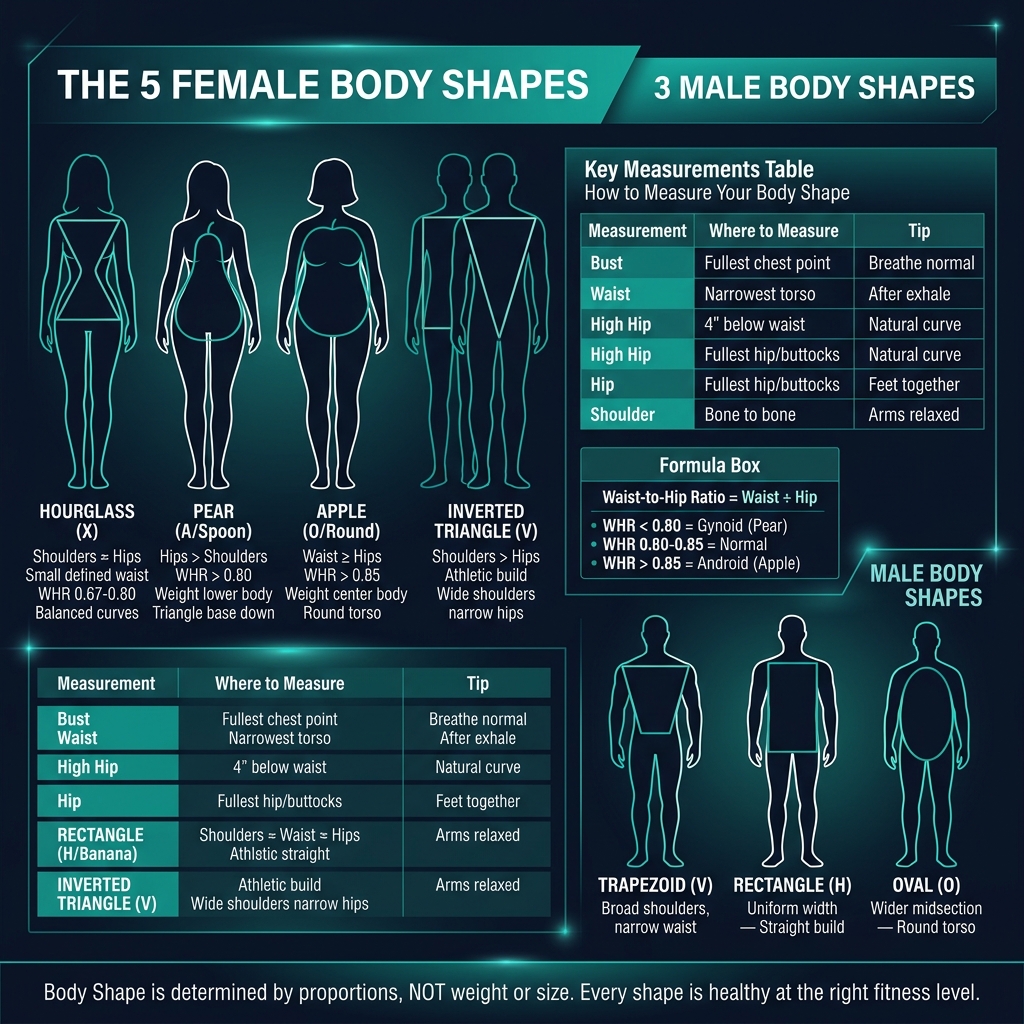
Step-by-Step Measurement Guide
- Select your sex and unit system — Results and shape categories differ between female and male classifications.
- Measure your shoulders — Measure across the widest point of your back, from shoulder bone to shoulder bone. Keep arms relaxed at sides.
- Measure your bust — Wrap the tape around the fullest part of your chest. Breathe normally; avoid pulling too tight.
- Measure your waist — Find the narrowest part of your torso (usually 1 inch above your belly button). Measure after a normal exhale.
- Measure your hips — Stand with feet together and measure around the fullest part of your seat and hips.
- Click Calculate — Your body shape, waist-to-hip ratio (WHR), shoulder-to-waist ratio (SWR), and bust-to-hip ratio (BHR) appear instantly.
Measurement tips: Always use a flexible tape measure. Measure against skin or fitted clothing (not over bulky layers). Take each measurement twice for accuracy.
Body Shape Calculator: The Complete Guide
Your body shape is determined by the proportions between your shoulders, bust, waist, and hips — not your weight or clothing size. Understanding your shape is the foundation of effective dressing, fitness planning, and health awareness.
The Five Female Body Shapes
The internationally recognized system classifies women's bodies into five main shapes based on measurement ratios:
1. Hourglass (X Shape) The hourglass shape features bust and hips of similar width with a noticeably smaller waist — the waist is at least 9 inches smaller than both the bust and hips. The waist-to-hip ratio is typically 0.67–0.80. Both upper and lower body carry balanced proportions, making this shape versatile for most clothing styles.
2. Pear (A/Triangle Shape) Pear-shaped bodies have hips that are wider than the bust by at least 3.6 inches, combined with a defined waist. Weight tends to accumulate in the hips and thighs. This shape benefits from emphasizing the upper body to create balance.
3. Apple (Round/Oval Shape) Apple-shaped bodies carry more weight around the midsection, with a waist that is roughly equivalent to or wider than the hips. The bust is typically fuller. Health research links this shape to higher visceral fat risk, making waist measurement an important health metric.
4. Rectangle (H/Banana Shape) The rectangle body shape has shoulders, waist, and hips all within a few inches of each other, creating a straight silhouette. This is common among athletic builds. While the silhouette is uniform, adding visual curves through clothing choices is straightforward with the right techniques.
5. Inverted Triangle (V Shape) Broad shoulders and a narrower waist and hip define this shape. Common among swimmers and athletic women. Balancing the lower body proportionally is the key styling goal.
The Three Male Body Shapes
Trapezoid (V Shape): Broad shoulders tapering to a narrower waist — widely considered the athletic ideal. Strong upper body with a lean midsection.
Rectangle (H Shape): Uniform shoulder, waist, and hip width. Common in lean athletic builds. Benefits from exercises that add upper body width.
Oval (O Shape): A wider midsection with shoulders and hips of similar or narrower width. Abdominal focus is the key fitness priority.
Key Measurement Ratios Explained
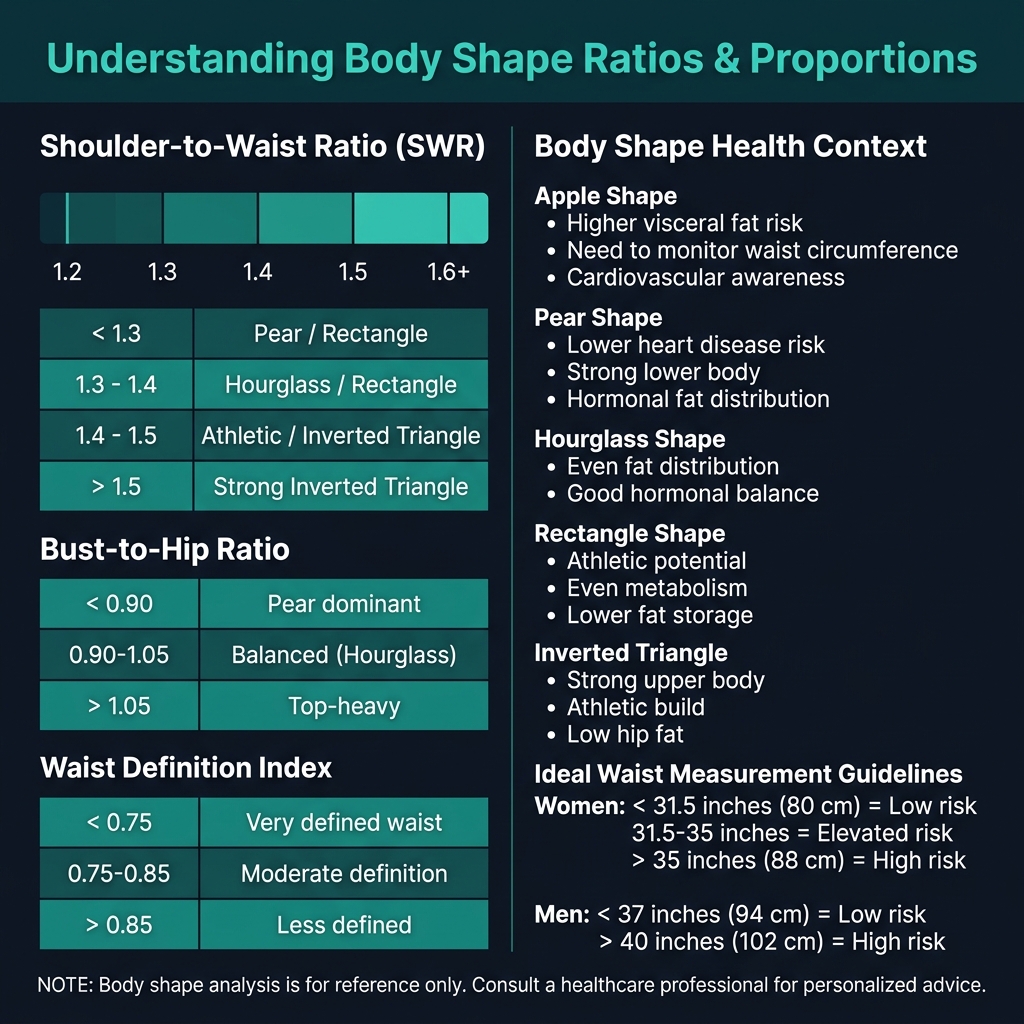
Waist-to-Hip Ratio (WHR) WHR is the most clinically studied body proportion metric. It is calculated by dividing your waist measurement by your hip measurement:
WHR = Waist ÷ Hip
The World Health Organization uses WHR as a health screening metric:
- Women: WHR < 0.80 = Low risk | 0.80–0.85 = Moderate | > 0.85 = High
- Men: WHR < 0.90 = Low risk | 0.90–1.00 = Moderate | > 1.00 = High
Shoulder-to-Waist Ratio (SWR) SWR = Shoulder ÷ Waist. This metric is particularly useful for male body shape classification and for detecting inverted triangle shapes in women. A higher SWR indicates greater upper-body dominance.
Bust-to-Hip Ratio (BHR) BHR = Bust ÷ Hip. When close to 1.0 with a significantly smaller waist ratio, this indicates the hourglass shape. When below 0.90, it indicates lower-body dominance (pear shape).
Body Shape and Health Connections
Body shape classification has practical health implications beyond fashion:
- Apple (android) shapes are associated with higher visceral fat storage around organs, which correlates with increased cardiovascular and metabolic risk. Monitoring waist circumference is especially important.
- Pear (gynoid) shapes are associated with subcutaneous fat storage in hips and thighs, which carries lower health risk than visceral fat.
- All shapes can be healthy or present health risks depending on overall fitness, diet, and lifestyle — body shape classification is a reference tool, not a medical diagnosis.
Health organizations recommend using waist circumference alongside BMI and body shape for a more complete picture. Use our BMI Calculator alongside this tool for a comprehensive health assessment.
Body Shape and Fitness Planning
Different shapes respond well to different training approaches:
- Hourglass: Maintain proportional training across all muscle groups. Avoid extreme loading on any single area.
- Pear: Upper body compound movements (rows, presses, lat pulldowns) create visual balance. Lower body training for strength without excess hypertrophy.
- Apple: Core-strengthening and cardiovascular training are priorities. Compound full-body exercises accelerate metabolic output.
- Rectangle: Upper body hypertrophy (particularly shoulders and chest) and glute training create the most visual proportion change.
- Inverted Triangle: Lower body focus (squats, lunges, hip thrusts) adds balance and visual width to the lower half.
Body Shape and Style Guide
| Shape | Emphasize | Balance |
|---|---|---|
| Hourglass | Fitted waist styles | All silhouettes work |
| Pear | Shoulders, neckline, tops | A-line or wide-leg bottoms |
| Apple | Elongated lines, V-necks | Empire waists, wrap dresses |
| Rectangle | Ruffles, layers, peplums | Create waist definition |
| Inverted Triangle | Flared skirts, wide-leg pants | Avoid heavy shoulder details |
Internal Tools for a Complete Health Assessment
- BMI Calculator — Calculate your Body Mass Index alongside shape analysis
- Age Calculator — Know your precise age for age-adjusted health metrics
- Investment Calculator — Plan your fitness program budget long-term
- Loan Calculator — Finance gym memberships or health coaching programs