Remainder Calculator
Free Remainder Calculator: enter any dividend and divisor to instantly get the quotient, remainder (truncated division), true modulo (floored),...
????? ???? ??? ?????
How to Use the Remainder Calculator
Enter the dividend (the number being divided) and the divisor (the number you are dividing by), then click Find Remainder. The calculator instantly shows the quotient, remainder (truncated division), true modulo (Python-style floored division), a step-by-step long division breakdown, and a visual number-line diagram.
Both positive and negative integers are fully supported. The calculator clearly distinguishes between two commonly confused operations: truncated remainder (C/Java/JavaScript behavior) and true modulo (Python/mathematical behavior). Understanding which one you need is essential for programming and mathematics.
Step-by-Step Instructions
- Enter the dividend — any integer you want to divide (positive or negative).
- Enter the divisor — any non-zero integer to divide by.
- Click Find Remainder — results appear instantly with full breakdown.
- Read the step-by-step — follow the long division steps to understand how the result was computed.
- Copy any result — click any result cell to copy that value to clipboard.
The Division Algorithm Explained
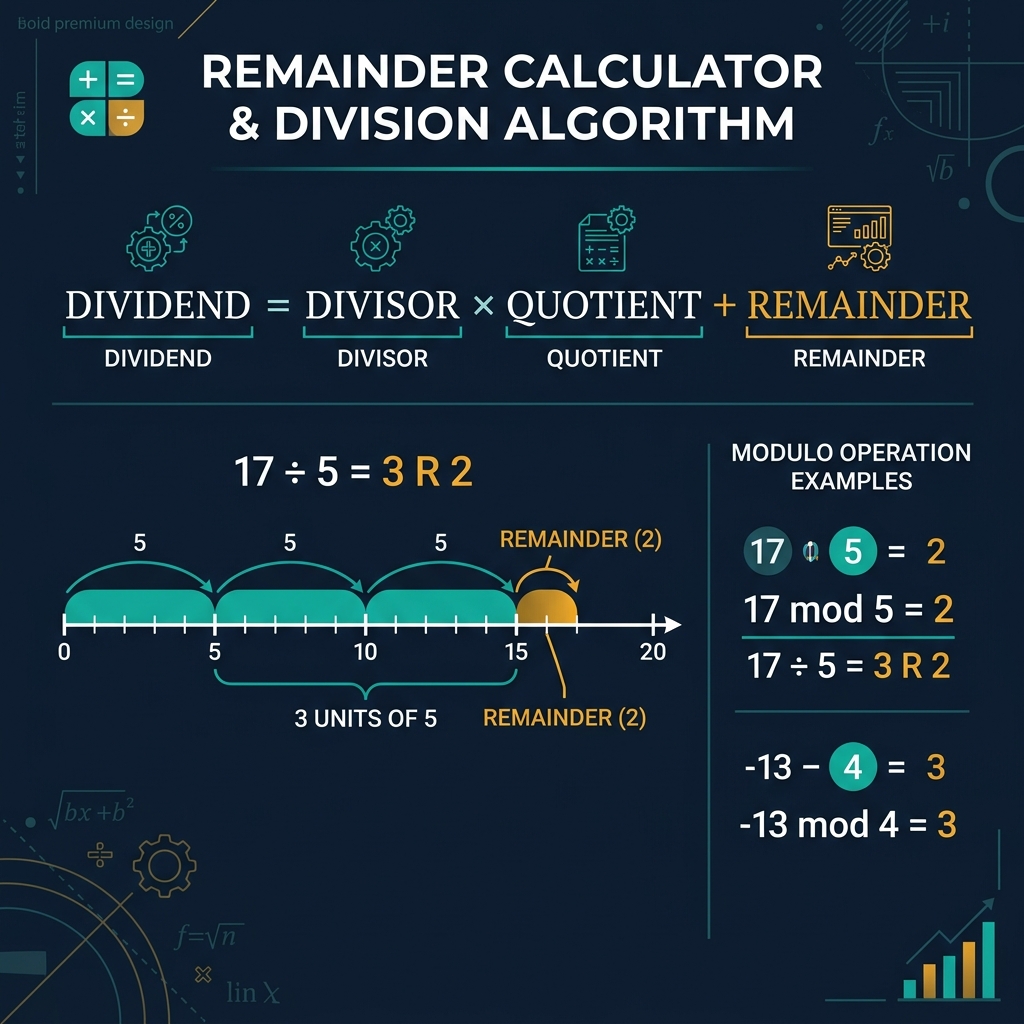
The Division Algorithm is one of the most foundational theorems in number theory. It states that for any integer a (dividend) and any non-zero integer b (divisor), there exist unique integers q (quotient) and r (remainder) such that:
a = b × q + r, where 0 ≤ r < |b|
This guarantees that the remainder is always non-negative and strictly less than the absolute value of the divisor. The key insight is that the quotient q is the largest integer such that b × q does not exceed a in absolute value.
Key Components
- Dividend (a): The number being divided — the numerator of the division. Can be any integer.
- Divisor (b): The number dividing the dividend — the denominator. Must be non-zero; can be any other integer.
- Quotient (q): The integer result of the division, discarding any fractional part. Also called "integer quotient" or "floor quotient".
- Remainder (r): What is left over after the divisor goes into the dividend as many times as possible. Satisfies 0 ≤ r < |b|.
Long Division Step by Step: 17 ÷ 5
- Divide: How many times does 5 go into 17? → 3 times (since 3 × 5 = 15 ≤ 17, but 4 × 5 = 20 > 17). So quotient = 3.
- Multiply: 3 × 5 = 15.
- Subtract: 17 − 15 = 2.
- Result: 17 = 5 × 3 + 2. Quotient = 3, Remainder = 2.
- Verify: 5 × 3 + 2 = 15 + 2 = 17 ✓
Remainder vs. Modulo: Critical Difference
The terms "remainder" and "modulo" are frequently confused — even by experienced programmers — because they give different results for negative numbers. Understanding this difference is essential for programming and cryptography.
Truncated Division (C, Java, JavaScript, PHP)
In most programming languages, the % operator uses truncated division: the quotient is rounded toward zero. This means the remainder takes the sign of the dividend.
13 % 4 = 1(same as true modulo)-13 % 4 = -1(different from true modulo!)13 % -4 = 1(takes sign of dividend)
Floored Modulo (Python, Ruby, mathematical modulo)
Python's % operator and mathematical modular arithmetic use floored division: the quotient is rounded toward negative infinity. The result always takes the sign of the divisor and is always non-negative when the divisor is positive.
13 % 4 = 1(same)-13 % 4 = 3(true modulo — always 0–3 for divisor 4)13 % -4 = -3(takes sign of divisor)
The mathematical relationship between the two: True Modulo = ((a % b) + |b|) % b. This formula is used by this calculator to convert between the two representations.
Real-World Applications of Remainder and Modulo

The remainder and modulo operations are not just abstract mathematics — they power many of the systems we interact with daily.
Clock Arithmetic and Time
Time is the most intuitive example of modular arithmetic. The 12-hour clock operates in modulo 12: if it is currently 10:00 AM and you add 5 hours, you get (10 + 5) mod 12 = 3:00 PM. Military time and day-of-week calculations (mod 7) work identically. This is why number theorists say "clocks are the canonical example of Z/12Z" — integers modulo 12.
Cryptography and Security
Modern encryption — including RSA, Diffie-Hellman, and elliptic curve cryptography — is built entirely on modular arithmetic. RSA encryption works as: ciphertext = (message^e) mod n, and decryption as: message = (ciphertext^d) mod n. The security of these systems relies on the computational difficulty of factoring large numbers — a problem intimately connected to modular arithmetic. Without the modulo operation, public-key cryptography as we know it would not exist.
Programming and Computer Science
Programmers use modulo constantly:
- Even/odd detection:
if (n % 2 == 0)— even;n % 2 == 1— odd - Circular array indexing:
index = (current + 1) % array.lengthwraps around to 0 after the last element - Hash tables:
bucket = hash(key) % table_sizemaps any hash to a valid array index - Rate limiting: Check if a counter is a multiple of N:
if (count % 100 == 0) flush() - Bit manipulation:
n % 2^kis equivalent to masking the last k bits — useful for power-of-two modulo
Check Digits and Validation
Many identification systems use modular arithmetic to detect transcription errors:
- ISBN-10: Uses mod 11 to compute the check digit — any single transposition or digit error changes the modulo result.
- ISBN-13 / EAN-13: Uses mod 10 with alternating weights 1 and 3.
- IBAN bank numbers: Computed using mod 97 — a bank number is valid if its numerical equivalent is ≡ 1 (mod 97).
- Credit cards (Luhn algorithm): Alternating digit doubling with mod 10 reduction detects most single-digit errors.
Calendar Calculations
The day of the week for any historical or future date can be computed with Zeller's congruence formula, which relies entirely on modulo 7 arithmetic. Similarly, leap year detection uses mod 4, mod 100, and mod 400 — making the remainder operation central to all date/time libraries.
Common Mistakes and How to Avoid Them
- Confusing remainder with modulo: Always clarify which convention you need. For most mathematical contexts and Python programming, use true modulo. For C/Java/JavaScript, use truncated remainder. This calculator shows both.
- Dividing by zero: The remainder is undefined when the divisor is zero — division by zero produces no finite result. Always validate that your divisor is non-zero before computing.
- Remainder of a fraction: The division algorithm applies only to integers. For decimal division, you need the fractional part function, not the integer remainder.
- Sign confusion: −17 mod 5: the mathematical result is 3 (not −2), because −17 = 5 × (−4) + 3. Use this calculator to verify both representations.
Related Math Calculators
The remainder and modulo operation connects to a wide range of mathematical tools:
- Percentage Calculator — Convert division results to percentage form and compute proportional relationships
- Average Calculator — Calculate mean, median, and mode of data sets using division operations at their core
- Random Number Generator — Random integer generation uses modulo to constrain output to a specified range