Harris-Benedict Calculator
Calculate your Basal Metabolic Rate (BMR) and Total Daily Energy Expenditure (TDEE) with the Harris-Benedict & Mifflin-St Jeor equations. Get personalized...
?????? ?????????
Calculate BMR & TDEE
How to Use the Harris-Benedict Calculator
Enter your sex, age, weight, height, and activity level to instantly calculate your Basal Metabolic Rate (BMR) and Total Daily Energy Expenditure (TDEE). Select your preferred formula — the Revised Mifflin-St Jeor is recommended for most people as it is more accurate for modern populations.
Step-by-Step Instructions
- Select your sex — Male and female have different BMR formulas due to differences in lean body mass
- Enter your age — BMR decreases by approximately 1–2% per decade after age 30
- Enter your weight — Use kilograms (kg) or switch to pounds (lbs) using the unit toggle
- Enter your height — Enter in centimeters (cm) or feet and inches
- Select your activity level — Choose honestly; this is the most common source of error
- Choose your formula — Mifflin-St Jeor revised is recommended; use Original Harris-Benedict for historical comparison
- Click Calculate — View your BMR, TDEE, and calorie targets for three goals
What Is Basal Metabolic Rate (BMR)?
The Harris-Benedict equation is one of the most widely cited formulas in nutrition science for estimating an individual's basic caloric needs. First published in 1919 by J. Arthur Harris and Francis G. Benedict at the Carnegie Institution of Washington, it transformed how physicians and nutritionists approach dietary planning.
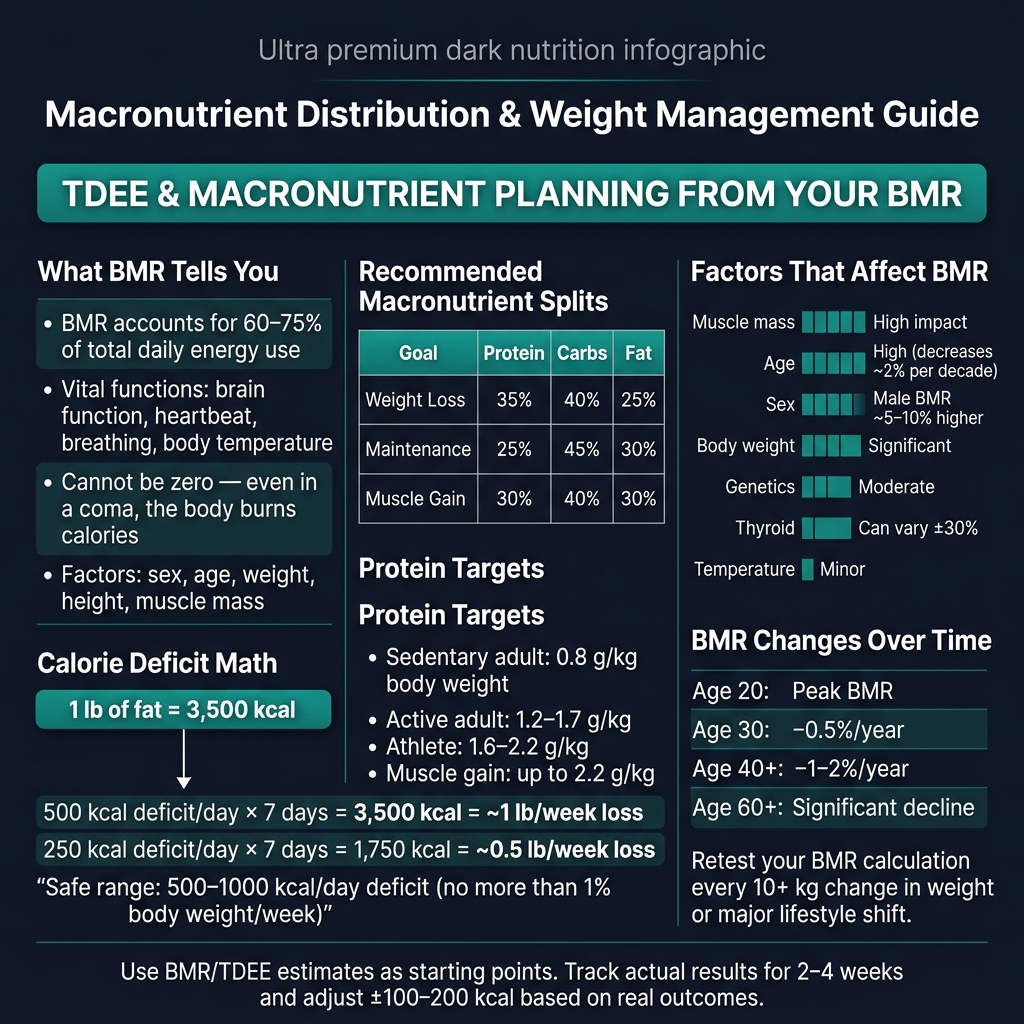
Your Basal Metabolic Rate is the number of calories your body requires at complete rest to maintain vital physiological functions: breathing, circulation, temperature regulation, brain activity, and cellular repair. BMR represents 60–75% of your total daily energy expenditure and is the foundation of all calorie calculations.
BMR is not zero even during sleep. It represents the theoretical minimum — the calories you would burn in a perfectly controlled clinical setting lying completely still in a temperature-neutral environment for 24 hours.
Key factors affecting BMR:
- Sex — Males have higher BMR due to greater muscle mass on average
- Age — BMR declines approximately 1–2% per decade after age 30
- Body weight — Heavier individuals have higher BMR (more body mass = more energy to maintain)
- Height — Taller people have more surface area and slightly higher BMR
- Muscle mass — Muscle tissue burns ~3x more calories than fat tissue at rest
Harris-Benedict vs. Mifflin-St Jeor: The Two Formulas
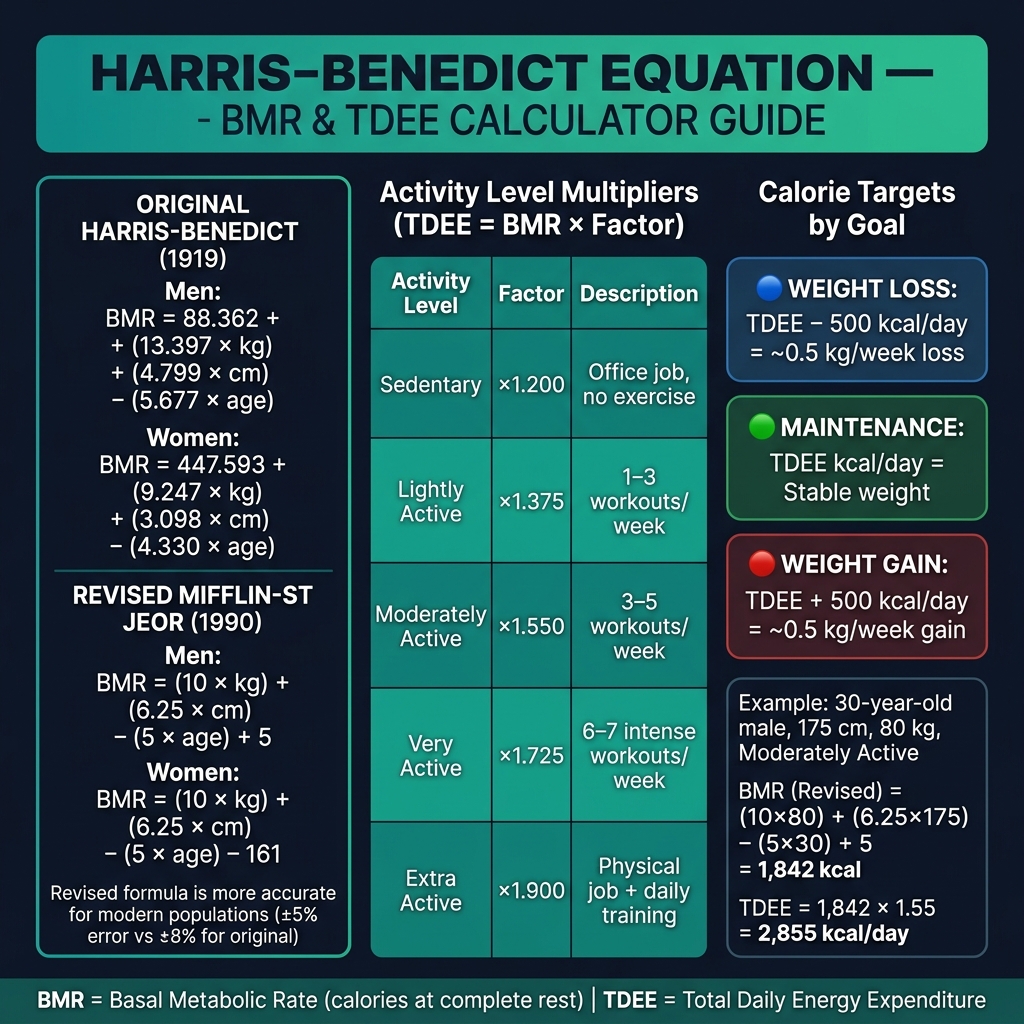
Original Harris-Benedict (1919):
For men: BMR = 88.362 + (13.397 x weight in kg) + (4.799 x height in cm) - (5.677 x age)
For women: BMR = 447.593 + (9.247 x weight in kg) + (3.098 x height in cm) - (4.330 x age)
Revised Formula - Mifflin-St Jeor (1990):
For men: BMR = (10 x weight in kg) + (6.25 x height in cm) - (5 x age) + 5
For women: BMR = (10 x weight in kg) + (6.25 x height in cm) - (5 x age) - 161
The revised Mifflin-St Jeor equation was published in the Journal of the American Dietetic Association in 1990 following a controlled study of 498 subjects. Research consistently shows the Mifflin-St Jeor equation is more accurate for contemporary Western populations (plus or minus 5% error vs. plus or minus 8% for the original Harris-Benedict formula). The revised formula is now the preferred equation in clinical dietetics practice.
From BMR to TDEE: Activity Level Multipliers
Your Total Daily Energy Expenditure (TDEE) accounts for both your resting metabolic needs and the additional energy burned through daily activity. Multiply your BMR by the appropriate activity factor:
- Sedentary (x1.200) — Desk job, little to no planned exercise
- Lightly Active (x1.375) — Light exercise 1-3 days per week
- Moderately Active (x1.550) — Moderate exercise 3-5 days per week
- Very Active (x1.725) — Hard training 6-7 days per week
- Extra Active (x1.900) — Physical labor job + intense daily training
Choosing your activity level is the single most impactful variable in the calculation. Most people underestimate their sedentary time and overestimate their activity. A realistic activity level will give you the most useful TDEE estimate.
Using Your TDEE for Weight Goals
Once you have your TDEE (maintenance calories), applying a calorie adjustment creates predictable change in body weight:
- Weight Loss: TDEE minus 500 kcal/day = approximately 0.5 kg (1 lb) per week loss. This is safe, sustainable, and preserves muscle mass when combined with adequate protein intake.
- Maintenance: Eating at TDEE maintains current weight over time.
- Weight Gain / Muscle Building: TDEE + 300-500 kcal/day = gradual muscle gain with minimal fat accumulation.
The "3,500 calorie rule" states that a deficit of 3,500 kcal equals approximately 1 pound of fat loss. In practice, actual weight loss is slightly lower due to adaptive thermogenesis — the body reducing its metabolic rate in response to dieting.
Macronutrient Distribution
Once you know your calorie target, distributing those calories across macronutrients optimizes body composition results:
- For weight loss: Protein 35% - Carbohydrates 40% - Fat 25%
- For maintenance: Protein 25-30% - Carbohydrates 40-50% - Fat 25-30%
- For muscle gain: Protein 30% - Carbohydrates 40-45% - Fat 25-30%
Protein targets deserve special attention. Research supports 1.6-2.2 g/kg of body weight per day for individuals engaged in resistance training. Higher protein intake (up to 2.2 g/kg) has been shown to maximize muscle protein synthesis and reduce muscle loss during calorie deficits.
Limitations and Accuracy of the Harris-Benedict Equation
Like all population-based equations, the Harris-Benedict and Mifflin-St Jeor formulas estimate BMR for the average person. Individual variation exists due to:
- Genetic metabolic rate differences — Some individuals have naturally faster or slower metabolisms unrelated to body composition.
- Body composition — The formulas use total body weight rather than lean body mass. A heavily muscled athlete and a person with the same weight but higher body fat will have the same BMR in the calculation, but the athlete's true BMR will be significantly higher.
- Thyroid function — Hypothyroidism reduces BMR by 25-40%; hyperthyroidism increases it by 25-80%.
- Adaptive thermogenesis — Prolonged calorie restriction causes the body to downregulate BMR by 10-15% as a survival mechanism.
For this reason, treat your calculated TDEE as a starting point. Track your actual calorie intake and body weight for 2-4 weeks, then adjust by 100-200 kcal based on your real-world results.
For a complete health picture, check your BMI Calculator to assess healthy weight range, and use the Body Shape Calculator for body proportion analysis. Knowing your age precisely with the Age Calculator helps with age-adjusted fitness programming. For height-based calculations and context, see the Height Calculator.