Point Slope Form Calculator
Free Point Slope Form Calculator: enter a point (x₁,y₁) and slope m to instantly get point-slope form y−y₁=m(x−x₁), slope-intercept y=mx+b, standard form...
?????? ?????????
How to Use the Point Slope Form Calculator
This calculator supports three input modes and outputs every useful form of the line equation instantly:
- Mode 1 — Point + Slope: Enter a known point (x₁, y₁) and slope m. Instantly get point-slope form y−y₁=m(x−x₁), slope-intercept form y=mx+b, standard form Ax+By=C, general form Ax+By+C=0, x-intercept, y-intercept, parallel slope, perpendicular slope, and the equation's distance from the origin.
- Mode 2 — Two Points: Enter points (x₁, y₁) and (x₂, y₂). The calculator first computes slope m=(y₂−y₁)/(x₂−x₁), then derives all equation forms. Also calculates the distance between the points, midpoint, and the rise and run components.
- Mode 3 — Slope + Y-Intercept: Enter slope m and y-intercept b. Converts directly from y=mx+b to point-slope form (using the y-intercept as the known point) and all other forms.
All outputs are click-to-copy. The interactive SVG graph visualizes the line, the given point(s), and key labeled features (intercepts, slope triangle).
What is Point Slope Form?
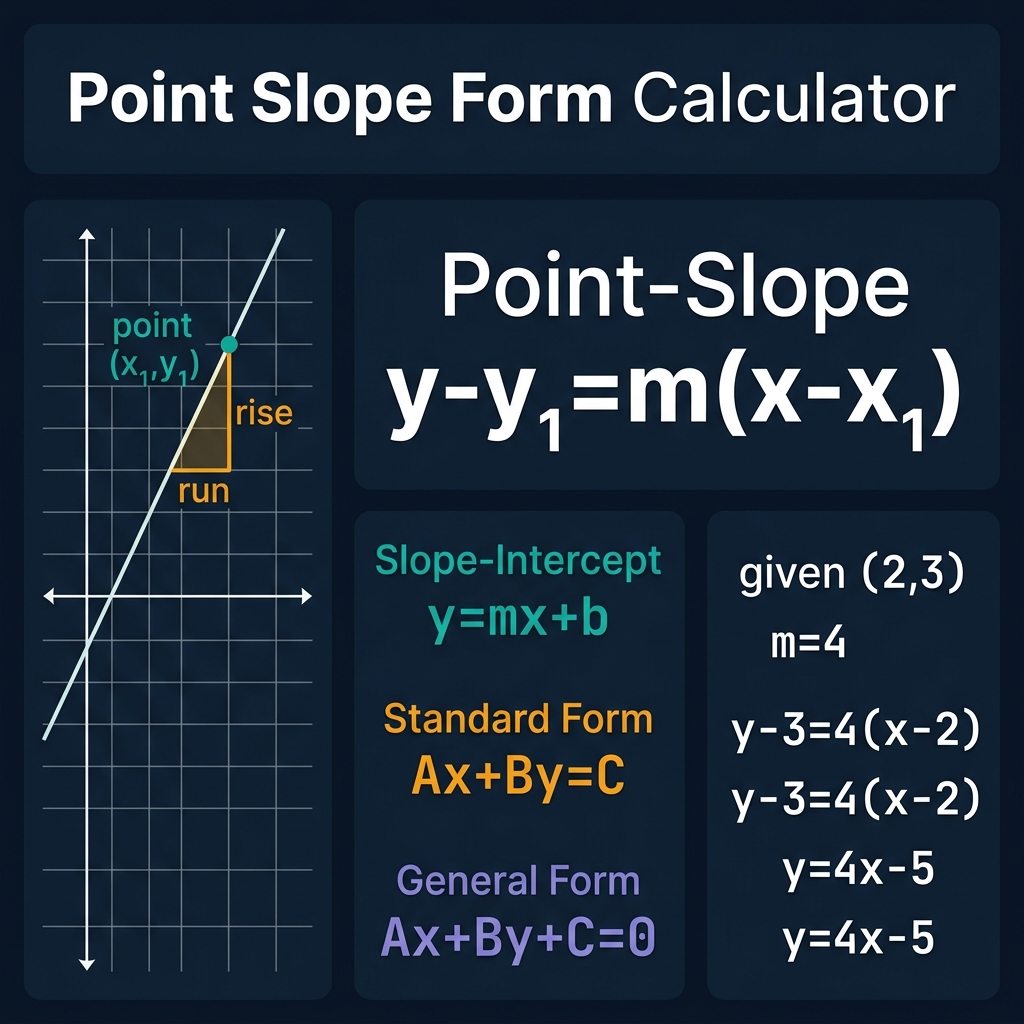
Point slope form is one of the four standard ways to write the equation of a straight line. The formula is:
y − y₁ = m(x − x₁)
where (x₁, y₁) is any known point on the line and m is the slope. This form is particularly useful when:
- You know one point and the slope (most common textbook scenario)
- You need an equation before finding the y-intercept
- You want to emphasize the geometric interpretation: the line passes through (x₁, y₁) with steepness m
The power of point-slope form lies in its direct connection to the slope definition. Recall: slope = rise/run = (y − y₁)/(x − x₁). Rearranging gives y − y₁ = m(x − x₁). So point-slope form is literally just the slope equation rearranged — which makes it the most mathematically transparent of all line forms.
Example: Line through (3, −2) with slope m = 5. Point-slope: y − (−2) = 5(x − 3) → y + 2 = 5(x − 3). Expand: y + 2 = 5x − 15 → y = 5x − 17 (slope-intercept). Standard form: −5x + y = −17 or 5x − y = 17.
The Four Forms of a Line
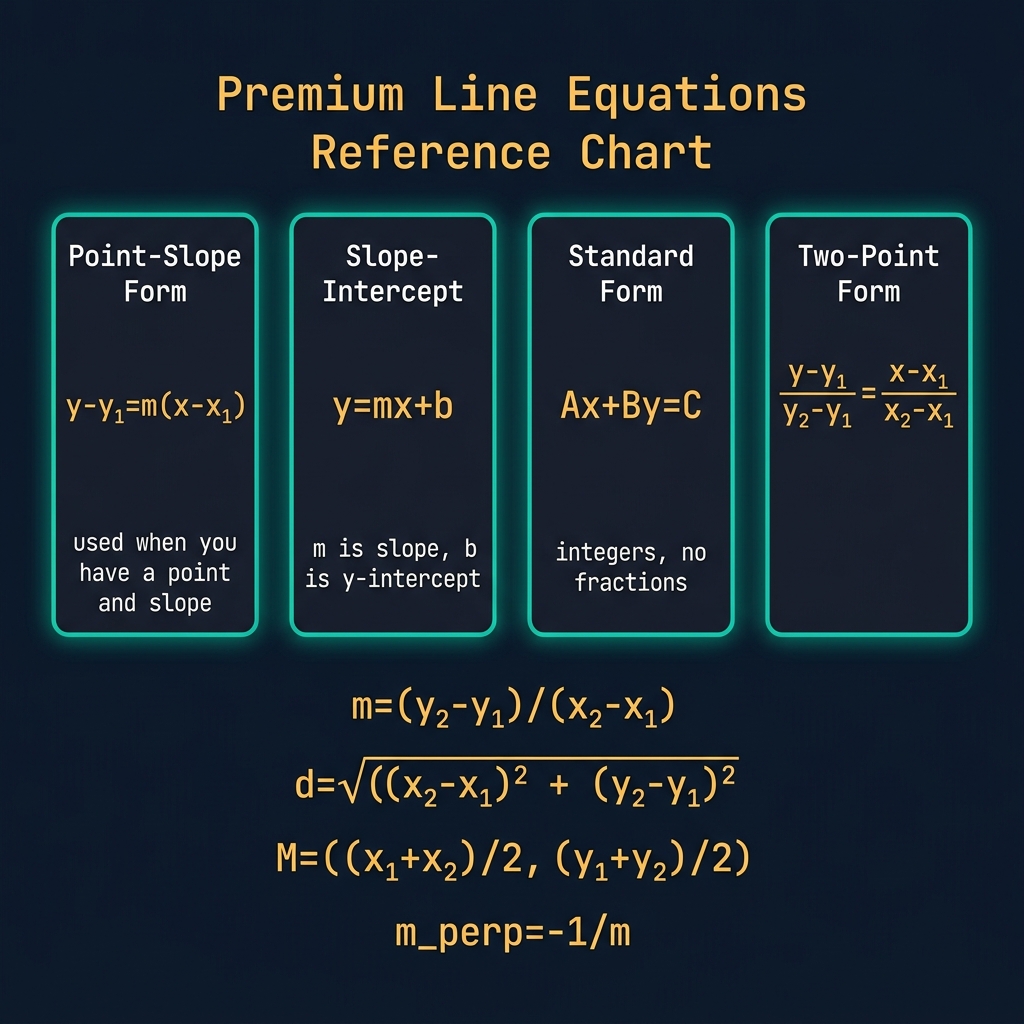
Every non-vertical, non-horizontal straight line can be written in four equivalent algebraic forms:
- 1. Point-Slope Form: y − y₁ = m(x − x₁) — Best for: writing an equation when given a point and slope, or when two points are given. It clearly, explicitly shows which point the line passes through. Any point on the line can be used as (x₁, y₁) — different choices of point give different-looking but equivalent expressions. Example: passing through (1,4) and (3,10): m = (10−4)/(3−1) = 3. Using (1,4): y−4 = 3(x−1). Using (3,10): y−10 = 3(x−3). Both simplify to y = 3x + 1.
- 2. Slope-Intercept Form: y = mx + b — Most famous form. m is the slope (steepness), b is the y-intercept (where the line crosses the y-axis). To convert from point-slope: expand and solve for y. Example: y − 4 = 3(x − 1) → y = 3x − 3 + 4 → y = 3x + 1, so b = 1. This form is ideal for graphing: start at (0, b) and apply slope m to find more points. Use our Midpoint Calculator to find the midpoint of a segment on this line.
- 3. Standard Form: Ax + By = C — Convention: A, B, C are integers; A ≥ 0; GCD(A,B,C) = 1. Convert from y = mx + b by moving terms: mx − y = −b, multiply by −1/GCD if needed. Some textbooks write as Ax + By + C = 0 (General Form). Example: y = 3x + 1 → −3x + y = 1 → multiply by −1: 3x − y = −1. While less intuitive for graphing, standard form is the most general: it also covers vertical lines (x = k, written as 1·x + 0·y = k, which slope-intercept cannot represent).
- 4. Two-Point Form: (y−y₁)/(y₂−y₁) = (x−x₁)/(x₂−x₁) — Directly derives the equation from two points without first computing slope. Rearranges to the slope formula and then point-slope form. Useful in theoretical derivations. Example: (1,4) and (3,10): (y−4)/(10−4) = (x−1)/(3−1) → (y−4)/6 = (x−1)/2 → y−4 = 3(x−1) ✓.
Understanding Slope: Rise, Run, and Sign
Slope m = rise/run = (y₂−y₁)/(x₂−x₁) measures the steepness and direction of a line:
- Positive slope (m > 0): Line rises from left to right (↗). Steeper line = larger |m|. Example: m = 2 means for every 1 unit right, go 2 units up.
- Negative slope (m < 0): Line falls from left to right (↘). Example: m = −3 means for every 1 unit right, go 3 units down.
- Zero slope (m = 0): Perfectly horizontal line. Equation: y = b (constant). Point-slope: y − y₁ = 0·(x − x₁) → y = y₁.
- Undefined slope: Vertical line x = x₁. Cannot be expressed in point-slope or slope-intercept form; only standard form handles it: 1·x + 0·y = x₁.
- Slope = 1: 45° angle. Line y = x + b bisects quadrants I and III (or II and IV). Reflection symmetry about identity line.
- Parallel lines: Same slope, different y-intercepts. Line parallel to y = 2x + 3 through (1,5): slope = 2, so y − 5 = 2(x − 1) → y = 2x + 3. Wait — same intercept! That means (1,5) lies on the original line. Check: y = 2(1) + 3 = 5 ✓. The "parallel line" through a point on the original is the original line itself.
- Perpendicular lines: Slopes multiply to −1: m₁ × m₂ = −1, so m₂ = −1/m₁. Line perpendicular to y = 2x + 3 through (4, 1): m_perp = −1/2, so y − 1 = −½(x − 4) → y = −½x + 3. Perpendicular lines always intersect at right angles (90°). Use our Trigonometry Calculator to verify the 90° angle between direction vectors.
X-Intercept, Y-Intercept, and Their Uses
The intercepts are where the line crosses the coordinate axes:
- Y-intercept: Set x = 0 in y = mx + b → y-intercept = b. From point-slope form y − y₁ = m(x − x₁): set x=0, solve for y: y = y₁ − m·x₁ + m·0 = y₁ − m·x₁ = b. So b = y₁ − m·x₁. Example: point (3, 7), slope 2: b = 7 − 2(3) = 7 − 6 = 1. Equation: y = 2x + 1. Y-intercept: (0, 1).
- X-intercept: Set y = 0 in y = mx + b → 0 = mx + b → x = −b/m (for m ≠ 0). Example: y = 2x + 1 → x-intercept = −1/2 = −0.5, so (−0.5, 0). From point-slope: set y = y₁ in y − y₁ = m(x − x₁): x = x₁ (just the point, not intercept). To find x-intercept from point-slope: set y = 0: −y₁ = m(x − x₁) → x = x₁ − y₁/m.
- Uses in practical problems: X-intercept = breakeven point in economics (where revenue equals cost: R = mx + b with b = fixed cost, m = variable cost). Y-intercept = fixed/initial value before any x-change. In science: y-intercept of a velocity-time graph = initial velocity; slope = acceleration (a = Δv/Δt).
Distance, Midpoint, and the Line
When working with two points on a line, three additional calculations are essential:
- Distance formula: d = √((x₂−x₁)² + (y₂−y₁)²). Derived from the Pythagorean theorem — the distance between two points equals the hypotenuse of the right triangle formed by the horizontal run and vertical rise. Visit our Hypotenuse Calculator for right-triangle problems where a² + b² = c².
- Midpoint formula: M = ((x₁+x₂)/2, (y₁+y₂)/2). The midpoint divides the line segment in half. It lies on the line — substituting M into the line equation verifies this. Use our Midpoint Calculator for full midpoint analysis including section formula for internal division.
- Angle of inclination: θ = arctan(|m|). The angle the line makes with the positive x-axis. Example: m = 1 → θ = 45°. m = √3 → θ = 60°. m → ∞ → θ → 90° (vertical). The slope m = tan(θ), connecting slope to trigonometry. See our Trigonometry Calculator for angle computations.
- Distance from a point to a line: For line Ax + By + C = 0 and point (x₀, y₀): d = |Ax₀ + By₀ + C| / √(A² + B²). This formula is the perpendicular (shortest) distance from the point to the line. Perpendicular lines appear frequently: the shortest path from a point to a road, the altitude of a triangle, the height of a trapezoid.
Real-World Applications
- Physics — Motion: Position-time graph of uniform motion is linear: x = x₀ + vt. Here x₀ is the initial position (y-intercept), v is velocity (slope), and t is time (x-axis). Point-slope form is used when you know position at a specific time: if a car is at x=50 m at t=2 s with velocity v=30 m/s, then x−50 = 30(t−2) → x = 30t − 10 m. Velocity-time graph gives acceleration as slope.
- Economics — Cost Functions: Total cost C = fixed cost + variable cost × quantity = b + mq. Point-slope form: if cost is $500 at q=10 units with marginal cost $20/unit: C − 500 = 20(q − 10) → C = 20q + 300. The y-intercept $300 is the fixed cost, slope $20 is marginal cost. Break-even: set C = Revenue = price × q, solve for q using our Percentage Calculator for the margin analysis.
- Engineering — Interpolation: When two calibration data points are known, a linear fit gives a conversion line. Example: thermometer reads 32°F at 0°C and 212°F at 100°C. Slope m = (212−32)/(100−0) = 1.8°F/°C. Using point (0, 32): F−32 = 1.8(C−0) → F = 1.8C + 32 (the famous Fahrenheit formula). Point-slope form directly gives the unit-conversion equation from just two calibration points.
- Data Science — Linear Regression: The least-squares regression line ŷ = b₀ + b₁x (slope-intercept form) is the line minimizing the sum of squared residuals. Point-slope form: for any point on the regression line (x̄, ȳ) (the mean point), ŷ − ȳ = b₁(x − x̄). This shows that the regression line always passes through the point of means (x̄, ȳ) — a key property. The slope b₁ = r × (s_y/s_x) where r is correlation and s_x, s_y are standard deviations.
- Architecture — Roof Pitch: Roof pitch is slope expressed as rise/run. A 6/12 pitch means m = 6/12 = 0.5. If the ridge starts at height 10 ft at x=0: y−10 = 0.5(x−0). The roof reaches 0 ft at x = −10/0.5 = −20 ft (20 ft from ridge to eave). Point-slope form calculates where the roof edge meets the wall.
- Coordinate Geometry — Triangles: Finding altitudes, medians, and perpendicular bisectors of triangles uses point-slope form extensively. The perpendicular bisector of segment from A(x₁,y₁) to B(x₂,y₂) passes through midpoint M and has slope m_perp = −(x₂−x₁)/(y₂−y₁). Point-slope: y − y_M = m_perp(x − x_M). The circumcenter of a triangle is where two perpendicular bisectors intersect — found by solving two such linear equations simultaneously.
Parallel and Perpendicular Lines in Depth
Two of the most common problems in coordinate geometry:
- Find the equation of a line parallel to y = 3x − 4 passing through (2, 7): Parallel lines have equal slopes: m = 3. Point-slope: y − 7 = 3(x − 2) → y = 3x + 1. The y-intercepts differ (−4 vs +1) — lines are parallel.
- Find the equation of a line perpendicular to y = 3x − 4 passing through (6, 2): Perpendicular slope: m_perp = −1/3. Point-slope: y − 2 = −(1/3)(x − 6) → y − 2 = −x/3 + 2 → y = −x/3 + 4. Standard form: x + 3y = 12.
- Verify perpendicularity: m₁ × m₂ = 3 × (−1/3) = −1 ✓. The slopes of perpendicular lines always multiply to −1. This is a theorem derived from the properties of rotation by 90°. If a line has direction vector (1, m), rotating 90° gives (−m, 1), so the new slope is 1/(−m) = −1/m.
- Distance between parallel lines y = mx + b₁ and y = mx + b₂: d = |b₁ − b₂| / √(1 + m²). Example: y = 3x + 1 and y = 3x − 4: d = |1−(−4)| / √(1+9) = 5/√10 = 5√10/10 = √10/2 ≈ 1.581 units.
Related Calculators
- Midpoint Calculator — The midpoint M of two points on a line lies on the line. This calculator finds M = ((x₁+x₂)/2, (y₁+y₂)/2) and also computes the section formula for internal and external division of a line segment. Since the perpendicular bisector passes through the midpoint and is perpendicular to the segment, Point Slope Form is essential for writing the perpendicular bisector's equation — a direct workflow between these two tools.
- Slope Calculator — Computes slope directly from two points (m = (y₂−y₁)/(x₂−x₁)), handles undefined (vertical) and zero (horizontal) slopes, and provides the angle of inclination θ = arctan(m). Once you have the slope from this tool, plug it directly into Point Slope Form y−y₁=m(x−x₁) with any of the two known points.
- Hypotenuse Calculator — The distance between two points d = √((x₂−x₁)²+(y₂−y₁)²) is the Pythagorean theorem applied in the coordinate plane: the horizontal run (x₂−x₁) and vertical rise (y₂−y₁) become the legs, while d is the hypotenuse. These two tools are complementary: Point Slope Form finds the line equation; the Hypotenuse Calculator finds the length of the segment.
- Trigonometry Calculator — The slope m = tan(θ), where θ is the angle of inclination (angle with the positive x-axis). If you know the slope, the angle is θ = arctan(m). Conversely, if you know the angle (e.g., 30°, 45°, 60°), the slope is tan(θ) — tan(30°) = 1/√3 ≈ 0.577, tan(45°) = 1, tan(60°) = √3 ≈ 1.732. Use the Trigonometry Calculator to convert between angles and slopes, then build the line equation using Point Slope Form.
- Exponent Calculator — While most line equations are linear (degree 1), many real-world curves are modeled by power functions y = axⁿ. Applying logarithms to both sides: log(y) = log(a) + n·log(x) — a linear equation in log-log space! If you fit a line to log-log data using Point Slope Form, then convert back with the Exponent Calculator, you recover the power law parameters a and n for the original curve.