Significant Figures Calculator
Free Significant Figures Calculator: count sig figs in any number, round to N significant figures, perform arithmetic with correct sig fig rules for...
Formula used
How to Use the Significant Figures Calculator
This calculator provides four distinct tools in one interface — select the tab that fits your problem:
- Count Sig Figs: Enter any number (integer, decimal, or scientific notation) and the calculator identifies every significant figure with a color-coded digit breakdown, states the count, and converts to scientific notation.
- Round to N Sig Figs: Enter a number and choose how many significant figures you want to keep. The calculator rounds correctly and shows the result in both standard and scientific notation with a step-by-step explanation.
- Arithmetic (×÷ rule): Enter two numbers. The calculator multiplies or divides them and applies the multiplication/division sig fig rule: the result is rounded to the fewest sig figs present in either input.
- Arithmetic (+− rule): Enter two numbers. The calculator adds or subtracts them and applies the addition/subtraction sig fig rule: the result is rounded to the fewest decimal places present in either input.
All results show a step-by-step breakdown of how the answer was reached, color-coded digit annotations, and scientific notation conversions so you can verify your work against any textbook.
The 5 Rules for Counting Significant Figures
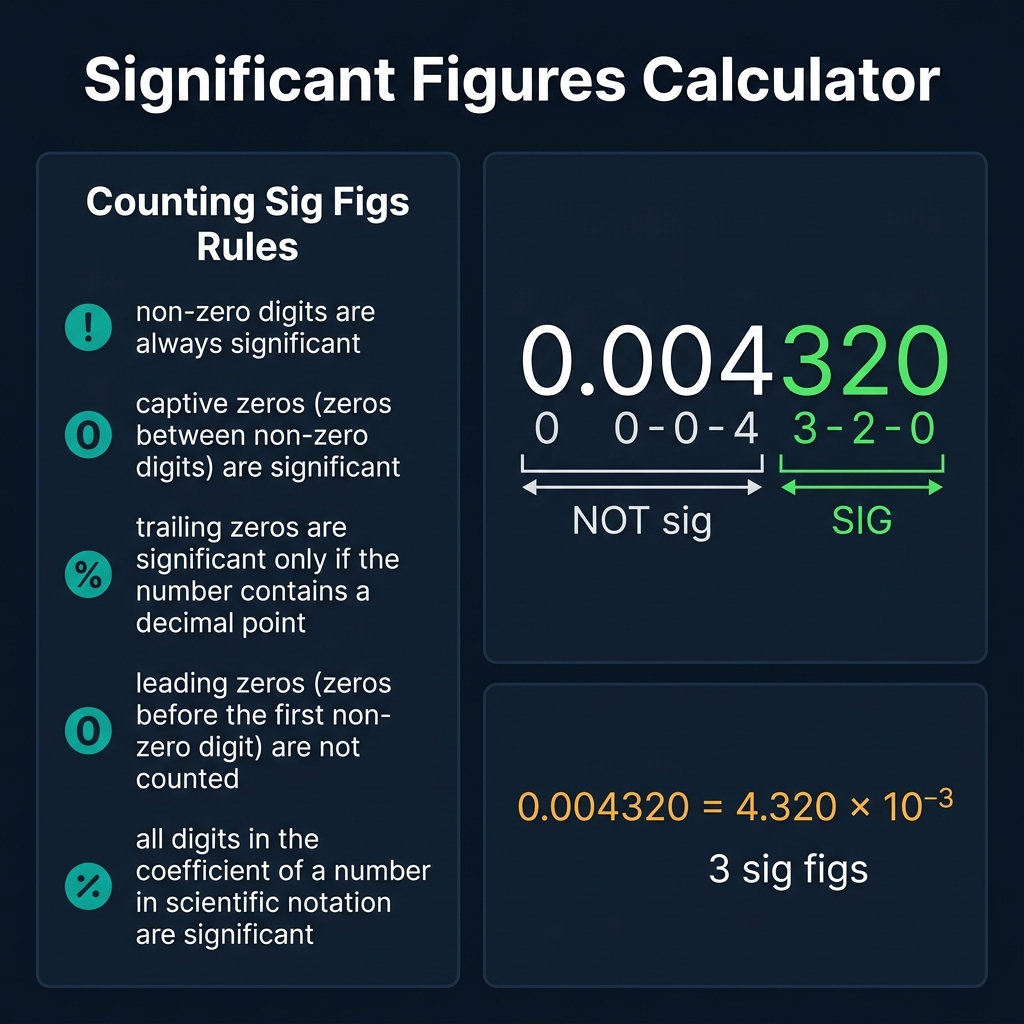
Knowing which digits count as significant is the foundation of all sig fig work. Here are the five rules applied in this calculator:
- Rule 1 — Non-zero digits are always significant. In 4,728, all four digits are significant. In 0.457, the 4, 5, and 7 are all significant (3 sig figs total).
- Rule 2 — Zeros between non-zero digits (captive zeros) are always significant. In 40,027, all five digits are significant. The zeros between 4 and 2, and between 2 and 7, are both captive. In 1.0045, the two zeros are captive, giving 6 sig figs.
- Rule 3 — Leading zeros are never significant. Leading zeros merely fix the position of the decimal point. In 0.00432, the three leading zeros (0, 0, 0) are not significant — only 4, 3, and 2 are, giving 3 sig figs. Converting to scientific notation removes leading zeros: 4.32 × 10⁻³.
- Rule 4 — Trailing zeros in a number with a decimal point are significant. In 0.004320, the trailing zero IS significant — giving 4 sig figs (4, 3, 2, 0). In 100.0, all four digits are significant. In 1.500, four sig figs. The presence of the decimal point indicates the trailing zero was deliberately recorded.
- Rule 5 — Trailing zeros in a whole number without a decimal point are ambiguous. The number 700 could have 1, 2, or 3 sig figs. To avoid ambiguity, use scientific notation: 7 × 10² (1 sig fig), 7.0 × 10² (2 sig figs), or 7.00 × 10² (3 sig figs). This calculator treats trailing zeros in integers without a decimal point as ambiguous and will prompt you to use scientific notation for precision.
Sig Fig Rules for Arithmetic
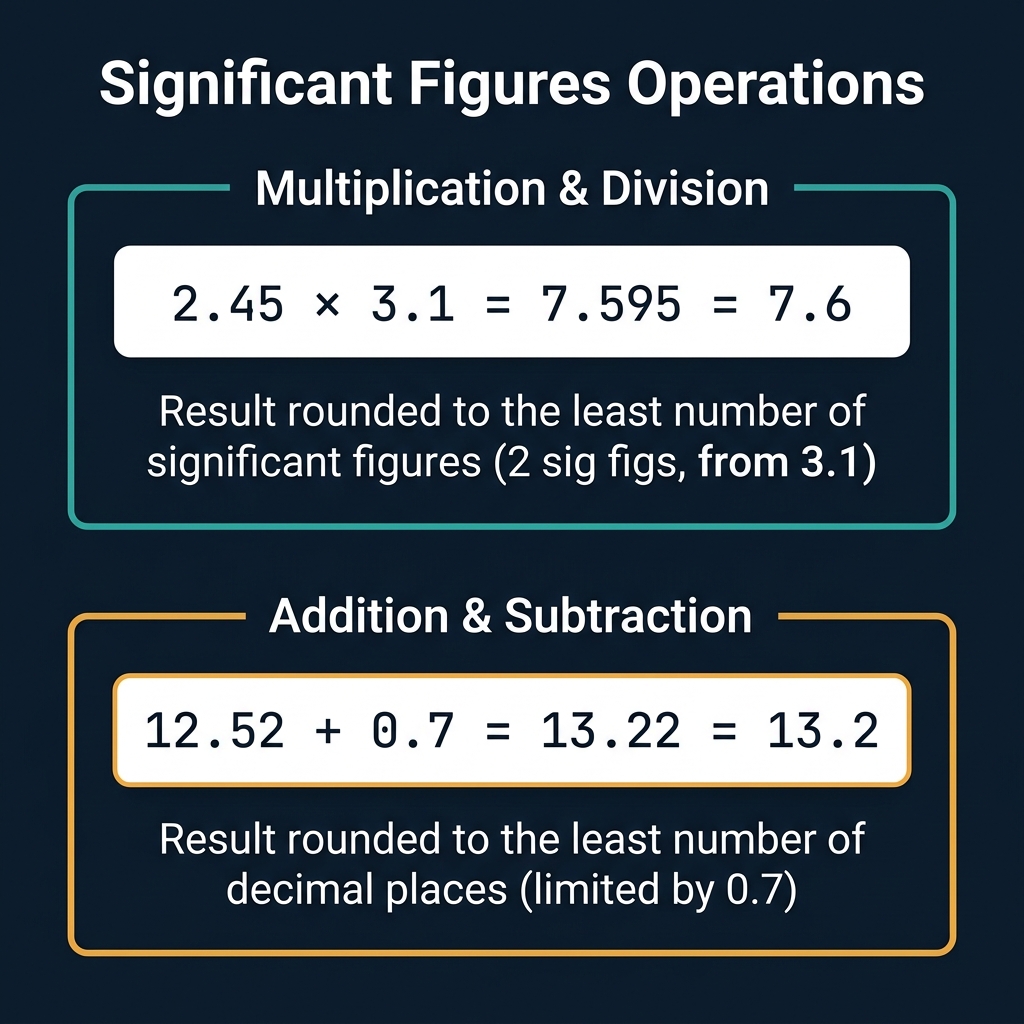
Arithmetic with significant figures uses two different rules depending on the operation:
- Multiplication and Division: The result has the same number of significant figures as the input with the fewest significant figures. Example: 2.45 × 3.1 = 7.595 → rounded to 7.6 (2 sig figs, limited by 3.1 which has only 2). Another: 486.0 ÷ 12.3 = 39.512… → 39.5 (3 sig figs, limited by 12.3).
- Addition and Subtraction: The result is rounded to the same number of decimal places as the input with the fewest decimal places. Example: 12.52 + 0.7 = 13.22 → rounded to 13.2 (1 decimal place, limited by 0.7). Another: 1,000.3 − 2.456 = 997.844 → rounded to 997.8 (1 decimal place, from 1,000.3).
A critical nuance: these are different rules. Do not apply the multiplication rule to addition/subtraction or vice versa. When combining multiple operations (e.g., (2.3 + 1.15) × 4.2), apply each rule at each step, carrying extra digits in intermediate calculations and rounding only the final answer.
Scientific Notation and Significant Figures
Scientific notation is the unambiguous way to express significant figures. The format is: coefficient × 10ⁿ, where the coefficient contains exactly the significant digits.
- 0.00432 = 4.32 × 10⁻³ → exactly 3 sig figs, no ambiguity.
- 5,600,000 could be 5.6 × 10⁶ (2), 5.60 × 10⁶ (3), or 5.600 × 10⁶ (4 sig figs). Pick the correct one for your measurement precision.
- Converting to scientific notation: Move the decimal point left until one non-zero digit is left of the decimal. Count the moves for the exponent. Moving left gives a positive exponent; moving right gives a negative one. Example: 45,200 → 4.5200 × 10⁴ (but sig figs depend on context).
This calculator automatically converts every result to scientific notation alongside the standard form so you always have both representations.
How to Round to N Significant Figures
Step-by-step procedure for rounding 0.0045678 to 3 significant figures:
- Identify the first significant figure: the digit 4 (at position 10⁻³).
- Count 3 sig figs from there: 4, 5, 6 — so you keep 4, 5, and decide based on 7.
- Look at the next digit (7): since 7 ≥ 5, round up the 6 to 7.
- Result: 0.00457 = 4.57 × 10⁻³.
Rounding rules: if the digit after the last kept digit is 5, the common convention (round half up) rounds up. In scientific contexts, "round half to even" (banker's rounding) is sometimes used to reduce bias — this calculator uses the standard round-half-up convention by default, matching most textbooks and online resources.
For very large numbers — e.g., rounding 3,456,789 to 4 sig figs: keep 3, 4, 5, 6 and look at 7 (≥ 5, round up): → 3,457,000. Note the trailing zeros are not significant here — use scientific notation (3.457 × 10⁶) to make it explicit.
Real-World Applications of Significant Figures
- Chemistry: Stoichiometry calculations require tracking the least precise measurement through every step. A balance reads to ±0.001g, so mass = 4.325g (4 sig figs). Volume from a graduated cylinder might only be ±0.1mL, limiting molarity calculations to 2 sig figs no matter how precisely mass was measured.
- Physics: Gravitational acceleration g = 9.8 m/s² (2 sig figs in standard usage) versus g = 9.80665 m/s² (6 sig figs, exact standard gravity). Using g = 9.8 limits any velocity, force, or energy answer to 2 sig figs. Use a Slope Calculator for incline problems where precision matters.
- Engineering: A dimension measured as 12.5 mm has 3 sig figs. Multiplying 12.5 mm × 8.32 mm = 104 mm² (3 sig figs). Reporting 104.0 mm² would falsely imply 4 sig figs of precision. Tolerance and precision requirements are specified in engineering drawings — always match sig figs to the specification.
- Statistics: When reporting percentages, error margins, or averages, sig figs determine how to present results. A calculated average of 14.237 from 3 measurements each ±0.1 should be reported as 14.2, not 14.237. Use our Average Calculator to compute descriptive statistics, then apply sig fig rules to the output.
- Finance: While financial amounts are typically reported in exact currency units (cents), percentage calculations like interest rates and ROI follow sig fig principles intuitively. Reporting an ROI as 23.47% from inputs with 3 sig figs would be over-precise. See our Percentage Calculator for percentage computations.
Common Significant Figure Mistakes
- Reporting all calculator digits: A calculator displays 7.328194 for 2.3 × 3.187. The answer should be 7.3 (2 sig figs from 2.3). Never report all digits — they represent false precision from the arithmetic, not real measurement precision.
- Rounding intermediate steps: Round only the final answer. Keep extra digits in intermediate calculations to avoid compounding rounding errors. Report the intermediate value with one or two guard digits beyond the final precision level.
- Applying the wrong rule: Using the "fewest sig figs" rule for addition/subtraction is incorrect. For 100 + 1.32 = 101.32, the answer is 101 (0 decimal places, from 100), not 101 (3 sig figs from 1.32). Always check which operation you are performing.
- Treating exact numbers as limited: Exactly 12 eggs (counted, not measured), a conversion factor of 1000 mL/L, or π = 3.14159... in a formula — these are exact and do not limit sig figs. Only measured values introduce sig fig constraints.
- Leading zeros in intermediates: 0.045 and .045 both have 2 sig figs, not 3. The zero before the decimal is a convention (not significant), and the zero immediately after the decimal is a leading zero (not significant either).
Related Math Calculators
- Percentage Calculator — Apply sig fig rules after computing percentage changes and ratios. The precision of the result depends on the precision of both input values.
- Average Calculator — Statistical averages should be reported to the same number of decimal places as the least precise data point. Use this tool to compute the average, then apply sig fig rounding here.
- Slope Calculator — Rise-over-run slope calculations involve division, so the result should have sig figs equal to the least precise of rise and run. Slope as a percentage grade multiplies by 100 (an exact number, no sig fig change).
- Right Triangle Calculator — All trigonometric calculations produce outputs governed by the precision of inputs. Leg lengths with 3 sig figs produce angle values accurate to 3 sig figs, regardless of the internal precision of sin/cos functions.
- Percentage Increase Calculator — Percentage changes computed from measured values inherit the sig figs of the input measurements. A stock price with 4 sig figs can yield a percentage change with 4 sig figs maximum.