Semicircle Area Calculator
Compute the area, perimeter, arc length, and all dimensions of a semicircle from any known measurement — radius, diameter, area, or perimeter — with full step-by-step derivation and live diagram.
Semicircle Area Calculator
Area · Perimeter · Arc Length · Diameter — Instant Geometry Engine
What Is a Semicircle?
A semicircle is exactly one half of a circle, formed by cutting a circle along a diameter — the straight line that passes through the center and connects two points on the circle's edge. Every semicircle has three key elements: a curved arc (half the circumference of the full circle), a flat diameter side (the chord connecting the two endpoints of the arc), and an interior area equal to exactly half the area of the full circle.
The term "semicircle" derives from Latin semi (half) and Greek kirkos (circle). In geometry, semicircles are classified as plane figures — they exist in a two-dimensional plane and are bounded by both a curved edge (the arc) and a straight edge (the diameter). The angle inscribed in a semicircle is always exactly 90° (Thales' theorem), making semicircles fundamental to geometric proofs and constructions.
Semicircles appear throughout mathematics, physics, architecture, and engineering. Understanding their area, perimeter, and arc length is essential for a wide range of practical calculations, from designing arched windows to calculating the cross-sectional area of half-pipe structures.
Area & Perimeter Formulas
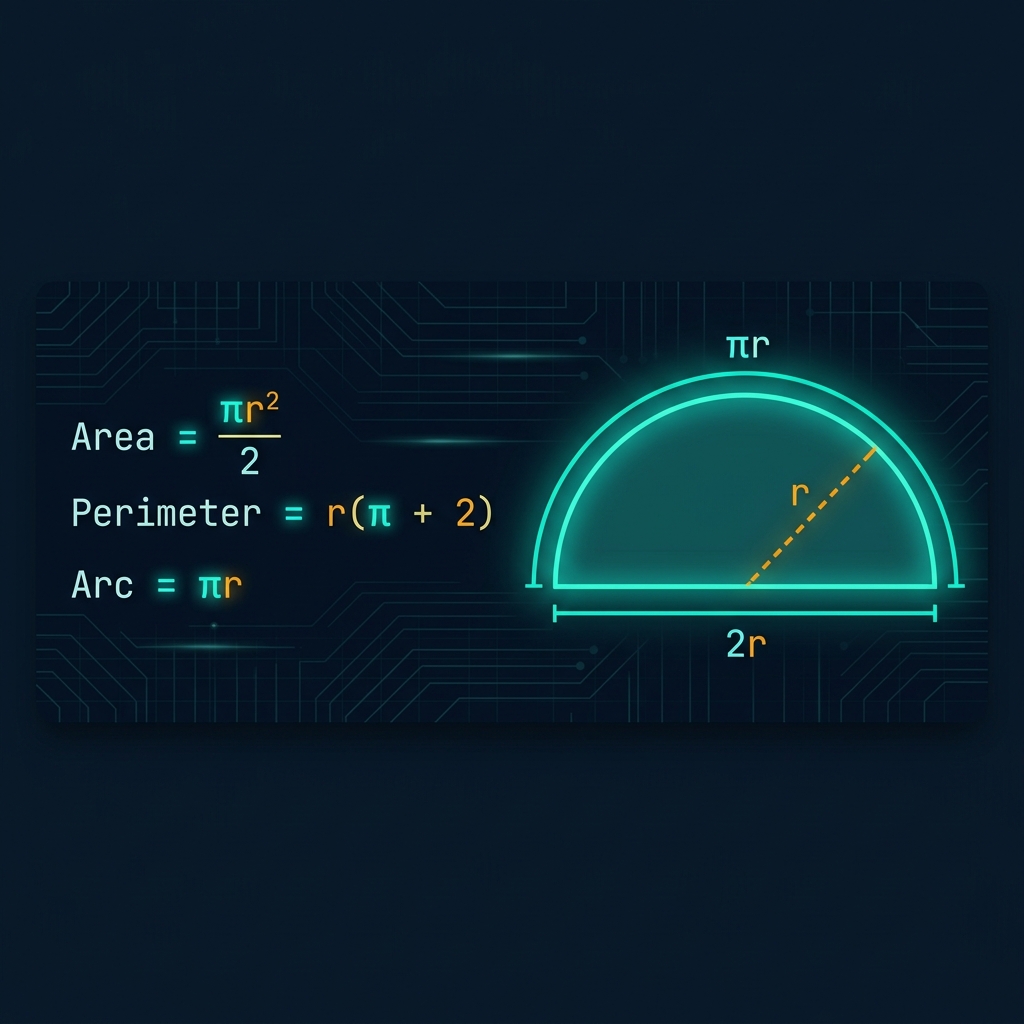
The fundamental formulas for a semicircle with radius r and diameter d = 2r are:
- Area: A = πr²/2 — exactly half the area of a full circle (πr²)
- Area from diameter: A = πd²/8 — substitute r = d/2
- Arc length: L = πr — half the circumference of the full circle (2πr)
- Perimeter: P = πr + 2r = r(π + 2) — the arc plus the diameter
- Perimeter from diameter: P = d(π/2 + 1) = d(π + 2)/2
The perimeter of a semicircle includes both the arc and the diameter. This is a common source of confusion: the arc length alone is πr, but the full perimeter (boundary) of the semicircular shape also includes the straight diameter side (2r), giving P = πr + 2r = r(π + 2) ≈ 5.14159r.
The numerical value of π (pi) used in all calculations is 3.14159265358979… — an irrational, transcendental number. Our calculator uses IEEE 754 double-precision floating-point for maximum accuracy (15+ significant figures).
How to Use This Calculator
The Semicircle Area Calculator supports four input modes, so you can compute all properties starting from any known measurement:
- Step 1 — Select input mode: Choose from Radius (r), Diameter (d), Area (A), or Perimeter (P) using the mode tabs at the top of the calculator.
- Step 2 — Enter your value: Type the numeric measurement in the input field. Supports mm, cm, m, in, ft, and yd for linear inputs; area inputs are interpreted in unit².
- Step 3 — Select unit: Use the unit dropdown to match your measurement system. The unit label in the input field updates automatically.
- Step 4 — Choose decimal places: Select 2 to 10 decimal places for output precision.
- Step 5 — Click Calculate Area: The calculator instantly computes all properties: area, perimeter, arc length, diameter, and radius. A live SVG diagram updates to reflect your input.
- Step 6 — Copy results: Click any KPI card to copy its value to clipboard instantly.
The step-by-step derivation panel shows every calculation step, including substituted values — ideal for homework, engineering verification, or understanding the math.
All Four Input Modes
Each mode solves for all semicircle properties starting from one known value:
- From Radius (r): The primary mode. Direct formula application: A = πr²/2, L = πr, P = r(π+2), d = 2r. All other properties follow immediately.
- From Diameter (d): First computes r = d/2, then applies all formulas. Useful when the span width (diameter) is known — common in architecture and engineering.
- From Area (A): Reverses A = πr²/2 to get r = √(2A/π). Then derives all other properties. Useful when a required floor area or cross-section area is specified.
- From Perimeter (P): Reverses P = r(π+2) to get r = P/(π+2). Then derives all other properties. Useful when the boundary length (fencing, edging) is the known constraint.
Mathematical Derivation
All semicircle formulas derive directly from full circle geometry. A circle with radius r has:
- Full circle area: A_circle = πr²
- Full circumference: C = 2πr
Cutting along the diameter gives a semicircle where:
- Area = A_circle / 2 = πr² / 2 (exactly half — the diameter cut divides the circle into two equal halves)
- Arc length = C / 2 = 2πr / 2 = πr (exactly half the circumference)
- Perimeter = arc + diameter = πr + 2r = r(π + 2) (the full boundary includes the straight edge)
The inverse formulas (solving for r from A or P) use basic algebra:
- From area: A = πr²/2 → 2A = πr² → r² = 2A/π → r = √(2A/π)
- From perimeter: P = r(π+2) → r = P/(π+2)
The centroid (center of mass) of a semicircle is located at height 4r/(3π) ≈ 0.4244r above the diameter. This is important for structural analysis and moment of inertia calculations.
Key Properties of Semicircles
- Thales' theorem: Any angle inscribed in a semicircle (with the diameter as one side) is exactly 90°. This is one of the oldest geometric theorems, attributed to Thales of Miletus (~600 BCE).
- Area ratio: The semicircle's area is exactly 1/2 the full circle area, regardless of size. This ratio is constant — a fundamental property of symmetry.
- Arc/perimeter ratio: The curved arc is πr out of total perimeter r(π+2). The arc fraction = π/(π+2) ≈ 0.6109 (about 61.1% of total boundary is curved).
- Diameter is the longest chord: The diameter (2r) is the longest possible chord of the semicircle — no straight line segment within the shape can be longer.
- Moment of inertia: For structural calculations, the second moment of area of a semicircle about its diameter axis is πr⁴/8 and about an axis through the centroid it is (π/8 − 8/(9π))r⁴.
- Sector relationship: A semicircle is a special case of a circular sector with central angle 180° (π radians). The sector area formula A = (θ/2)r² = (π/2)r² = πr²/2 confirms the semicircle area.
Worked Examples
- Arched window (r = 0.6 m): Area = π × 0.6² / 2 = π × 0.36 / 2 ≈ 0.5655 m². Arc length = π × 0.6 ≈ 1.885 m. Perimeter = 0.6 × (π + 2) ≈ 3.085 m (total framing material needed).
- Half-pipe cross section (d = 10 ft): r = 5 ft. Area = π × 25 / 2 ≈ 39.27 ft². This is the cross-sectional flow area of a half-pipe drain or skateboard ramp.
- From area (A = 50 cm²): r = √(2 × 50 / π) = √(100/π) = √(31.831) ≈ 5.642 cm. Diameter ≈ 11.284 cm. Perimeter = 5.642 × (π + 2) ≈ 28.93 cm.
- Irrigation channel (P = 12 m): r = 12 / (π + 2) = 12 / 5.14159 ≈ 2.334 m. Area = π × 2.334² / 2 ≈ 8.551 m². A semicircular channel cross-section maximizes flow area per unit of perimeter.
- Pizza slice (r = 30 cm): A full semicircle pizza (half a 60 cm diameter pie): Area = π × 900 / 2 ≈ 1414.7 cm². Arc (crust) ≈ 94.25 cm. Total crust + diameter ≈ 154.25 cm.
Real-World Applications
Semicircles appear in an extraordinary range of practical contexts:
- Architecture and construction: Arched doorways, Romanesque and Gothic windows, tunnel cross-sections, and stadium bowl designs use semicircular geometry. The Roman arch (semicircular) was the dominant structural form for 1,500 years. Calculating the area helps estimate materials, and the arc length determines trim and framing quantities.
- Hydraulic engineering: Semicircular channel cross-sections are the most hydraulically efficient shape for open channels — they maximize the flow area for a given perimeter (wetted perimeter), minimizing frictional resistance. Civil engineers use A = πr²/2 and P = r(π+2) when designing irrigation canals, sewer pipes, and storm drains.
- Landscaping and garden design: Semicircular garden beds, patios, and driveways are calculated using the area formula. A semicircular flower bed with r = 2 m has area = 2π ≈ 6.28 m², which determines soil, mulch, and planting quantities. The perimeter determines edging material length.
- Athletics and sports: The D area on a soccer/football pitch (penalty arc) is a semicircle of radius 9.15 m (10 yards) from the penalty spot. The semicircular center circle in basketball and the half-circle in tennis are other examples where area and perimeter calculations are needed for court construction and line painting.
- Manufacturing and CNC machining: Semicircular cutouts, slots, and profiles are common in sheet metal parts, gaskets, and brackets. The area determines material removal, and the arc length determines cutting path length (and thus machining time and cost).
- Physics and optics: Semicircular prisms and D-shaped optical elements use Thales' theorem — any ray entering perpendicular to the flat face hits the curved surface at exactly the critical angle for total internal reflection. Semicircular tanks are used in optics experiments to study refraction.
- Graphic design and typography: Semicircles are fundamental shapes in logo design, icon design, and font geometry. Calculating semicircle area is important for accurate SVG path generation and proportional design layout in digital art.
Related Calculators
- Area of a Circle Calculator — The semicircle area is exactly half the full circle area (πr²). Use this calculator for complete circle calculations including circumference, diameter, and sector areas.
- Circumference Calculator — The arc length of a semicircle (πr) is exactly half the circumference of the full circle (2πr). Use for any circle circumference and related calculations.
- Sector Area Calculator — A semicircle is a special 180° sector. For other sector angles, use this calculator. Formula: A = (θ/2)r² where θ is in radians.
- Arc Length Calculator — The semicircle arc (πr) is a special case. For arc length at any angle, use this calculator. Formula: L = rθ where θ is in radians.
- Triangle Area Calculator — When a right triangle is inscribed in a semicircle (Thales' theorem), its hypotenuse equals the diameter. Combine with semicircle calculations for composite shape areas.
- Pythagorean Theorem Calculator — By Thales' theorem, every triangle inscribed in a semicircle is a right triangle. The Pythagorean theorem (a² + b² = c²) with c = diameter connects all three sides.
Frequently Asked Questions about Semicircle Area Calculator
What is the formula for the area of a semicircle?
The area of a semicircle with radius r is A = πr²/2. This is exactly half the area of a full circle (πr²). If you know the diameter d instead, use A = πd²/8 (substitute r = d/2). Example: r = 5 cm → A = π × 25 / 2 ≈ 39.27 cm².
How do I calculate the perimeter of a semicircle?
The perimeter of a semicircle is P = πr + 2r = r(π + 2) ≈ 5.14159r. This includes BOTH the curved arc (πr) AND the straight diameter side (2r). A common mistake is counting only the arc. Example: r = 4 m → P = 4 × (3.14159 + 2) = 4 × 5.14159 ≈ 20.57 m.
What is the arc length of a semicircle?
The arc length (curved portion only, not including the diameter) is L = πr ≈ 3.14159r. This is exactly half the full circle circumference (2πr). Example: r = 7 cm → L = π × 7 ≈ 21.99 cm. Note: the arc length is different from the perimeter — the perimeter also adds the diameter (2r).
How do I find the radius of a semicircle from its area?
Rearrange A = πr²/2 to solve for r: r = √(2A/π). Example: A = 50 cm² → r = √(2 × 50 / π) = √(100/π) = √(31.831) ≈ 5.642 cm. From the perimeter: r = P/(π+2). Example: P = 20 m → r = 20 / (π+2) = 20 / 5.14159 ≈ 3.888 m.
Where is the centroid (center of mass) of a semicircle?
The centroid of a semicircle is located at a height of 4r/(3π) ≈ 0.4244r above the diameter (the flat base). This is the balance point of the shape. For r = 10 cm, the centroid is 4 × 10 / (3π) ≈ 4.244 cm from the diameter. The centroid is important for calculating moments of inertia in structural engineering.
What is Thales' theorem and how does it relate to semicircles?
Thales’ theorem states that any angle inscribed in a semicircle (where the two sides of the angle meet the two endpoints of the diameter) is exactly 90°. In other words, if you draw any triangle with its hypotenuse as the diameter of a semicircle, the angle at the opposite vertex (on the arc) is always a right angle. This is one of the oldest theorems in Greek geometry and is widely used in geometric proofs, optics (semicircular prisms), and circle constructions.