How this investment calculator supports your financial planning
If you are sizing a long-term portfolio or a recurring savings plan, you need more than a single “future value” figure. This investment calculator lets you stress compound interest, interpret return on investment (ROI) against what you actually deposited, and layer scenario comparison on top of a disciplined monthly contribution assumption. The workspace below adds KPI tiles, four analytic charts, and a line-by-line amortization schedule so you can reconcile each period in your own language and currency context. For debt-side planning in the same locale, pair projections with a loan calculator or mortgage calculator so cash-flow assumptions stay consistent. Illustrative figures round to the nearest dollar for clarity; always cross-check against the live calculator output before relying on any number in a memo or client deck.
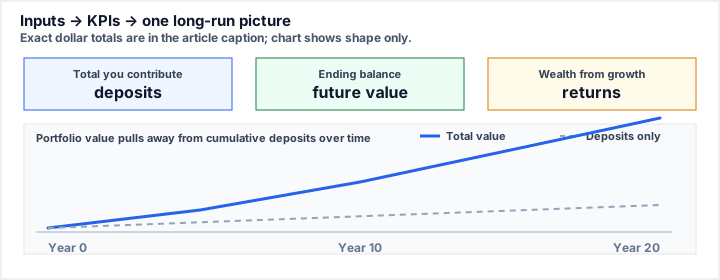
What this shows: the tool surfaces how much you put in, where you land, and how much of the ending balance came from growth, then plots the classic “two lines diverge” curve (total value vs deposits only).
Assumptions (USD-style example): $20,000 starting balance, $500 per month, 7.00% nominal APR, monthly compounding, 20-year horizon.
Representative outputs: ending balance ≈ $312,480; cumulative deposits $140,000; growth from returns ≈ $172,480 — match these in the live calculator before citing them.
Compound growth, nominal rates, and compounding frequency
The engine uses your nominal annual rate and compounding frequency to grow the balance each period, then applies your recurring deposit in line with the same schedule used in typical DCA (dollar-cost averaging) models for retirement and brokerage accounts.
Nominal vs. real: the quoted APR is nominal unless you explicitly model inflation elsewhere. When you compare products, also look at the effective annual rate (EAR) implied by compounding cadence—two accounts advertising the same headline rate can differ slightly once interest credits more often than once per year.
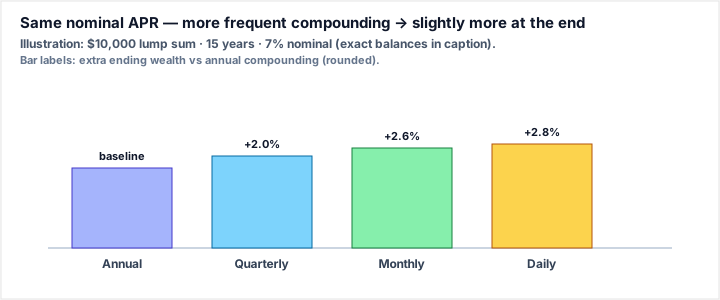
What this shows: with the same nominal rate and horizon, crediting interest more often slightly raises the ending balance. Labels on the bars are approximate % uplift vs annual compounding (not the APR itself).
Assumptions: $10,000 lump sum, no further contributions, 15 years, 7.00% nominal APR held constant across frequencies.
Ending balances (illustrative): annual $27,590 · quarterly $28,138 · monthly $28,309 · daily $28,359. Monthly beats annual by about $719 here — your live run may differ slightly after rounding.
Why compounding frequency still matters
For the same quoted APR, more frequent compounding increases the effective yield. Use the controls above to match your fund factsheet or bank disclosure before relying on any projection.
- Match frequency to the product disclosure (daily sweep vs monthly credit).
- Keep contributions consistent with how you actually invest (monthly payroll, etc.).
KPI dashboard and four analytic charts
The KPI dashboard summarizes ending balance, cumulative deposits, ROI on contributions, a simplified annualized figure, and how much of the final value came from interest. The growth vs contributions chart shows the widening gap over time; composition splits deposits and accumulated returns; monthly interest highlights early acceleration; scenario comparison overlays conservative, aggressive, and higher-savings tracks.
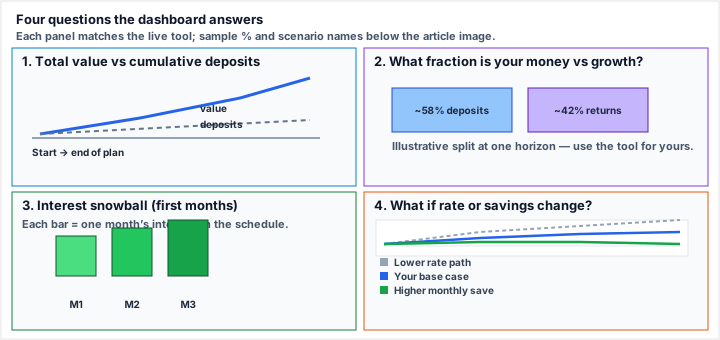
What this shows: (1) gap between account value and what you contributed, (2) how much of the ending balance is principal vs accumulated return, (3) that monthly interest tends to climb early in the plan, (4) side-by-side stress tests (lower rate, base, higher savings).
Sample numbers (one USD-style run): long-run balance ≈ $485k on the growth view; composition ≈ 58% deposits / 42% returns; month-12 interest ≈ $1,842 in the early-month bar strip.
Scenario endpoints (illustrative): base ≈ $312k; +1% rate path ≈ $348k; −$100/month path ≈ $268k — always read the scenario table in the widget for your inputs.
Amortization schedule and cash-flow transparency
Switch between monthly rows (opening balance, deposit, interest, closing balance) and a yearly summary to validate numbers the same way you would read a schedule—here tuned for wealth accumulation. Pair that review with future value and finance calculators in this locale for a fuller picture.
- Audit trail: export mentally to a spreadsheet by copying a few periods and reconciling interest factors against your fund’s disclosure.
- Limits of the model: constant rate and fixed contributions ignore sequence-of-returns risk, taxes, and fees—use the output as a baseline, not a forecast of realized wealth.
Related calculators and internal resources
Use crawlable anchors in this locale to connect this investment calculator to the rest of the site — including tools that complement growth modeling:
- Percentage calculator — quick checks on rates, discounts, and allocation splits before you lock inputs here.
- Profit calculator — contrast business margins with long-term portfolio projections.
- Loan calculator and mortgage calculator — balance investable cash flow with repayment schedules.
- Finance calculators category — browse ROI, savings, and related utilities as they ship.
- HTML sitemap — structured index for users and crawlers.
- Site search — find scientific, health, or unit tools in this language.
- Trust Tool home — return to the hub without losing your locale prefix.
- FAQ (below) — compound interest, ROI vs yield, scenarios, and disclaimers, with FAQ structured data for search.
Disclaimer: Outputs are educational projections only. Taxes, fund fees, inflation, and market volatility are not modeled exhaustively. Speak with a licensed advisor before acting on any result.