Antilog Calculator
Free Antilog Calculator: compute antilogarithm for base 10 (10^x), natural antilog (e^x), binary antilog (2^x), any custom base, and the classic log-table...
F�rmula utilizada
What Is Antilogarithm? Definition and Formula
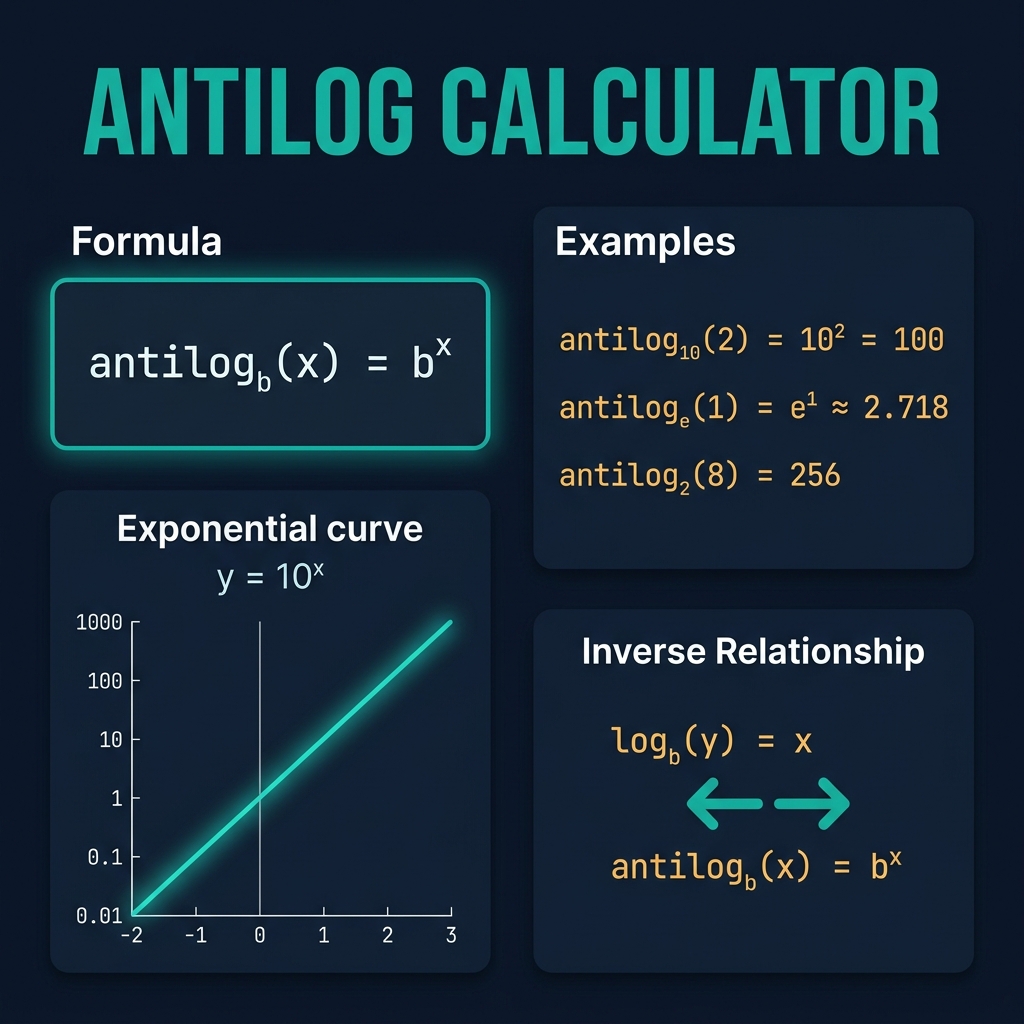
The antilogarithm (antilog) is the inverse operation of the logarithm. If the logarithm tells you "to what power must I raise the base to get this number?", the antilogarithm answers "given this power, what number do I get?" Mathematically:
- If logb(N) = x, then antilogb(x) = bx = N
- The antilog simply undoes the logarithm, exactly as multiplication undoes division
The general antilog formula is: antilogb(x) = bx, where b is the base (b > 0, b ≠ 1) and x is the logarithm value (any real number). This is identical to the exponential function with base b.
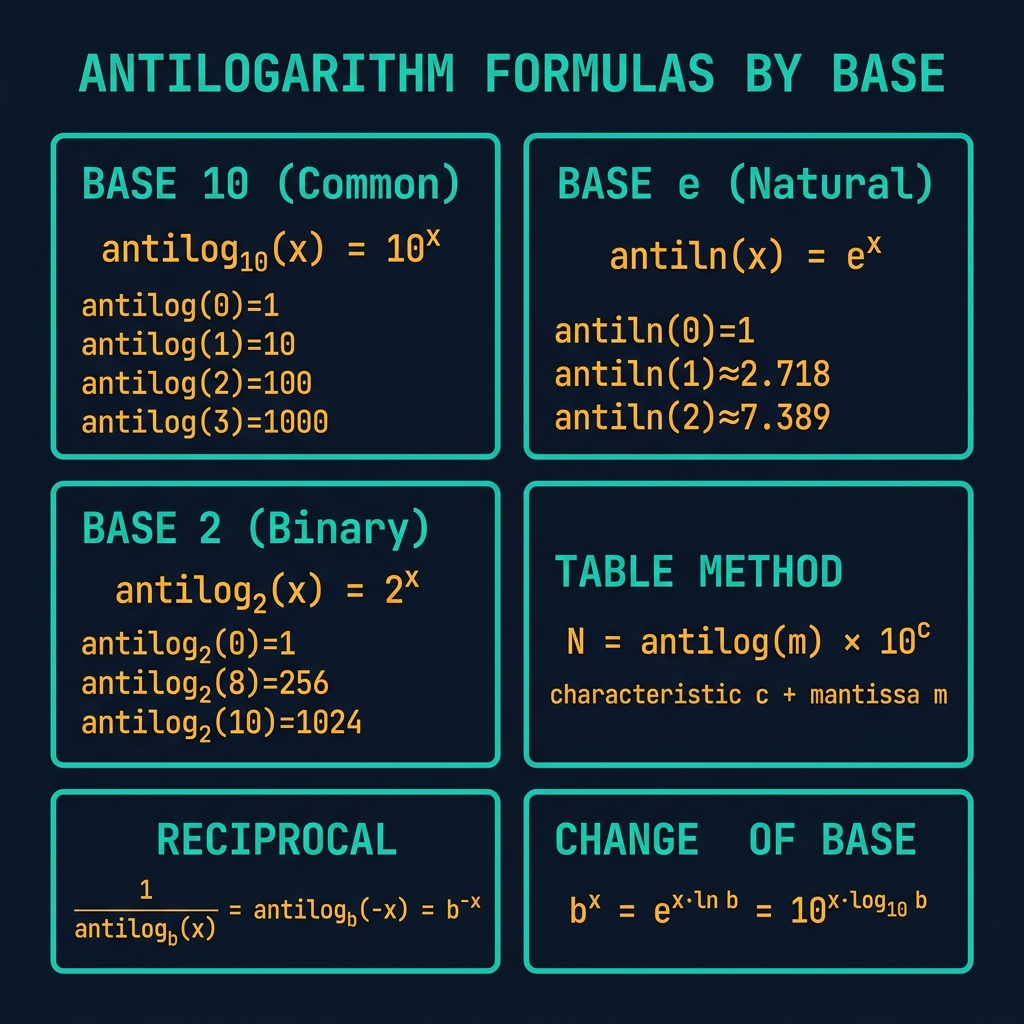
- Common antilog (base 10): antilog10(x) = 10x. This is the most widely used form in science, engineering, and traditional logarithm tables.
- Natural antilog (base e): antiln(x) = ex ≈ 2.71828x. Used extensively in calculus, physics, probability, and finance.
- Binary antilog (base 2): antilog2(x) = 2x. Fundamental in computer science, information theory, and digital signal processing.
- Custom base: antilogb(x) = bx for any valid base b.
Common Antilog (Base 10): antilog(x) = 10x
The base-10 antilogarithm is the most commonly encountered form in everyday mathematics and science. It is simply 10 raised to the power x:
- antilog(0) = 100 = 1
- antilog(1) = 101 = 10
- antilog(2) = 102 = 100
- antilog(3) = 103 = 1,000
- antilog(0.5) = 100.5 = √10 ≈ 3.16227766
- antilog(−1) = 10−1 = 0.1
- antilog(−2.5) = 10−2.5 ≈ 0.003162
Notice the pattern: each unit increase in x multiplies the antilog by 10. This is why logarithmic scales (like the Richter scale, decibel scale, and pH scale) are so useful — they compress enormous ranges into manageable numbers. An earthquake of magnitude 7 releases 10 times more energy than one of magnitude 6, because antilog(7) / antilog(6) = 107/106 = 10.
To use our Exponent Calculator for antilog verification: enter base = 10 and exponent = x to cross-check any antilog(x) result.
Natural Antilog: antiln(x) = ex
The natural antilogarithm is the exponential function ex, where e ≈ 2.71828182845904523536… is Euler's number — one of the most important constants in mathematics. This is the inverse of the natural logarithm (ln):
- antiln(0) = e0 = 1
- antiln(1) = e1 = e ≈ 2.71828
- antiln(2) = e2 ≈ 7.38906
- antiln(−1) = e−1 ≈ 0.36788
- antiln(0.5) = e0.5 = √e ≈ 1.64872
The natural antilog appears constantly in real-world applications: continuous compound interest uses A = P·ert; radioactive decay follows N(t) = N₀·e−λt; population growth is modeled by P(t) = P₀·ekt; and the normal distribution in statistics contains e−x²/2 in its formula.
A key identity connects the natural antilog to the common antilog: 10x = ex·ln(10) = ex × 2.302585…. This change-of-base formula allows conversion between any two bases.
Binary Antilog: antilog2(x) = 2x
The base-2 antilogarithm is the foundation of binary arithmetic and information theory. Shannon's information entropy is measured in bits precisely because log₂ is its natural unit, making 2x the corresponding antilog:
- antilog2(0) = 20 = 1 bit → 1 possibility
- antilog2(1) = 21 = 2 → binary digit (0 or 1)
- antilog2(8) = 28 = 256 → 256 possible byte values
- antilog2(10) = 210 = 1,024 → 1 kibibyte (KiB)
- antilog2(20) = 220 = 1,048,576 → 1 mebibyte (MiB)
- antilog2(−1) = 2−1 = 0.5
Computer memory sizes are all powers of 2: 4 GB = 232 bytes, 16 GB = 234 bytes. A hash table with 2k buckets is indexed by the k least significant bits. The number of possible IP addresses in IPv4 is 232 = 4,294,967,296.
Antilog Tables: Characteristic + Mantissa Method
Before electronic calculators, scientists and engineers used printed antilog tables to work with large numbers efficiently. Every common logarithm (base 10) can be split into two parts:
- Characteristic: The integer part of log₁₀(N). For N ≥ 1: characteristic = ⌊log₁₀(N)⌋ ≥ 0. For 0 < N < 1: characteristic is negative.
- Mantissa: The non-negative decimal part, always in the range [0, 1). The mantissa is always ≥ 0 regardless of whether the characteristic is positive or negative.
Example 1: log₁₀(356) = 2.5514. Characteristic = 2, mantissa = 0.5514. Antilog table gives antilog(0.5514) ≈ 3.560. Result: N = 3.560 × 10² = 356.0 ✓
Example 2: log₁₀(0.00356) = −2.4486. In bar notation: 3̄.5514 (meaning characteristic = −3, mantissa = +0.5514). Antilog table gives antilog(0.5514) ≈ 3.560. Result: N = 3.560 × 10−3 = 0.003560 ✓
This splitting is powerful because the mantissa determines the significant figures of the result (via the antilog table), while the characteristic sets the order of magnitude (the position of the decimal point). For significant-figure precision, see our Significant Figures Calculator.
The antilog table method formula: N = antilog10(mantissa) × 10characteristic
- This is equivalent to N = 10characteristic + mantissa = 10log₁₀(N) = N (identity check)
- The table lookup gives antilog(mantissa) for mantissa ∈ [0.0000, 0.9999]
- Our calculator automates this: enter characteristic and mantissa separately for instant results
Scientific Notation and Antilog
The base-10 antilog is directly tied to scientific notation. Any number N in scientific notation is written as N = m × 10k where 1 ≤ m < 10 and k is an integer. This means:
- log₁₀(N) = log₁₀(m) + k, where 0 ≤ log₁₀(m) < 1 (the mantissa) and k is the characteristic
- antilog(k + log₁₀(m)) = m × 10k = N (recovering the original number)
Examples of antilog in scientific notation:
- antilog(6.3010) = 106.3010 = 2.000 × 106 = 2,000,000 (log₁₀(2,000,000) = 6.3010 ✓)
- antilog(−4.2218) = 10−4.2218 ≈ 6.0 × 10−5 = 0.000060
- antilog(23.456) = 1023.456 ≈ 2.859 × 10²³ (a number on the order of Avogadro's number)
Our calculator automatically displays results in both standard and scientific notation, making it easy to handle numbers spanning many orders of magnitude.
Antilog vs Logarithm: Inverse Relationship
The log and antilog are inverse functions. This means they cancel each other out:
- antilogb(logb(N)) = N for all N > 0
- logb(antilogb(x)) = x for all real x
- Graphically: the antilog curve (exponential) is the reflection of the log curve across the line y = x
Key comparison table:
- log10(100) = 2 ↔ antilog10(2) = 100
- ln(e²) = 2 ↔ antiln(2) = e² ≈ 7.389
- log2(1024) = 10 ↔ antilog2(10) = 1024
This inverse relationship explains why antilog is essential for solving exponential equations: to solve 10x = 500, take log₁₀ of both sides: x = log₁₀(500) ≈ 2.699. To verify: antilog(2.699) = 102.699 ≈ 500 ✓. Our Factor Calculator can help explore the prime structure of integer antilog results like 100 = 2² × 5² or 1000 = 2³ × 5³.
Real-World Applications of Antilogarithm
- pH and Chemistry: pH = −log₁₀[H⁺], so the hydrogen ion concentration is [H⁺] = antilog(−pH) = 10−pH. A neutral solution has pH = 7, so [H⁺] = 10−7 mol/L. An acid with pH = 3 has [H⁺] = 10−3 = 1,000 times more concentrated than neutral water.
- Decibels (dB): Sound intensity in dB is L = 10·log₁₀(I/I₀). Inverting: I = I₀ × antilog(L/10) = I₀ × 10L/10. A 30 dB sound is 103 = 1,000 times more intense than 0 dB (the threshold of hearing).
- Richter Scale (Seismology): The magnitude M = log₁₀(A/A₀). Amplitude A = A₀ × 10M. An earthquake of magnitude 8.0 has seismic amplitude antilog(8) = 108 = 100,000,000 times the reference amplitude.
- Compound Interest: With continuous compounding, A = P·ert. At r = 5% = 0.05 for t = 10 years: A = P·antiln(0.5) = P·e0.5 ≈ 1.6487P. Your money grows by 64.87% over 10 years.
- Star Magnitude (Astronomy): Two stars differ by n magnitudes → brightness ratio = antilog(n × 0.4) = 100.4n. A 5-magnitude difference corresponds to a ratio of 102 = 100 (the Pogson scale).
- Entropy and Information Theory: Shannon entropy H = −Σ pᵢ·log₂(pᵢ) measures information in bits. To find the number of equally likely outcomes: n = antilog₂(H) = 2H. A coin flip has H = 1 bit → 21 = 2 outcomes.
Key Antilog Properties and Identities
- Antilog of 0: b0 = 1 for any base b. So antilogb(0) = 1 always.
- Antilog of 1: b1 = b. So antilogb(1) = b (equals the base).
- Product rule: antilogb(x + y) = bx+y = bx × by = antilogb(x) × antilogb(y)
- Quotient rule: antilogb(x − y) = antilogb(x) / antilogb(y)
- Power rule: antilogb(n·x) = [antilogb(x)]n
- Reciprocal rule: antilogb(−x) = 1 / antilogb(x) = b−x
- Change of base: antilogb(x) = bx = ex·ln(b) = 10x·log₁₀(b)
- Antilog of a sum is a product: antilog(2.301) = antilog(2) × antilog(0.301) = 100 × 2 = 200 (since log₁₀(2) ≈ 0.301 ✓)
These properties are why logarithms were historically so useful for computation — multiplication and division of large numbers became addition and subtraction of their logarithms, with the antilog table used to recover the final answer. The Pythagorean Theorem Calculator uses related exponential operations (squaring and square roots) when computing with very large triangle sides.
Related Calculators
- Exponent Calculator — The antilog bx is fundamentally an exponentiation operation. Our Exponent Calculator computes bx directly with support for fractional, negative, and very large exponents. Use it to verify any antilog result or to explore the laws of exponents that govern antilog properties (bx·by = bx+y, (bx)y = bxy). The connection is exact: antilogb(x) ≡ bx.
- Significant Figures Calculator — When working with antilog results in scientific and engineering contexts, proper significant figure handling is essential. The mantissa of a common logarithm has as many significant figures as the original number. For example, log₁₀(3.56) = 0.5514 (4 sig figs), so antilog(0.5514) = 3.560 should be expressed to 4 significant figures.
- Factor Calculator — Integer antilog results (such as antilog₁₀(2) = 100, antilog₂(8) = 256) have rich factorization structure. The number 256 = 28 has τ(256) = 9 divisors and is a perfect power. The Factor Calculator reveals these properties instantly for any antilog integer result.
- Pythagorean Theorem Calculator — The Pythagorean theorem a² + b² = c² involves squaring (base-2 exponentiation), directly related to antilog₂(x) = 2x. Pythagorean triples like (3, 4, 5) and (5, 12, 13) appear naturally when antilog values produce perfect squares. The connection to number theory runs deep: every primitive Pythagorean triple involves numbers whose factorizations reveal their square-free structure.
- Triangle Area Calculator — Heron's formula A = √[s(s−a)(s−b)(s−c)] involves square roots, which connect to antilog10(0.5) = √10 and more generally antilogb(1/2) = √b. When computing areas of triangles with irrational side lengths — such as those derived from antilog values — Heron's formula and antilog calculations work hand in hand.