Calorie Deficit Calculator
Calculate your exact daily calorie deficit to reach your goal weight by a target date. Get TDEE, required deficit, daily calorie target, weekly milestones,...
Formule utilis�e
How to Use the Calorie Deficit Calculator
This calculator works in Goal Mode: you enter your current weight, goal weight, and timeline — and it computes the precise daily calorie deficit and intake target required to reach your goal on schedule. Before using this tool, it helps to first understand your maintenance calories by running our Maintenance Calorie Calculator — because your calorie deficit is always calculated relative to your TDEE.
Step-by-Step Guide
- Select sex and unit system — Biological sex affects BMR constants. Choose Imperial (lbs, ft/in) or Metric (kg, cm).
- Enter your age — Age directly affects BMR. Metabolism slows approximately 1–3% per decade after age 30.
- Enter current weight — Use your morning weight (after waking, before eating). This is your most consistent body weight measurement.
- Enter goal weight — Your target body weight. The calculator determines total fat loss required from the difference between current and goal weight.
- Enter your height — Required for BMR calculation. Accurate height prevents systematic errors of 50–100 kcal/day in your TDEE estimate.
- Select activity level — Choose honestly. Most people overestimate activity by one tier. When in doubt, select one level lower and adjust based on real weight trends.
- Set your timeline — Enter the number of weeks you want to reach your goal. The calculator automatically checks whether the required deficit is safe.
- Click Calculate — Your TDEE, daily deficit, calorie target, safety rating, weekly milestones, and macronutrient targets appear instantly.
The Science of Calorie Deficits and Fat Loss
The fundamental law of energy balance states: when you consistently consume fewer calories than your body expends, it draws on stored energy — primarily body fat — to make up the difference. The same BMR equations that power our Harris-Benedict Calculator underpin this tool's TDEE calculation, ensuring your deficit is computed from an accurate metabolic baseline.
The 3,500 Calorie Rule (and Its Limitations)
The classic formula states that 1 pound (0.45 kg) of body fat contains approximately 3,500 kcal of stored energy. Therefore, a 500 kcal/day deficit creates a 3,500 kcal weekly deficit — theoretically yielding 1 lb of fat loss per week. In metric terms, 1 kg of body fat ≈ 7,700 kcal, so a 550 kcal/day deficit yields approximately 1 kg of fat loss per week.
This calculator uses the metric-equivalent constant (7,700 kcal/kg) for all internal calculations, converting inputs and outputs as needed. The rule is accurate over short-to-medium timescales but has two important limitations:
- Adaptive thermogenesis: The body reduces TDEE by 100–300 kcal/day beyond what weight loss alone would predict during prolonged restriction, causing results to slow as the deficit is maintained.
- Composition of weight lost: In early stages, a significant portion of weight loss is water and glycogen — not fat. Over 3–4 weeks, the ratio shifts toward true fat loss.
Faster is Not Always Better
Research consistently shows that aggressive deficits above 750–1,000 kcal/day cause disproportionate lean muscle loss — even with adequate protein intake. This is counterproductive for long-term body composition because lean muscle raises resting metabolism, improves insulin sensitivity, and produces a more favorable body shape. The ideal rate of loss preserves muscle while shedding fat.
Safe vs. Aggressive Deficits: What the Research Says
Monitoring your health metrics alongside your weight loss journey — including your BMI as it changes — provides critical insight into whether your deficit is producing healthy results or putting you into an overly restrictive territory.
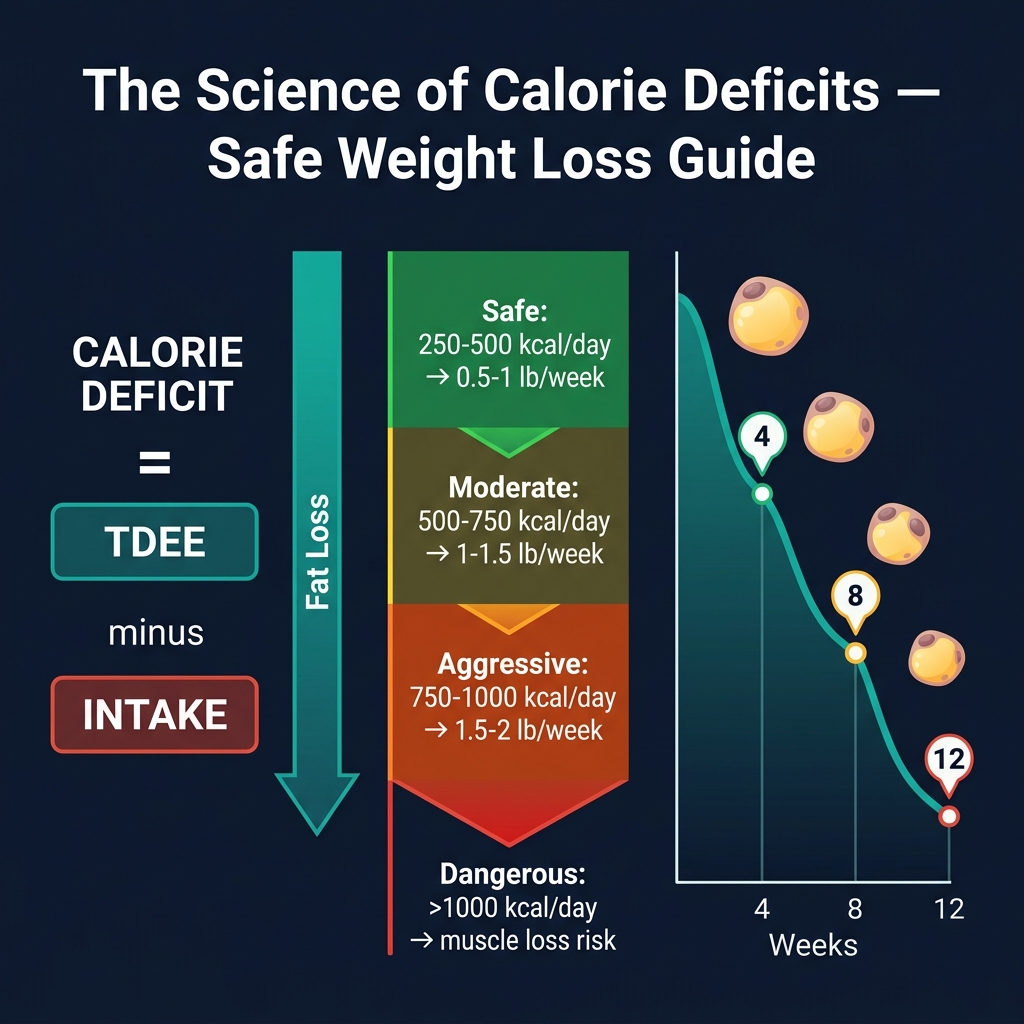
- Conservative (250 kcal/day deficit): Approximately 0.25 kg (0.5 lb) per week loss. Optimal for those close to goal weight, those with low body fat, or anyone who wants to preserve the maximum amount of muscle. Highly sustainable; rarely causes hunger or fatigue.
- Moderate (500 kcal/day deficit): Approximately 0.5 kg (1 lb) per week. The most widely recommended rate for fat loss. Supported by decades of clinical literature as an effective, sustainable approach that preserves lean mass when protein intake is adequate.
- Aggressive (750–1,000 kcal/day deficit): 0.75–1 kg (1.5–2 lbs) per week. Appropriate only for individuals with significant excess body fat under professional guidance. Increases risk of micronutrient deficiencies and muscle loss. Should not continue more than 8–12 weeks without diet breaks.
- Extreme (>1,000 kcal/day deficit): Not recommended for most people. Below 1,200 kcal/day for women and 1,500 kcal/day for men, nutrient adequacy becomes extremely difficult to maintain and metabolic adaptation intensifies. Seek medical supervision.
Minimum Safe Calorie Floors
Regardless of calculated deficit, intake should not fall below:
- Women: 1,200 kcal/day minimum (1,400–1,500 recommended for most)
- Men: 1,500 kcal/day minimum (1,600–1,800 recommended for most)
If your calculated daily target falls below these thresholds, lengthen your timeline — not shrink your intake further.
Why You Will Hit Plateaus and How to Break Them
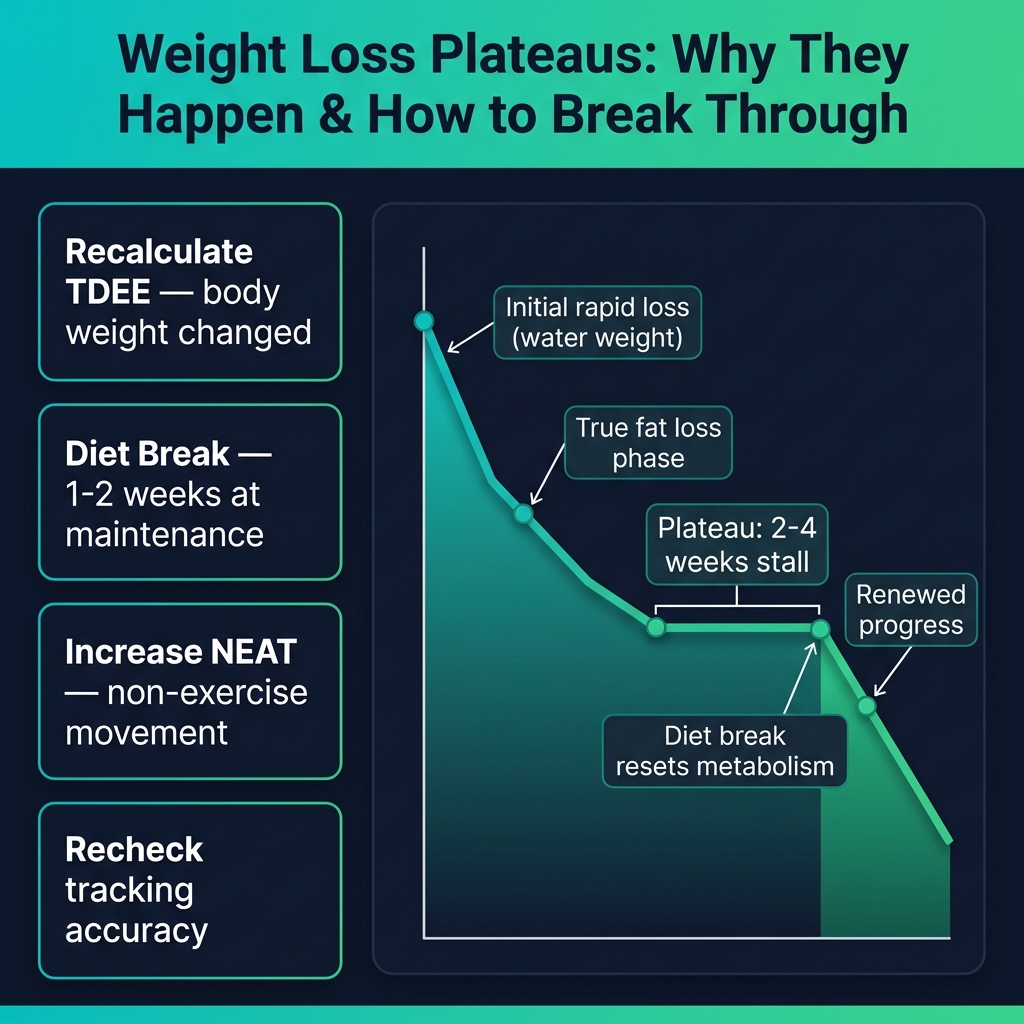
Weight loss plateaus are universal and predictable, not a sign that something is wrong. As you lose weight, your body weight — and therefore your TDEE — decreases. The deficit that produced 0.5 kg/week at 90 kg may produce no loss at 80 kg. Understanding your changing body proportions and shape through tools like the Body Shape Calculator reminds you that progress continues even when the scale stalls, as fat redistributes and body proportions shift.
Four Evidence-Based Plateau Strategies
- Recalculate your TDEE: After every 5–7 kg (10–15 lbs) of weight loss, re-run this calculator with your new current weight. Your TDEE decreases as you lose weight, so your deficit effectively shrinks without you changing anything.
- Take a structured diet break: Spend 1–2 weeks eating at maintenance calories. This reduces adaptive thermogenesis, restores leptin and thyroid hormone levels, improves psychological adherence, and makes the subsequent deficit phase more effective. Short-term weight gain during a diet break is mostly water — not fat.
- Increase NEAT: Non-Exercise Activity Thermogenesis — fidgeting, taking stairs, standing instead of sitting — accounts for up to 350 kcal/day of variation between individuals. Small increases in daily movement can restart progress without increasing exercise or reducing food.
- Audit your tracking accuracy: Research shows people systematically underestimate food intake by 20–50%. Re-weigh your food portions (using a food scale, not measuring cups) and re-log everything for one week.
Macronutrient Strategy During a Calorie Deficit
Knowing your precise height — verifiable with our Height Calculator — feeds directly into the BMR calculation that determines your deficit target, which in turn sets your protein requirements based on body weight. Getting height even slightly wrong creates compound errors across all downstream calculations.
Protein: The Non-Negotiable Priority
During a calorie deficit, dietary protein is the single most important macronutrient for preserving lean muscle mass. A landmark 2016 meta-analysis found that protein intakes of 1.8–2.7 g/kg of body weight per day during a calorie deficit preserved significantly more lean mass than lower intakes, even without resistance training.
- For weight loss with muscle preservation: 2.0–2.4 g protein per kg of current body weight per day
- For sedentary individuals: 1.6–2.0 g/kg is sufficient to minimize muscle loss
- Satiety benefit: Protein is the most satiating macronutrient per calorie. High protein diets naturally reduce hunger on lower calorie intakes, improving adherence without willpower.
Carbohydrates During a Deficit
Carbohydrates fuel high-intensity exercise performance. Cutting carbohydrates too aggressively reduces training quality, which accelerates muscle loss — the opposite of the goal. Maintain sufficient carbohydrates to support your activity level. A minimum of 100–150 g/day is recommended for active individuals.
Fat: The Minimum Floor
Dietary fat supports hormone synthesis (testosterone, estrogen, cortisol), fat-soluble vitamin absorption, and joint health. During a deficit, fat should not fall below 0.7 g/kg of body weight per day. Dropping fat below this floor can suppress testosterone by 10–15% in men and disrupt menstrual function in women.
Recommended Macro Splits During a Deficit
- Protein: 35% of total calories
- Carbohydrates: 35% of total calories
- Fat: 30% of total calories
Improving Accuracy: Beyond the Formula
Formula-based calculators are starting estimates — not perfect predictions. Individual metabolic variation means two people with identical inputs can have TDEEs that differ by 200–300 kcal/day. Use the following system to calibrate your actual deficit:
- Track food intake consistently for 2 weeks: Log everything using weight-based measurements (food scale, not cups). Calculate your average daily intake.
- Track weight under consistent conditions: Weigh daily at the same time and conditions. Use a 7-day rolling average to eliminate day-to-day water fluctuations.
- Calculate actual deficit from real # If your 7-day average weight fell by 0.5 kg over 2 weeks, you burned 0.5 kg × 7,700 kcal/kg = 3,850 kcal more than you ate. Divide by 14 days = 275 kcal/day actual deficit. Compare to your logged intake average to determine your true TDEE.
- Adjust by 100–200 kcal increments: Small adjustments every 2–3 weeks prevent overcorrection and preserve data clarity.
For a complete picture of your health metrics, combine this tool with the Maintenance Calorie Calculator to verify your TDEE baseline, the BMI Calculator to track your health category as weight changes, and the Harris-Benedict Calculator for a formula-by-formula BMR comparison with full macronutrient detail.