Hexagon Calculator
Calculate every property of a regular hexagon from any one known value — side, area, perimeter, apothem, circumradius, or short diagonal. Get area, perimeter, apothem, circumradius, long diagonal, short diagonal, and a step-by-step derivation instantly.
Hexagon Calculator
Regular Hexagon · Area, Perimeter, Diagonals, Apothem & More
Table of Contents
What Is a Regular Hexagon?
A regular hexagon is a polygon with six equal sides and six equal interior angles, each measuring exactly 120°. The sum of interior angles is 720°. A regular hexagon possesses the highest order of rotational symmetry of any polygon commonly encountered in nature and engineering — it can be rotated by 60°, 120°, 180°, 240°, or 300° and remain visually identical.
The hexagon's unique geometry makes it the most efficient shape for tiling a plane without gaps. It encloses more area per unit of perimeter than a square or triangle. This is precisely why honeycombs, basalt columns, and graphene lattices are hexagonal. The ratio of area to perimeter for a regular hexagon is s√3/4 per unit perimeter — approximately 13% more efficient than a square grid.
Every regular hexagon can be divided into six equilateral triangles, all with the same side length as the hexagon itself. This decomposition underpins most hexagon formulas and proofs. The center of the hexagon is equidistant from all six vertices (circumradius R = s) and equidistant from all six sides (apothem a = s√3/2).
How to Use the Hexagon Calculator
This Hexagon Calculator supports six input modes — you can enter any one known measurement and instantly compute all other hexagon properties. Here is a step-by-step guide:
- Step 1 — Select input type: Choose from Side Length, Area, Perimeter, Apothem, Circumradius (Long Diagonal / 2), or Short Diagonal.
- Step 2 — Enter your value: Type the numeric value in the input field. Use the unit selector to choose mm, cm, m, in, or ft.
- Step 3 — Click Calculate: The calculator instantly outputs all properties: area, perimeter, apothem, circumradius, long diagonal, short diagonal, and interior angle — with step-by-step derivation.
- Step 4 — Copy results: Click any result card to copy its value to clipboard.
All calculations use double-precision floating-point arithmetic (IEEE 754) and exact geometric constants (√3 = 1.7320508…). The SVG diagram updates in real time to reflect your hexagon's proportions.
Area of a Regular Hexagon
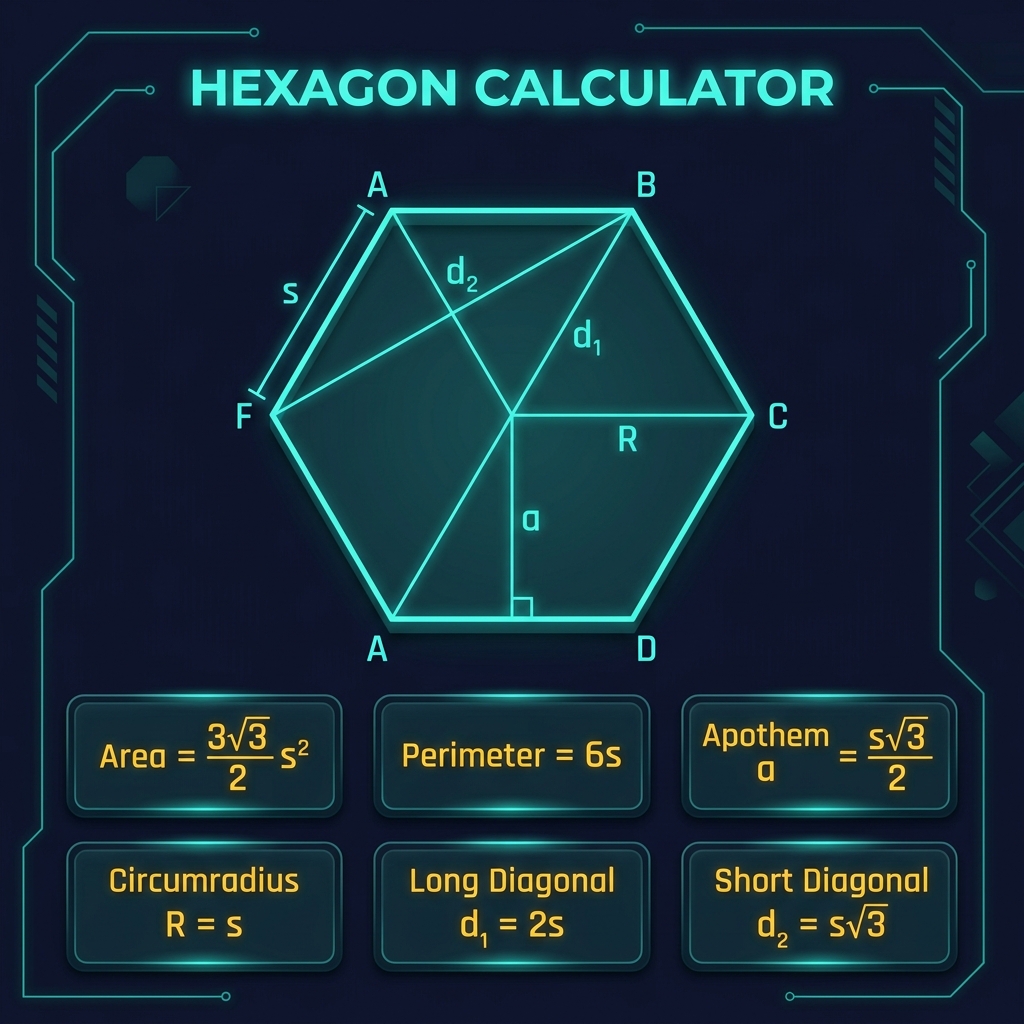
The area of a regular hexagon with side length s is:
- A = (3√3 / 2) × s² ≈ 2.5981 × s²
This formula is derived by decomposing the hexagon into six equilateral triangles, each with area (√3/4) × s², then multiplying by 6: A = 6 × (√3/4) × s² = (3√3/2) × s².
Example: A hexagonal floor tile with side s = 30 cm. A = (3√3/2) × 30² = 2.5981 × 900 = 2,338.3 cm². Compare this with a square tile of side 30 cm (A = 900 cm²) — the hexagon encloses 2.6× more area for the same side length.
When the area is known and you want the side length: s = √(2A / (3√3)). For example, A = 1,000 cm² → s = √(2000 / 5.1962) ≈ 19.60 cm.
Perimeter of a Regular Hexagon
The perimeter of a regular hexagon is simply six times the side length:
- P = 6s
Example: s = 25 mm → P = 6 × 25 = 150 mm = 15 cm. Conversely, given P, the side is s = P/6. A hexagonal nut (ISO metric) with P = 24 mm has s = 4 mm — this is the "across-the-flats" dimension used in engineering specifications.
The perimeter-to-area ratio is P/A = 6s / ((3√3/2)s²) = 4/(√3 × s) — it decreases as s increases, confirming that larger hexagons are proportionally more area-efficient.
Diagonals of a Regular Hexagon
A regular hexagon has nine diagonals total: three long diagonals and six short diagonals.
- Long diagonal (d₁) = 2s — passes through the center, connecting opposite vertices. This equals the diameter of the circumscribed circle (2R).
- Short diagonal (d₂) = s√3 ≈ 1.7321 × s — connects vertices two positions apart (skipping one vertex).
Example: s = 10 cm. Long diagonal d₁ = 20 cm; Short diagonal d₂ = 10√3 ≈ 17.32 cm. Note that d₂ equals the long diagonal of the equilateral triangle formed by three adjacent vertices — this is the basis for the "short diagonal" in hexagonal grid systems.
In engineering, the long diagonal determines the required bore size for a bolt hole, while the short diagonal (often called "across-the-flats" or width across flats) determines the wrench size. For ISO hex bolts, the two diagonals are related by d₁/d₂ = 2/√3 ≈ 1.1547.
Apothem (Inradius) Formula
The apothem (also called the inradius or r) is the perpendicular distance from the center of the hexagon to the midpoint of any side — it equals the radius of the largest inscribed circle:
- a = (s√3) / 2 ≈ 0.8660 × s
Example: s = 8 cm → apothem a = 8√3/2 = 4√3 ≈ 6.928 cm. The area can also be expressed using the apothem: A = 3 × a × s = 3as. This formula parallels A = (1/2) × P × a (half the perimeter times the apothem), the general polygon area formula.
If only the apothem is known: s = 2a/√3 = (2a√3)/3. For a = 10 cm: s = 20/√3 ≈ 11.547 cm.
Circumradius Formula
The circumradius R is the distance from the hexagon's center to any vertex — it equals the radius of the smallest circumscribed circle:
- R = s
This elegant result (R equals the side length itself) is unique to the regular hexagon. It follows directly from the fact that the hexagon consists of six equilateral triangles of side s. No other regular polygon has this property.
Example: s = 12 mm → R = 12 mm. The circumscribed circle has diameter 2R = 24 mm = d₁ (the long diagonal). If only R is known: s = R (trivially). This also means A = (3√3/2) × R² and P = 6R.
Solving from Any Known Value
The calculator automatically derives all properties from whichever input you provide. Key inverse formulas:
- From Area (A): s = √(2A / (3√3)); then all other properties follow.
- From Perimeter (P): s = P / 6.
- From Apothem (a): s = (2a) / √3 = (2a√3) / 3.
- From Circumradius (R): s = R.
- From Long Diagonal (d₁): s = d₁ / 2.
- From Short Diagonal (d₂): s = d₂ / √3 = (d₂√3) / 3.
All six input modes are supported in the calculator above. Select the known quantity, enter its value, choose your unit, and click Calculate.
Unit Conversion Table
The calculator computes all output in the unit you select. Area is returned in the selected unit squared. Here are key length unit relationships:
- 1 in = 25.4 mm = 2.54 cm
- 1 ft = 304.8 mm = 30.48 cm = 12 in
- 1 m = 100 cm = 1,000 mm ≈ 39.37 in ≈ 3.281 ft
- 1 yd = 91.44 cm = 3 ft
Area conversions (×unit²): 1 ft² = 929.03 cm²; 1 in² = 6.452 cm²; 1 m² = 10,000 cm². The calculator outputs the area in the selected unit².
Real-World Applications of the Hexagon
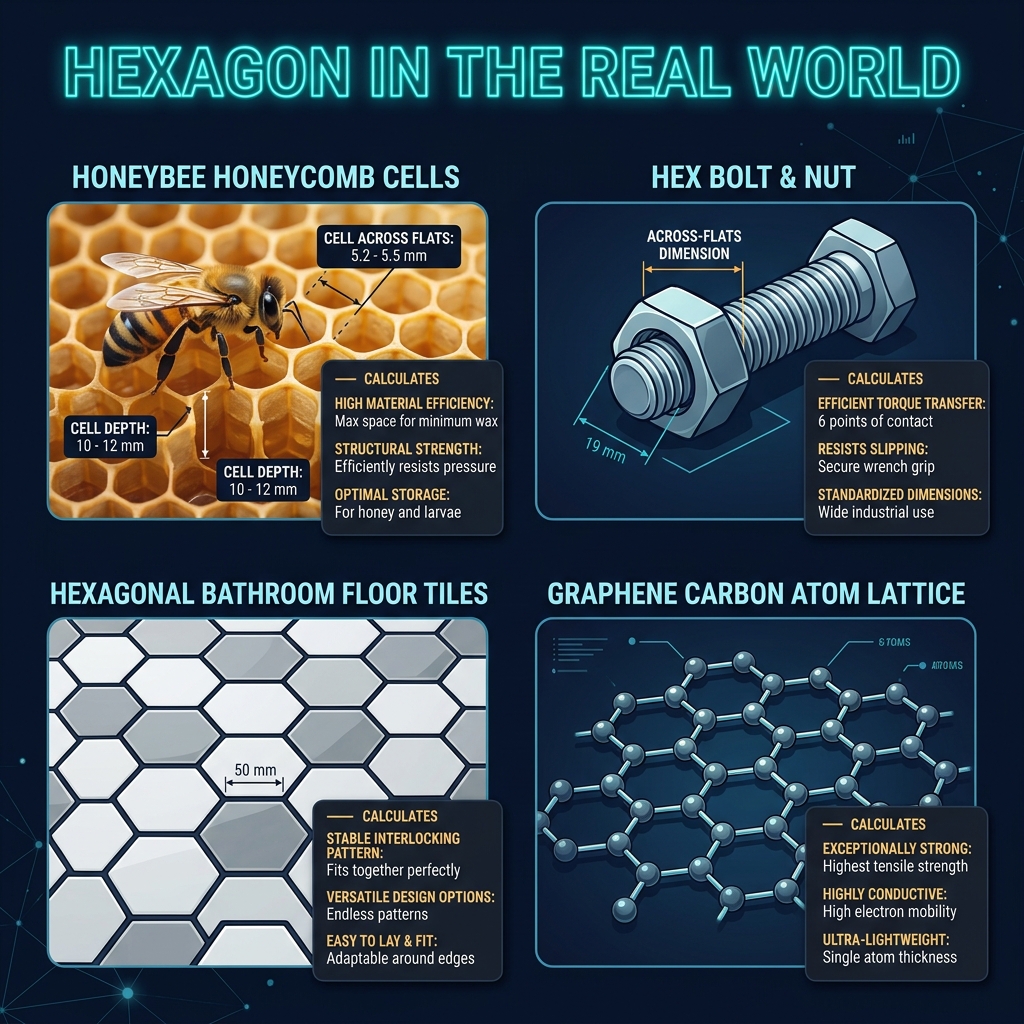
The regular hexagon appears in an extraordinary range of engineering, scientific, and design contexts:
- Honeybee combs: Bees build hexagonal cells because hexagonal packing minimizes the total wall material per unit of stored volume — a principle proved rigorously by Thomas Hales in the Honeycomb Conjecture (1999). The Area of a Circle Calculator helps compare circle vs. hexagon packing efficiency.
- Hex nuts and bolts: ISO and ANSI fastener standards define hex nut sizes by the width across flats (apothem × 2) and width across corners (long diagonal). A standard M10 hex nut has s ≈ 8.4 mm, giving an apothem of ≈ 7.3 mm (the 14.6 mm AF wrench size).
- Graphene and carbon nanotubes: Carbon atoms in graphene form a 2D hexagonal lattice with a C–C bond length (side) of 1.42 Å. The hexagonal unit cell area is A = (3√3/2) × (1.42 Å)² ≈ 5.24 Ų.
- Floor and wall tiling: Hexagonal tiles are preferred for bathrooms and kitchens because hexagonal grids have fewer grout lines per unit area than square grids. For a 10 m² floor using 30 cm tiles (s = 15 cm): A_tile = (3√3/2) × 15² ≈ 584.6 cm² = 0.0585 m². Number of tiles ≈ 10 / 0.0585 ≈ 171 tiles.
- Astronomy and hexagonal craters: Some impact craters and planetary features (Saturn's north polar hexagon, ~25,000 km across) exhibit near-hexagonal geometry due to standing wave patterns in the atmosphere.
- Board games and wargames: Hexagonal grids (hexmaps) are used in strategy games because each hex cell has six equidistant neighbors, unlike square grids (4 face-neighbors, 4 corner-neighbors at different distances).
Related Calculators — Internal Links
- Area of a Circle Calculator — Compute circle area, circumference, diameter, and radius. The circumscribed circle of a hexagon with side s has radius R = s and area π × s².
- Circumference Calculator — Find circle circumference, arc length, and sector area. For a hex circumscribed circle: C = 2π × s.
- Triangle Area Calculator — Calculate equilateral triangle area. A regular hexagon = 6 equilateral triangles of side s, each with area (√3/4)s².
- Sector Area Calculator — Arc length and sector area for any circle. Hexagon sectors subtend 60° central angles.
- Right Triangle Calculator — Solve right triangles. The apothem, half-side, and circumradius of a hexagon form a 30-60-90 triangle.
- Pythagorean Theorem Calculator — Find hypotenuse or sides. Used to verify hexagon diagonal relationships: d₂² = (s√3)² = 3s².
- Volume Calculator — Compute volumes of 8 3D shapes. Hexagonal prism volume = A_hex × h = (3√3/2)s² × h.
Frequently Asked Questions about Hexagon Calculator
What is the formula for the area of a regular hexagon?
The area of a regular hexagon with side length s is A = (3√3 / 2) × s² ≈ 2.5981 × s². This is derived by dividing the hexagon into 6 equilateral triangles, each with area (√3/4) × s², and multiplying by 6. Example: s = 10 cm → A = 2.5981 × 100 = 259.81 cm².
How do I find the perimeter of a regular hexagon?
The perimeter of a regular hexagon is simply P = 6s, where s is the side length. Since all six sides are equal, you just multiply the side length by 6. Example: s = 8 in → P = 48 in. If you know the perimeter and want the side: s = P / 6.
What is the apothem of a hexagon?
The apothem (inradius) is the perpendicular distance from the center of the hexagon to the midpoint of any side. For a regular hexagon: a = (s√3) / 2 ≈ 0.8660 × s. It equals the radius of the largest inscribed circle. Example: s = 12 cm → a = 12√3/2 ≈ 10.392 cm. If you know the apothem: s = 2a / √3.
What is the circumradius of a regular hexagon?
The circumradius R is the distance from the center to any vertex. For a regular hexagon, R = s (the circumradius equals the side length). This is unique to the regular hexagon — no other regular polygon has this property. It follows from the fact that the hexagon is made of 6 equilateral triangles of side s. The circumscribed circle has diameter 2s, which equals the long diagonal.
How many diagonals does a regular hexagon have?
A regular hexagon has 9 diagonals in total: 3 long diagonals (d₁ = 2s) that pass through the center connecting opposite vertices, and 6 short diagonals (d₂ = s√3 ≈ 1.7321 × s) that connect vertices two positions apart. The long diagonal equals the diameter of the circumscribed circle. In engineering, the long diagonal determines bore size while the short diagonal determines wrench size.
Where does a regular hexagon appear in real life?
Regular hexagons appear in many natural and engineering contexts: honeybee combs (hexagonal cells minimize wall material per unit volume), hex nuts and bolts (ISO fastener standards define sizes by width-across-flats and width-across-corners), graphene lattice (carbon atoms form a 2D hexagonal array with 1.42 Å bond length), floor tiles (hexagonal grids have fewer grout lines than square grids), Saturn's north polar hexagon (a massive atmospheric standing wave ~25,000 km across), and hexagonal grid maps used in strategy board games.