Sector Area Calculator
Free Sector Area Calculator: instantly compute the area of a sector, arc length, perimeter, chord length, and segment area from radius and central angle....
?????? ?????????
How to Use the Sector Area Calculator
This calculator computes six key measurements of a circular sector instantly from just two inputs: radius and central angle. Here is how to use it:
- Step 1 — Select angle unit: Choose Degrees (0°–360°) or Radians (0–2π ≈ 6.2832). The formula and input placeholder update automatically.
- Step 2 — Enter radius: The radius (r) is the distance from the center of the circle to the arc. Must be a positive number. Select your preferred length unit (cm, m, mm, in, ft, km, mi).
- Step 3 — Enter central angle: The central angle (θ) is the angle at the center of the circle subtended by the arc. Enter in your chosen unit.
- Step 4 — Click Calculate Area: The calculator returns six results: sector area, arc length, perimeter, chord length, circular segment area, and fraction of the full circle. Results appear with step-by-step formula breakdowns and an animated SVG diagram.
Click any KPI card to copy the value to your clipboard. Use the preset buttons for quick examples: 90°, 60°, π/3 rad, and more.
The Sector Area Formula
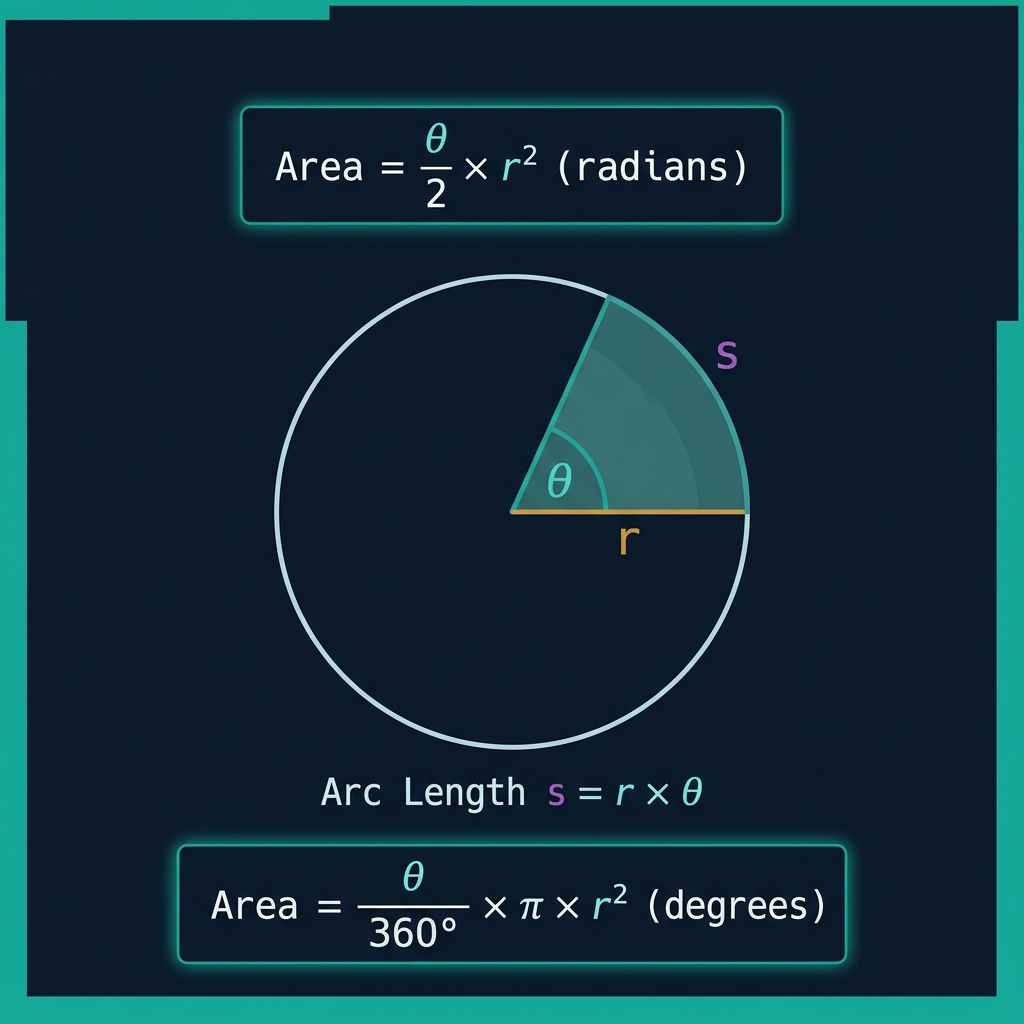
A sector is the region bounded by two radii and the arc between them — like a slice of pie. There are two equivalent formulas depending on whether the angle is in radians or degrees:
- Radians: A = ½ × r² × θ
- Degrees: A = (θ / 360°) × π × r²
Both formulas give identical results. The radian form is simpler and more fundamental (it is what your calculator uses internally after converting degrees). The degree form is more intuitive since most people think in degrees.
How the degree formula is derived: A full circle has area πr². A sector with angle θ° is a fraction (θ/360) of the full circle, so its area = (θ/360) × πr². Setting θ = 180° (a semicircle): Area = (180/360) × πr² = πr²/2 ✓. Setting θ = 90° (a quarter circle): Area = (90/360) × πr² = πr²/4 ✓.
Derivation of the radian form: Since 360° = 2π radians, substituting: A = (θ_rad / 2π) × πr² = θ_rad × r² / 2 = ½r²θ. The factor of ½ parallels the triangle area formula ½bh, which is not a coincidence — as θ → 0, the sector approaches a triangle.
Arc Length Formula
The arc length (s) is the length of the curved boundary of the sector. Formula:
- Radians: s = r × θ
- Degrees: s = (θ / 360°) × 2πr
This is one of the most fundamental relationships in circle geometry. The radian is defined precisely so that arc length = radius × angle in radians. A full circle (θ = 2π rad) gives s = 2πr — the circumference. A semicircle (θ = π rad): s = πr ≈ 3.1416r. See the Arc Length Calculator for dedicated arc length computations with more options.
Example: Circle with r = 10 cm, θ = 60°. Convert: 60° × π/180 = π/3 ≈ 1.0472 rad. Arc = 10 × 1.0472 = 10.47 cm. Alternatively: (60/360) × 2π × 10 = (1/6) × 62.83 = 10.47 cm ✓.
Perimeter of a Sector
The perimeter of a sector is the total boundary length: two straight radii plus the curved arc. Formula:
- P = 2r + s = 2r + rθ = r(2 + θ)
This is important for applications like fencing a pie-shaped land plot, cutting materials in a sector shape, or computing the edging needed for a curved garden bed.
Example: r = 5 m, θ = 90° = π/2 rad. Arc = 5 × π/2 = 7.854 m. Perimeter = 2×5 + 7.854 = 17.854 m.
Note: if only the arc is needed (not the full perimeter), use the arc length formula above. Perimeter always includes both radius sides.
Chord Length
The chord is the straight line connecting the two endpoints of the arc. It is not the arc itself (which is curved) but a straight line cutting across the sector opening. Formula:
- Chord = 2r × sin(θ/2)
The chord is always less than or equal to the arc length, with equality only at θ = 0 (degenerate). At θ = 180° (diameter), chord = 2r × sin(90°) = 2r — the full diameter. At θ = 60°: chord = 2r × sin(30°) = 2r × 0.5 = r, so an equilateral triangle is formed inside the circle.
Chord vs Arc: The arc curves around the outside while the chord cuts straight across. The difference between arc and chord length grows as θ increases. At θ = 360°, arc = full circumference = 2πr ≈ 6.28r, but chord = 0 (endpoints meet).
Circular Segment Area
A circular segment is the region between a chord and its arc (the region you get if you cut a sector and remove the triangle formed by the two radii and chord). Formula:
- Segment Area = Sector Area − Triangle Area = ½r²θ − ½r²sin(θ) = ½r²(θ − sin θ)
Example: r = 5 cm, θ = 90° = π/2 rad. Sector area = ½ × 25 × π/2 = 19.635 cm². Triangle area = ½ × 5² × sin(90°) = ½ × 25 × 1 = 12.5 cm². Segment area = 19.635 − 12.5 = 7.135 cm².
Segments appear in engineering (cutting shapes from circular stock, overlap of circular objects) and in computing the cross-sectional area of partially-filled cylindrical tanks.
Degrees vs Radians — Which to Use?
Both units measure angle — they are just different scales:
- Degrees (°): Full circle = 360°. Intuitive for everyday use. All basic geometry and most engineering applications use degrees.
- Radians (rad): Full circle = 2π ≈ 6.2832 rad. Natural for calculus, physics, and programming (all trigonometric functions in programming languages use radians). The arc length formula s = rθ works only in radians.
Conversion: Degrees to radians: multiply by π/180. Radians to degrees: multiply by 180/π. Key values: 30° = π/6 ≈ 0.5236 rad, 45° = π/4 ≈ 0.7854 rad, 60° = π/3 ≈ 1.0472 rad, 90° = π/2 ≈ 1.5708 rad, 180° = π ≈ 3.1416 rad.
This calculator handles both — enter the angle in whichever unit you have, and it converts internally before computing. See the Trigonometry Calculator for comprehensive degree/radian conversion and trig functions.
Worked Examples
- Quarter circle (90°): r = 5 cm, θ = 90°. Area = (90/360) × π × 25 = 19.635 cm². Arc = (90/360) × 2π × 5 = 7.854 cm. Perimeter = 10 + 7.854 = 17.854 cm.
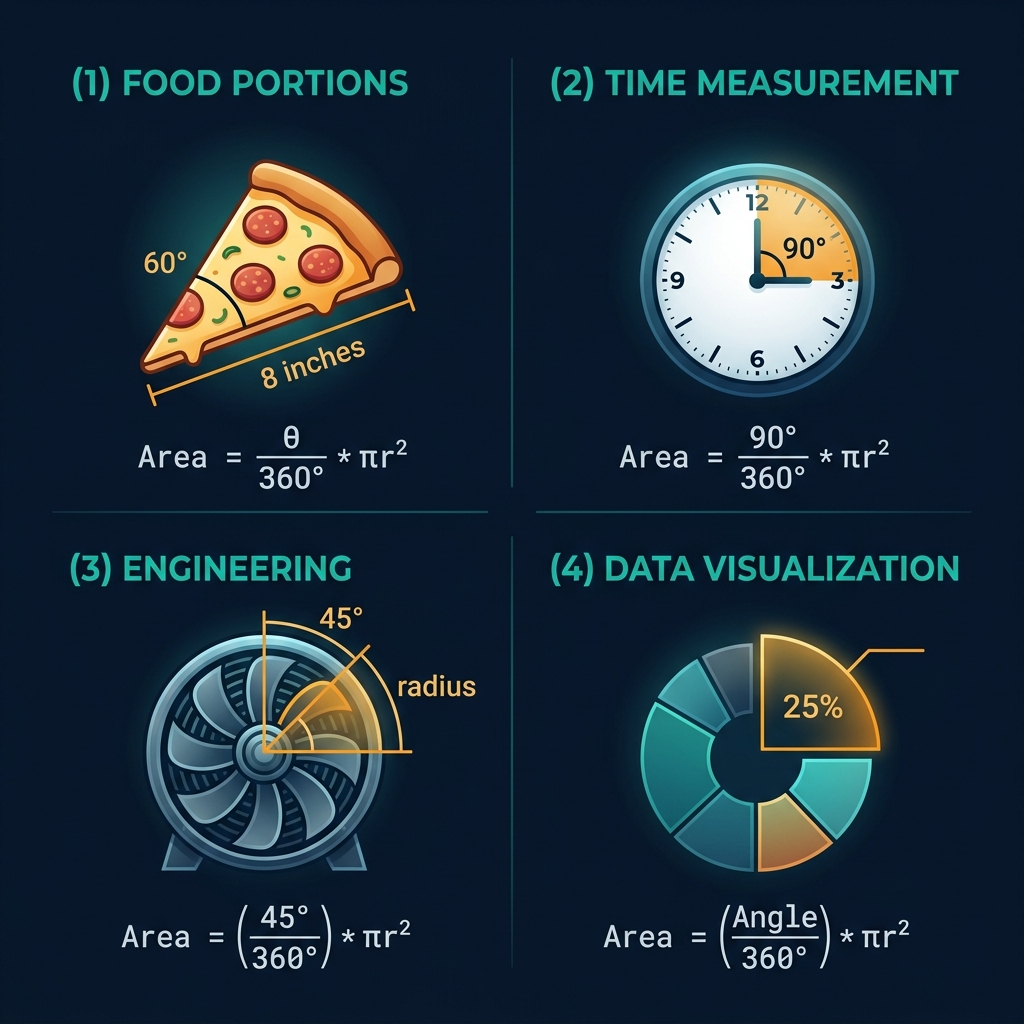
- Pizza slice: A 30 cm diameter pizza cut into 8 equal slices. r = 15 cm, θ = 360°/8 = 45°. Area per slice = (45/360) × π × 225 = 88.36 cm². Arc = (45/360) × 2π × 15 = 11.78 cm.
- Clock hand sector: Hour and minute hand form a 60° sector. r = 10 cm. Area = (60/360) × π × 100 = 52.36 cm².
- Radian example: r = 7 m, θ = π/3 rad (= 60°). Area = ½ × 49 × π/3 = 25.656 m². Arc = 7 × π/3 = 7.330 m. Chord = 2×7×sin(π/6) = 7 m (equilateral triangle formed).
Real-World Applications of Sector Area
- Food & portions: Calculating the area of a pizza slice or cake portion. If each slice has angle θ = 360°/n for n slices, the area per slice = πr²/n.
- Engineering & design: Fan blade area, turbine sector, spray patterns, spotlight coverage angles, and pivot-arm mechanisms all require sector area computation.
- Land surveying: Pie-shaped plots of land with a center point (cul-de-sac, radial street plan) require sector area for valuation and development planning.
- Architecture: Arched windows, curved walls, dome sections, and rotunda floor plans all involve sector geometry.
- Data visualization: Pie chart segments are sectors. If a chart has value v out of total T, the sector angle = (v/T) × 360° and the area = (v/T) × πr².
- Sports fields: Track and field corner arc sections, race courses with banked curves, and irrigation pivot systems use arc length and sector area.
- Physics: Solid angle calculations, moment of inertia of circular sectors, and centripetal acceleration problems involve sector geometry.
Related Calculators — Internal Links
- Area of a Circle Calculator — Compute the full circle area, diameter, circumference, and radius from any one known value. A sector is always a fraction of the full circle area.
- Arc Length Calculator — Dedicated calculator for arc length from radius and angle, with multi-unit support and worked examples.
- Circumference Calculator — Full circle circumference, diameter, radius, and arc length from any known measurement.
- Right Triangle Calculator — The chord of a sector forms a triangle with the two radii. Solve triangle sides and angles with this companion tool.
- Triangle Area Calculator — The triangle area subtracted from sector area gives the circular segment area. Solve any triangle by multiple methods.