Cylinder Volume Calculator
Free Cylinder Volume Calculator: find volume, lateral surface area, total surface area, base area, and diagonal. Also solve for radius or height from known...
F�rmula utilizada
How to Use the Cylinder Volume Calculator
This calculator covers every geometric property of a right circular cylinder in five powerful modes:
- Radius + Height → All Properties: Enter the radius r and height h to instantly compute the volume V = πr²h, lateral surface area, total surface area, base area, space diagonal, and inscribed/circumscribed sphere radii. Choose from 7 length units (mm, cm, m, km, in, ft, yd) for automatic unit conversion of every output.
- Volume + Height → Radius: Reverse the formula — given the cylinder's volume and height, find the radius: r = √(V/(πh)). Useful when sizing tanks, pipes, or columns to hit a target capacity.
- Volume + Radius → Height: Find the height required to achieve a specific volume: h = V/(πr²). Common in engineering when the tank footprint (radius) is fixed.
- Hollow Cylinder (Pipe): Enter outer radius R, inner radius r, and height h to find the volume of material in a pipe, annular column, or hollow drum: V = πh(R² − r²). Also computes inner/outer lateral areas, cross-section ring area, and average radius.
- Oblique Cylinder: An oblique cylinder with base radius r, slant height l, and tilt angle α still has the same volume as a right cylinder: V = πr²h where h = l·cos(α). The lateral surface area = 2πr·l (using slant height). Enter three knowns to compute the rest.
All modes include step-by-step breakdowns. Click any result tile to copy its value with six significant digits.
The Cylinder Volume Formula
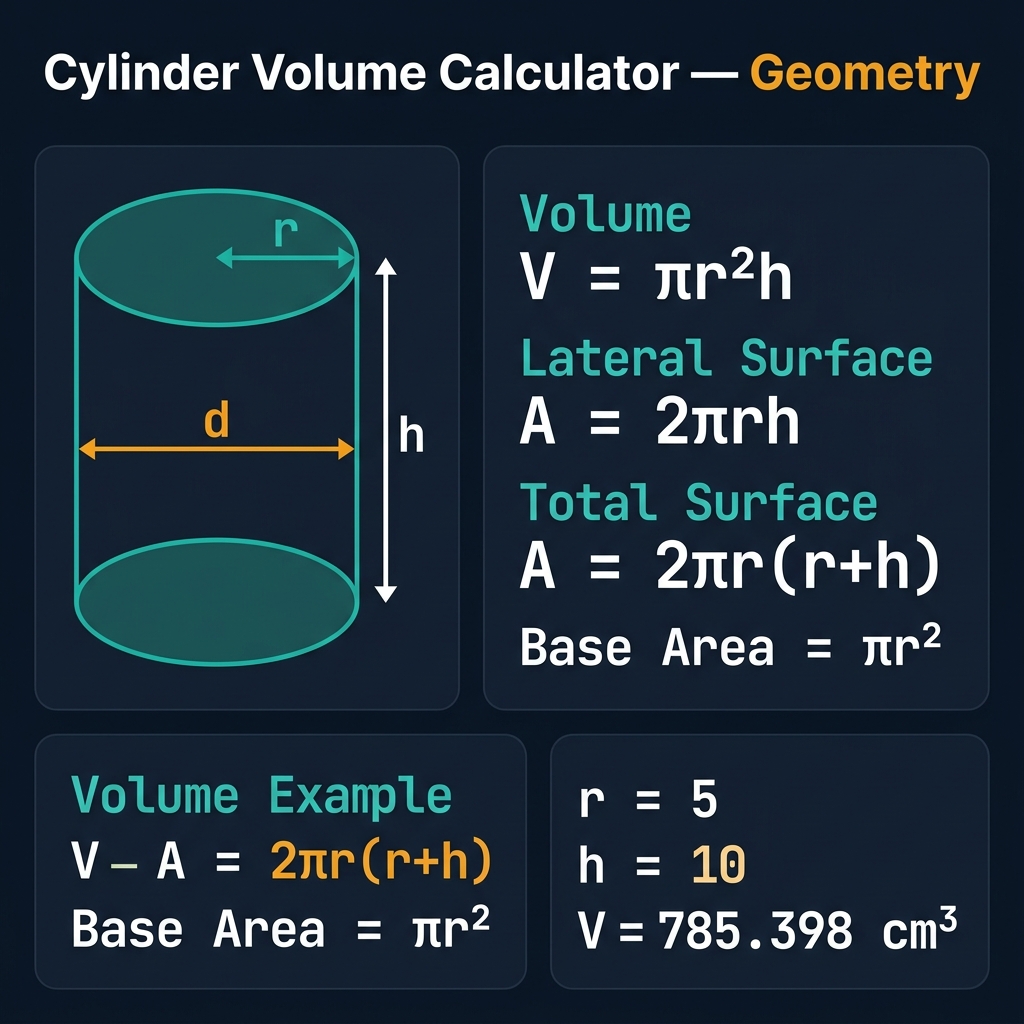
A right circular cylinder's volume is simply the area of the circular base multiplied by the height:
- V = πr²h — where r is the base radius and h is the perpendicular height between the two parallel circular bases.
- Equivalently, using diameter d = 2r: V = π(d/2)²h = πd²h/4
- From base area A_base = πr²: V = A_base × h
Worked example (r = 5 cm, h = 10 cm):
- Volume: V = π × 5² × 10 = π × 25 × 10 = 250π ≈ 785.398 cm³ ≈ 0.785 liters
- Lateral surface area: A_L = 2π × 5 × 10 = 100π ≈ 314.159 cm²
- Total surface area: A_T = 2π × 5 × (5 + 10) = 150π ≈ 471.239 cm²
- Base area: A_B = π × 5² = 25π ≈ 78.540 cm²
- Diagonal: d = √(4 × 25 + 100) = √200 = 10√2 ≈ 14.142 cm
Note that 1 liter = 1 dm³ = 1000 cm³. So a cylinder 10 cm tall and 5 cm radius holds about 0.785 liters — roughly 2.6 cups of liquid. Our Circumference Calculator provides full details on the circular base geometry (circumference, area, diameter relationships).
Surface Area Formulas
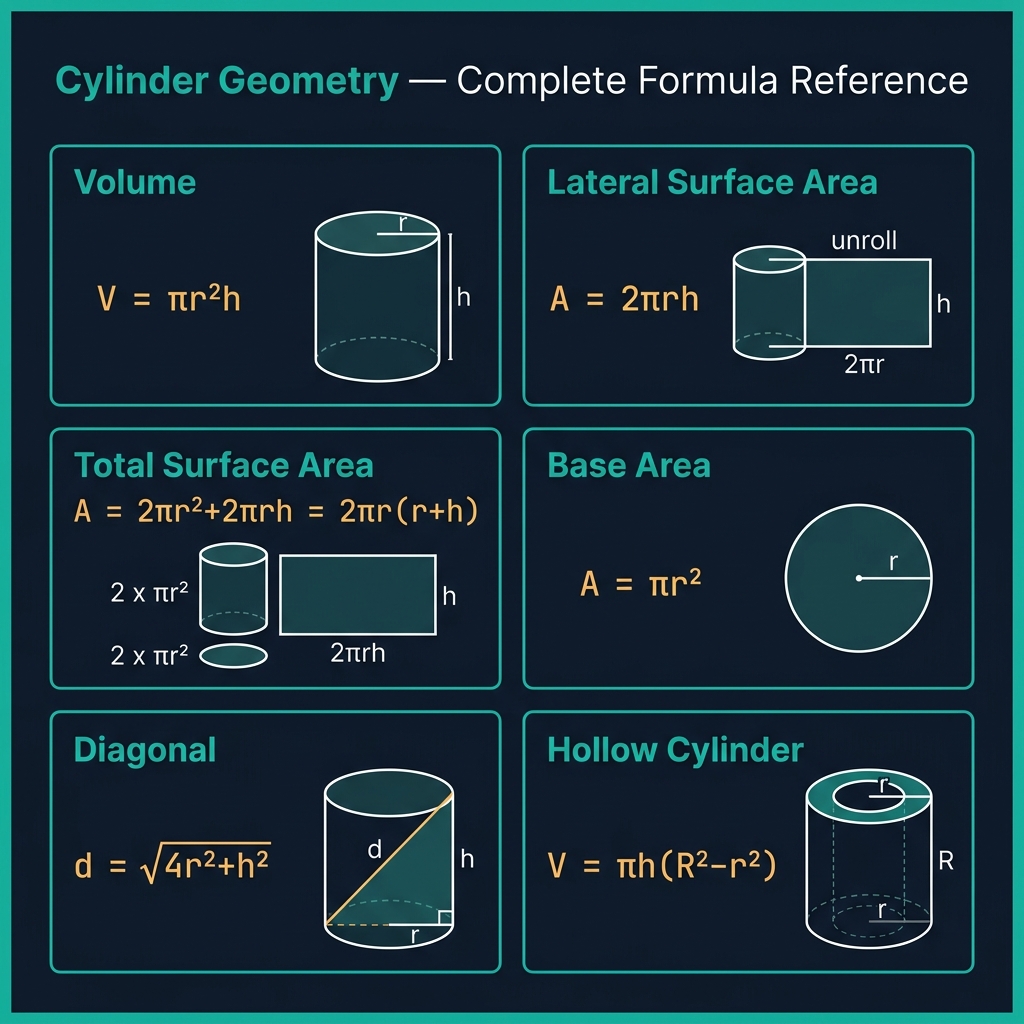
The cylinder has three surface area measurements:
- Base Area (one base): A_base = πr² — the area of one circular end. Multiply by 2 for both bases: 2πr².
- Lateral Surface Area (curved surface): A_lateral = 2πrh — the area of the curved side wall. Imagine unrolling the cylinder into a flat rectangle: its width = circumference of the base = 2πr, and its height = h. Area = width × height = 2πrh.
- Total Surface Area: A_total = 2πr² + 2πrh = 2πr(r + h) — both bases plus the lateral surface.
When do you need each? Lateral area is used when calculating the material needed for can labels, pipe insulation, or tank painting (sides only). Total surface area is needed for manufacturing closed containers (cans, drums, pipes with caps). Base area is used for calculating load distribution on the floor or piston face area in hydraulics.
The ratio of lateral area to total area = 2πrh / (2πr² + 2πrh) = h/(r + h). For a cube-like cylinder (h = 2r, i.e., height equals diameter), this ratio = 2r/(r + 2r) = 2/3 — exactly two-thirds of the surface is the lateral wall. This "optimal" proportion appears in many industrial containers to minimize material use for a given volume.
Hollow Cylinder (Pipe) Volume
A hollow cylinder (pipe, annular column, ring-shaped drum) has an outer radius R and inner radius r (r < R). Its volume is the difference of the two solid cylinders:
- V = πR²h − πr²h = πh(R² − r²)
- Cross-section area (ring/annulus): A_ring = π(R² − r²) = π(R+r)(R−r)
- Average radius: r_avg = (R + r) / 2
- Wall thickness: t = R − r
- Inner lateral area: 2πrh; Outer lateral area: 2πRh
Example — steel pipe: Outer radius R = 3 cm, inner radius r = 2.5 cm, length h = 200 cm. Volume of steel = π × 200 × (9 − 6.25) = π × 200 × 2.75 = 550π ≈ 1727.9 cm³. If steel density = 7.85 g/cm³, pipe mass ≈ 1727.9 × 7.85 ≈ 13,564 g ≈ 13.56 kg. Hollow cylinder calculations are essential in civil engineering (pile foundations), HVAC (duct volumes), and fluid mechanics (pipe flow capacity). Use our Arc Length Calculator for the curved perimeter of the annular cross-section.
Finding Radius or Height from Volume
Often you need to reverse the volume formula:
- Find radius from volume and height: V = πr²h → r² = V/(πh) → r = √(V/(πh))
- Find height from volume and radius: V = πr²h → h = V/(πr²)
Example 1 — Sizing a cylindrical tank: You need a tank with volume V = 500 liters = 500,000 cm³ and height h = 100 cm. Required radius: r = √(500,000 / (π × 100)) = √(500,000 / 314.159) = √1591.55 ≈ 39.89 cm ≈ diameter 79.8 cm. This is close to a standard 80 cm diameter tank.
Example 2 — Water column height: A cylindrical tank with radius r = 25 cm holds V = 200 liters = 200,000 cm³. Height needed: h = 200,000 / (π × 625) = 200,000 / 1963.5 ≈ 101.9 cm. These reverse calculations are used constantly in tank design, concrete column sizing, and fluid storage planning.
Use our Significant Figures Calculator to report these results at the correct precision — for engineering, typically 3–4 significant figures.
Unit Conversion for Volume
Volume units span many orders of magnitude. This calculator supports automatic conversion for all derived volumes:
- Metric: 1 m³ = 1,000 L (liters) = 1,000,000 mL = 1,000,000 cm³
- US Customary: 1 ft³ ≈ 7.481 US gallons = 28.317 liters
- Key conversions: 1 cm³ = 1 mL; 1 dm³ = 1 L; 1 m³ = 1000 L; 1 in³ ≈ 16.387 mL; 1 gallon (US) ≈ 3785.41 mL; 1 barrel (oil) = 42 US gallons ≈ 158.987 L
This calculator automatically converts volumes to liters, milliliters, cubic meters, cubic feet, cubic inches, US gallons, and UK gallons whenever you enter dimensions in any of the 7 supported length units. This is especially useful when working with tank capacity (often given in gallons or liters) while dimensions are in centimeters or inches.
Real-World Applications
- Water and Oil Tanks: Cylindrical tanks are the most common shape for liquid storage. A domestic water heater cylinder in the UK is typically 150–300 liters with diameter 45–55 cm and height 90–120 cm. Petroleum storage tanks can hold millions of liters. Our calculator instantly converts any tank's radius and height to capacity in liters and gallons.
- Concrete Columns and Piles: Civil engineers use cylindrical columns and drilled piles. A 300 mm diameter concrete pile, 10 m deep: V = π × 0.15² × 10 = 0.0707 m³ = 70.7 liters of concrete per pile. A building with 50 piles needs 3.53 m³ of concrete — with the pile cage rebar occupying some of that volume as a hollow cylinder. Use our Hypotenuse Calculator to check diagonal bracing in cylindrical frameworks.
- Food Cans and Packaging: The standard 400g food can has radius ≈ 3.7 cm and height ≈ 11.3 cm: V = π × 3.7² × 11.3 ≈ 486 cm³ = 486 mL ≈ 0.486 L. Packaging engineers balance material cost (surface area) against volume capacity. The optimal cylinder (minimum surface area for given volume) has h = 2r (height equals diameter) — with A/V ratio = 4πr²·2r / (πr³) = ... simplified: the ratio equals 6/r. For a 400 mL can, optimal r = (400/(2π))^(1/3) ≈ 3.99 cm ≈ 4 cm, optimal h ≈ 8 cm.
- Engines and Hydraulics: Engine cylinder volume (displacement per cylinder) determines engine power. A 2.0L 4-cylinder engine has ~500 cc displacement per cylinder: if bore (diameter) = 86 mm (r = 43 mm), stroke (height) = h = 86 mm: V = π × 43² × 86 = π × 1849 × 86 ≈ 499,600 mm³ ≈ 499.6 cc. ✓ Hydraulic cylinder force = pressure × piston area = pressure × πr².
- Astronomy: Planetary bodies and stellar cores are modeled as spheres but planets' atmospheres, magnetospheres, and accretion disks are sometimes approximated as cylinders. In MHD (magnetohydrodynamics), plasma in a magnetic tube is modeled as a cylinder. Jupiter's Great Red Spot can be approximated as a cylindrical storm system ≈ 16,000 km wide × 50 km deep.
- 3D Printing and CNC: When designing cylindrical parts for 3D printing, the volume × material density gives the part mass. For PLA (density 1.24 g/cm³): a cylinder 30 mm radius × 50 mm tall = π × 9 × 50 = 1413.7 cm³ × ... wait: r = 3 cm, h = 5 cm: V = π × 9 × 5 = 141.37 cm³. Mass = 141.37 × 1.24 = 175 g ≈ 175 g of filament. Use our Midpoint Calculator for locating centers of cylindrical objects on a coordinate system.
Comparing Cylinder, Sphere, and Cone Volumes
Archimedes proved a beautiful theorem: if you inscribe a sphere of radius r inside a cylinder of radius r and height 2r, their surface areas and volumes are in exact ratios:
- Cylinder volume = πr²(2r) = 2πr³
- Sphere volume = (4/3)πr³
- Cone of same base and height: (1/3)πr²(2r) = (2/3)πr³
- Ratio cone : sphere : cylinder = 1 : 2 : 3 — a perfect 1:2:3 ratio!
This means for a given circular base and height, the sphere holds exactly 2/3 of the cylinder's volume, and the cone holds exactly 1/3. Archimedes was so proud of this discovery that he requested a sphere-inside-cylinder engraved on his tombstone. For a full set of sphere calculations, pair this tool with our Circumference Calculator (which handles circular cross-section geometry) and our Arc Length Calculator for sphere sector arc lengths.
Related Calculators
- Circumference Calculator — The cylinder's two circular bases are the central element of its geometry. This tool computes the base circumference (= 2πr), diameter (= 2r), and base area (= πr²) for any circle. It also handles arc lengths and sector areas of the circular cross-section — essential if you're cutting curved panels for cylindrical tanks or calculating the material needing for a partial cylinder.
- Arc Length Calculator — When a cylinder is cut obliquely (at an angle) rather than straight across, the intersection curve is an ellipse. The perimeter of the cut face requires elliptic integral calculations. For straight sector cuts of cylindrical sections, the arc length of the curved edge of each piece = rθh (where θ is the sector angle). This calculator handles all circular arc measurements for cylinder cross-sections.
- Hypotenuse Calculator — The space diagonal of a cylinder (from a point on one base circle to the diametrically opposite point on the other base circle) is d = √(4r² + h²), derived from the Pythagorean theorem applied to the rectangle formed by the unrolled lateral surface. This tool computes hypotenuse, leg relationships, and all right triangle properties — useful for diagonal calculations in cylindrical structures.
- Midpoint Calculator — The center of a cylinder in 3D space is the midpoint of its axis. Given the centers of the two circular faces (points in 3D), the axis midpoint (cylinder center) is exactly the 3D midpoint. This tool handles 2D and 3D midpoint formulas, section formula, and centroid calculations — useful for positioning cylindrical objects on architectural or mechanical drawings.
- Significant Figures Calculator — Engineering cylinder calculations often involve results like V = 785.398 cm³ that need rounding to the precision of the input measurements. If r = 5.0 cm (2 sig figs) and h = 10 cm (2 sig figs), the volume should be reported as 790 cm³ (2 sig figs, not 785.398). This tool correctly applies sig fig rules to all arithmetic operations.