Right Triangle Calculator
Free Right Triangle Calculator: instantly find any missing side (a, b, hypotenuse c), angles (α, β), area, perimeter, and altitude from any two known...
Formule utilis�e
How to Use the Right Triangle Calculator
This calculator solves any right triangle when you provide any two of its five key measurements — legs a and b, hypotenuse c, and angles α (opposite to a) and β (opposite to b). The right angle is always 90°, so you only need two additional values to define the triangle completely.
Simply select which two values you know from the tabs, enter them, choose your preferred unit, and click Calculate Triangle. The tool instantly computes every remaining measurement: the missing sides, both acute angles, the area, the perimeter, and the altitude from the right angle to the hypotenuse. An interactive SVG diagram updates to show your exact triangle to scale.
- Two Legs (a & b): The most common case — use the Pythagorean theorem to find c, then inverse tangent for angles.
- One Leg + Hypotenuse: Rearrange the Pythagorean theorem to find the missing leg; use arcsine or arccosine for angles.
- One Leg + Angle: Use SOH-CAH-TOA trigonometric ratios to compute missing sides; remaining angle = 90° − α.
- Hypotenuse + Angle: Multiply hypotenuse by sin(α) to get the opposite leg; multiply by cos(α) for the adjacent leg.
The Pythagorean Theorem — Foundation of Right Triangle Geometry
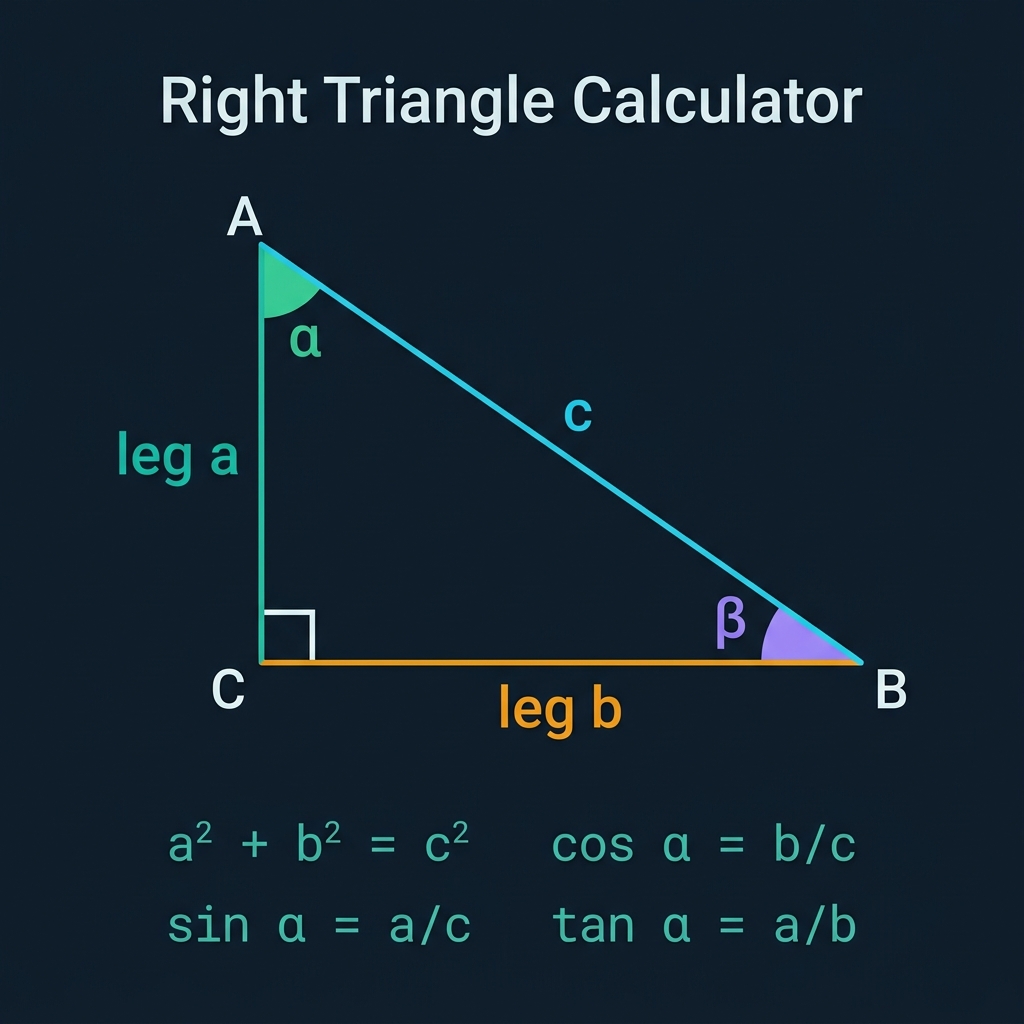
Named after the ancient Greek philosopher Pythagoras (c. 570–495 BCE), the Pythagorean theorem is one of the most fundamental relationships in all of mathematics:
- a² + b² = c² — The square of the hypotenuse equals the sum of the squares of the two legs.
- c = √(a² + b²) — Hypotenuse from both legs.
- a = √(c² − b²) — Leg a from hypotenuse and leg b.
- b = √(c² − a²) — Leg b from hypotenuse and leg a.
The theorem was known to the Babylonians over 1,000 years before Pythagoras — a clay tablet (Plimpton 322, c. 1800 BCE) lists Pythagorean triples. However, Pythagoras and his followers are credited with the first rigorous proof. There are over 370 distinct published proofs today, including visual proofs, algebraic proofs, and even one by U.S. President James Garfield in 1876.
SOH-CAH-TOA: Trigonometric Ratios Explained
When one side and one acute angle are known, trigonometric ratios give us all remaining sides. In a right triangle with hypotenuse c, leg a opposite to angle α, and leg b adjacent to α:
- sin(α) = opposite/hypotenuse = a/c → SOH
- cos(α) = adjacent/hypotenuse = b/c → CAH
- tan(α) = opposite/adjacent = a/b → TOA
- α = arctan(a/b) — angle from legs
- β = 90° − α — the other acute angle (since angles sum to 180°)
The mnemonic SOH-CAH-TOA was popularized in English-speaking countries and remains one of the most recognized memory aids in mathematics education. These ratios extend beyond right triangles to define the sine and cosine functions for all angles, forming the foundation of trigonometry, Fourier analysis, and signal processing.
Key Parts of a Right Triangle
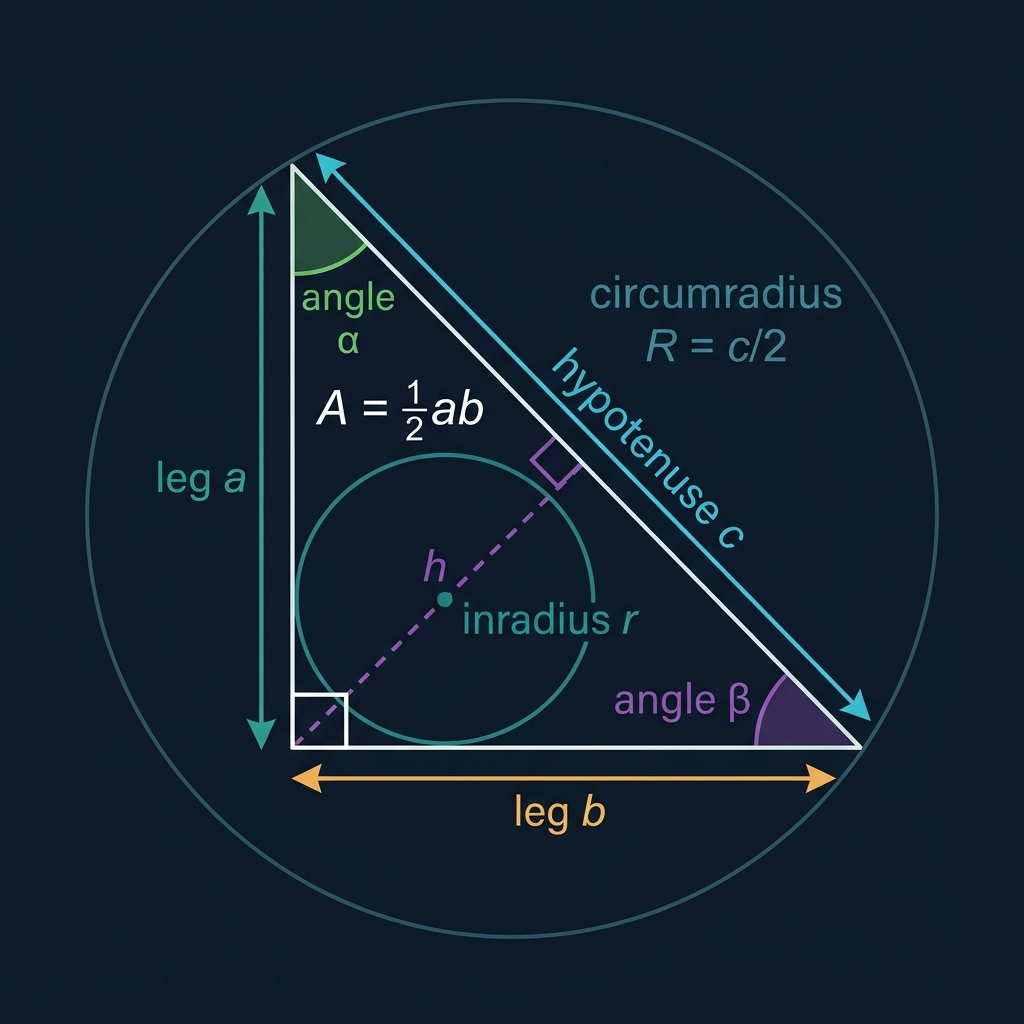
- Legs (a, b): The two shorter sides that form the right angle. Also called catheti (singular: cathetus) in Latin-derived terminology.
- Hypotenuse (c): The longest side, always opposite the 90° right angle. It is the diameter of the circumscribed circle (circumcircle) around the right triangle.
- Right Angle (90°): The defining feature of a right triangle, typically marked with a small square in diagrams.
- Acute Angles (α, β): The two non-right angles, always summing to 90°. α is opposite leg a; β is opposite leg b.
- Altitude (h): The perpendicular from the right-angle vertex to the hypotenuse. h = (a × b) / c. This altitude divides the hypotenuse into two segments and creates two smaller triangles, each similar to the original.
- Area: A = (a × b) / 2 — half the product of the two legs. Equivalently, A = (c × h) / 2.
- Perimeter: P = a + b + c — the sum of all three sides.
- Inradius (r): r = (a + b − c) / 2 — the radius of the inscribed circle tangent to all three sides.
- Circumradius (R): R = c / 2 — for a right triangle, the circumradius equals half the hypotenuse.
Special Right Triangles: 45-45-90 and 30-60-90
Two right triangles have side ratios so elegant they appear constantly in geometry, architecture, and engineering:
- 45-45-90 Triangle: The isosceles right triangle. Legs are equal (a = b); hypotenuse c = a√2 ≈ 1.4142a. Cutting a square diagonally creates two 45-45-90 triangles. Used in origami, diagonal roof trusses, and pixel diagonal calculations.
- 30-60-90 Triangle: Half of an equilateral triangle. If the shortest leg (opposite 30°) is a, then the longer leg is a√3 and the hypotenuse is 2a. The ratio 1 : √3 : 2. Appears in hexagonal grids, crystalline structures, and architectural equilateral layouts.
Pythagorean Triples — Perfect Integer Right Triangles
A Pythagorean triple is a set of three positive integers (a, b, c) satisfying a² + b² = c². The most famous are:
- 3-4-5: The classic, known to ancient Egyptians. Rope knotted at 13 equal intervals formed a 3-4-5 triangle for right-angle construction.
- 5-12-13: Used in carpentry and navigation.
- 8-15-17: A primitive triple used in surveying.
- 7-24-25, 20-21-29: Less obvious but exact.
- Infinite family: Any multiple of (3,4,5) — e.g., (6,8,10), (9,12,15) — is also a Pythagorean triple. There are infinitely many primitive triples, as proven by Euclid's formula: a = m²−n², b = 2mn, c = m²+n² for any positive integers m > n > 0.
Real-World Applications of Right Triangle Geometry
- Construction & carpentry: The 3-4-5 rule is used to ensure walls are perfectly square. Roof pitch is calculated as a right triangle ratio (rise over run). Stair stringers use right triangles to determine tread, rise, and stringer length.
- Navigation & surveying: GPS triangulation uses distances and angles. Surveyors use theodolites to measure angles and the law of sines to calculate distances across rivers or terrain features. The "measuring height of a tree" classic problem uses the tangent ratio.
- Architecture & engineering: Bridge truss design relies on right triangle analysis for load distribution. Ramps, inclines, and slopes are analyzed as right triangles. Diagonal bracing in steel structures follows hypotenuse calculations.
- Physics & vectors: Any 2D vector can be decomposed into horizontal and vertical components using SOH-CAH-TOA. Force analysis in mechanics, projectile motion, and wave superposition all use right-triangle trigonometry.
- Computer graphics & gaming: Calculating screen distances, collision detection, and 3D rotation matrices all depend on the Pythagorean theorem. The distance formula d = √((x₂−x₁)² + (y₂−y₁)²) is the Pythagorean theorem in coordinate form.
- Astronomy: Stellar parallax, calculating the distance to nearby stars, uses the right triangle formed by Earth's orbit, the star, and the baseline between two observation points six months apart.
The Geometric Mean Altitude Theorem
One of the most beautiful results in right triangle geometry: when altitude h is drawn from the right-angle vertex C to the hypotenuse, it creates two triangles (ACD and BCD) that are both similar to the original triangle ABC and to each other. This yields:
- h² = p × q — where p and q are the two segments the altitude divides the hypotenuse into (p + q = c).
- a² = p × c — leg a squared equals the adjacent hypotenuse segment times the full hypotenuse.
- b² = q × c — same relationship for leg b.
This geometric mean relationship appears in the proof of the Pythagorean theorem attributed to the ancient Greek mathematician Euclid (Book VI, Proposition 31).
Related Math Calculators
- Circumference Calculator — The circumscribed circle of a right triangle has radius R = c/2. Use this to find the circumference 2πR = πc of the circumcircle from any right triangle hypotenuse.
- Slope Calculator — The slope of the hypotenuse of a right triangle on a coordinate grid equals the tangent of the angle it makes with the horizontal: slope = tan(α) = a/b.
- Average Calculator — When averaging multiple triangle measurements in statistical geometry, use this tool to find mean side lengths or mean angles across a dataset.
- Percentage Calculator — Express any side as a percentage of another (e.g., leg a is what percent of hypotenuse c?). This connects proportions to trigonometric ratios.