Volume Calculator
Free Volume Calculator: instantly compute the volume of a cube, rectangular box, sphere, cylinder, cone, pyramid, triangular prism, and ellipsoid. Includes...
Formule utilis�e
How to Use the Volume Calculator
This Volume Calculator computes the exact volume of eight 3D geometric shapes from your measurements. Here is a step-by-step guide:
- Step 1 — Select a shape: Choose from Cube, Rectangular Box, Sphere, Cylinder, Cone, Pyramid (square base), Triangular Prism, or Ellipsoid using the shape tabs at the top of the calculator.
- Step 2 — Enter your measurements: Input the required dimensions (length, width, height, radius, etc.) for the selected shape. Each input accepts decimal values. Use the unit selector to choose your preferred length unit (mm, cm, m, in, ft, yd).
- Step 3 — Click Calculate: Instantly see the volume result, a full volume unit conversion table (cm³, mL, L, m³, in³, ft³, US gal, UK gal), and a step-by-step formula breakdown.
- Step 4 — Copy or share: Click any result tile to copy the value to your clipboard. All conversions are pre-computed.
The calculator uses IEEE 754 double-precision arithmetic for maximum accuracy. All unit conversions use exact SI and NIST-defined factors.
Cube Volume Formula
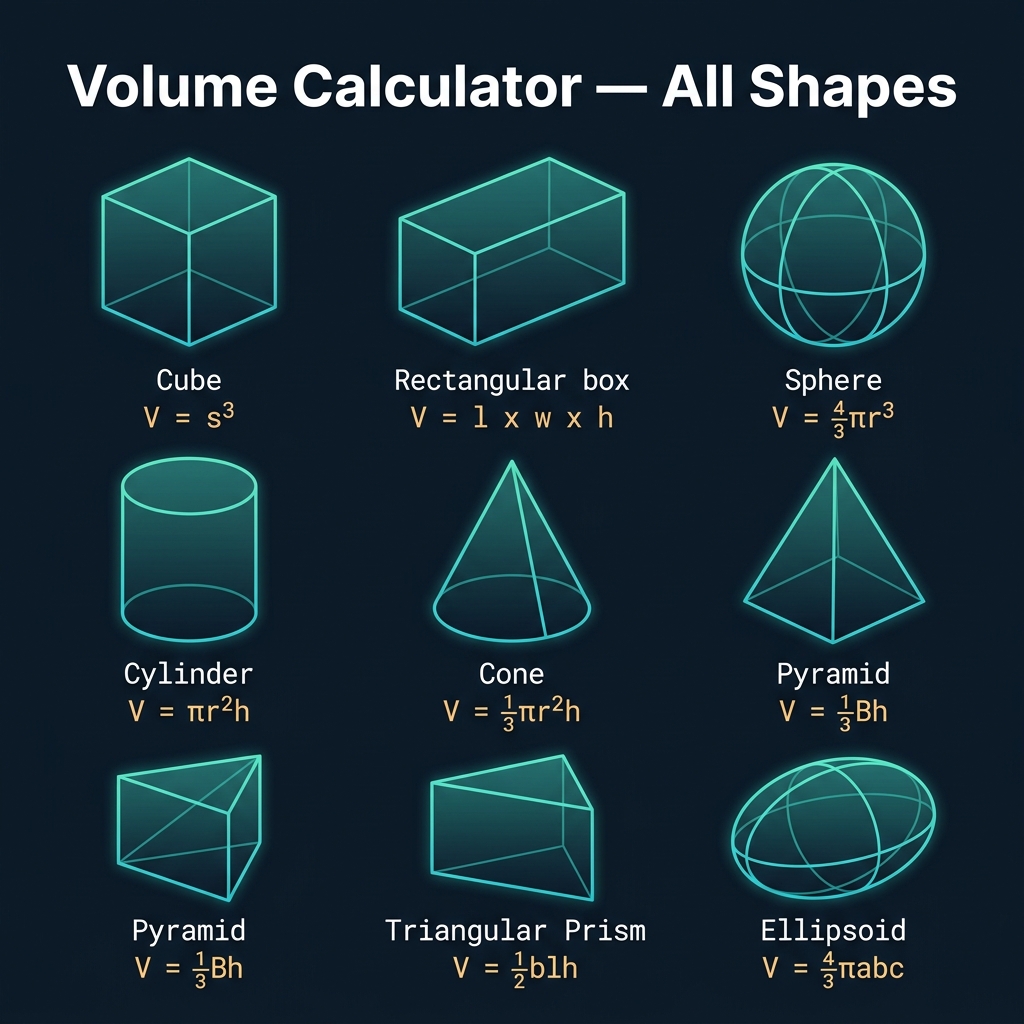
A cube is a regular solid with six equal square faces. All three dimensions are equal. The volume of a cube formula is:
- V = a³ — where a is the side length (edge length)
Example: A cube with side a = 5 cm. V = 5³ = 125 cm³. This is exactly 0.125 L. A standard Rubik's Cube is approximately 5.7 cm per side, giving V ≈ 185 cm³.
The cube is the most efficient rectangular solid — it encloses the maximum volume per unit of surface area among all rectangular boxes. Its surface area is A = 6a², and the space diagonal is d = a√3.
Rectangular Box (Cuboid) Volume Formula
A rectangular box (also called a cuboid or rectangular prism) has three pairs of identical rectangular faces. The volume of a rectangular prism formula is:
- V = l × w × h — length × width × height
Example: A shipping box measuring 30 cm × 20 cm × 15 cm. V = 30 × 20 × 15 = 9,000 cm³ = 9 L. This is the most commonly used volume formula in everyday life — from cardboard boxes to swimming pools to room volumes.
Surface area: A = 2(lw + lh + wh). Space diagonal: d = √(l² + w² + h²). When l = w = h, the box becomes a cube.
Sphere Volume Formula
A sphere is a perfectly round 3D solid where every point on its surface is equidistant from the center. The volume of a sphere formula (derived by Archimedes ca. 225 BCE) is:
- V = (4/3) × π × r³
Example: A basketball with radius r = 12 cm. V = (4/3) × π × 12³ = (4/3) × π × 1,728 = 7,238.2 cm³ ≈ 7.24 L.
The sphere encloses the maximum volume per unit of surface area of any shape — this is why soap bubbles and planets are spherical. The surface area of a sphere is A = 4πr². Archimedes proved that a sphere's volume is exactly (2/3) of the circumscribed cylinder's volume — a result he considered his greatest achievement.
Cylinder Volume Formula
A cylinder has two circular bases connected by a curved lateral surface. The volume of a cylinder formula is:
- V = π × r² × h
Example: A water tank with r = 0.5 m and h = 1.2 m. V = π × 0.25 × 1.2 = 0.9425 m³ = 942.5 L. For a dedicated calculator, see the Cylinder Volume Calculator which also computes surface area, hollow cylinders, and oblique cylinders.
Cone Volume Formula
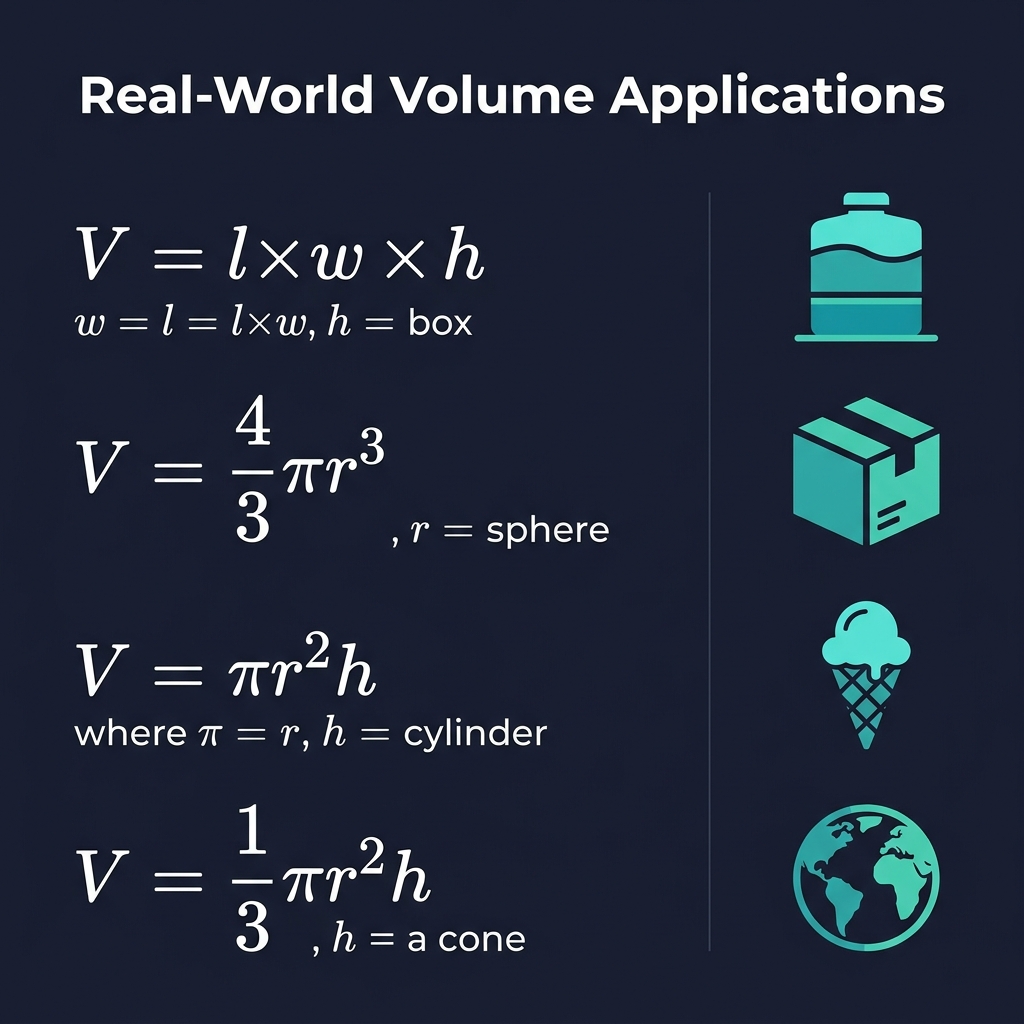
A cone has a circular base and tapers to a point (apex). The volume of a cone is one-third of the cylinder with the same base and height:
- V = (1/3) × π × r² × h
Example: An ice cream cone with r = 3 cm and h = 10 cm. V = (1/3) × π × 9 × 10 = 94.25 cm³ ≈ 94.25 mL. The "one-third rule" applies to all pyramids and cones: their volume is always (1/3) of the corresponding prism or cylinder with the same base and height. This relationship was proved by Eudoxus of Cnidus.
Square Pyramid Volume Formula
A square pyramid has a square base and four triangular faces meeting at an apex. Its volume formula follows the (1/3) rule:
- V = (1/3) × a² × h — where a is the base side length and h is the perpendicular height
Example: The Great Pyramid of Giza has base side a ≈ 230.4 m and height h ≈ 138.5 m (original). V = (1/3) × 230.4² × 138.5 = (1/3) × 53,084 × 138.5 ≈ 2,451,000 m³. That's 2.45 million cubic metres of solid material.
Triangular Prism Volume Formula
A triangular prism has two triangular bases and three rectangular lateral faces. The volume of a triangular prism is:
- V = (1/2) × b × tri_h × l — where b is the triangle base, tri_h is the triangle height, and l is the prism length
Example: A Toblerone chocolate box with triangular base (b = 5 cm, tri_h = 4.33 cm) and length l = 20 cm. V = 0.5 × 5 × 4.33 × 20 = 216.5 cm³. Triangular prisms are commonly used in architecture (roof sections, ramps), optics (glass prisms for light dispersion), and structural engineering.
Ellipsoid Volume Formula
An ellipsoid is a generalization of a sphere with three potentially different semi-axes. The volume of an ellipsoid is:
- V = (4/3) × π × a × b × c — where a, b, c are the three semi-axes
When a = b = c = r, this reduces to the sphere formula (4/3)πr³. When a = b ≠ c, it produces a prolate (c > a) or oblate (c < a) spheroid. The Earth itself is an oblate spheroid with equatorial radius a ≈ 6,378 km and polar radius c ≈ 6,357 km, giving V ≈ 1.083 × 10¹² km³.
Volume Unit Conversions
Volume units span an enormous range of scales. Key conversions:
- 1 L = 1,000 cm³ = 1 dm³
- 1 m³ = 1,000 L = 1,000,000 cm³
- 1 US gallon = 3.785 L = 3,785.41 cm³
- 1 UK gallon = 4.546 L = 4,546.09 cm³
- 1 in³ = 16.387 cm³
- 1 ft³ = 28,316.85 cm³ = 28.317 L
The calculator automatically generates a conversion table for all these units from your computed volume. Click any cell to copy the value.
Related Calculators — Internal Links
- Cylinder Volume Calculator — Advanced cylinder calculator with hollow cylinder (pipe) mode, oblique cylinder, inverse solving (find radius or height from volume), and full surface area computation.
- Area of a Circle Calculator — Compute full circle area, circumference, diameter, and radius. Essential for cylinder and cone base calculations.
- Circumference Calculator — Circle circumference, arc length, sector area, and diameter from any known measurement.
- Right Triangle Calculator — Solve right triangles by sides and angles. Useful for computing pyramid heights and cone slant lengths.
- Triangle Area Calculator — Calculate triangle area by multiple methods (base-height, Heron's formula, SAS, SSA, SSS, coordinates). Needed for triangular prism base area.
- Pythagorean Theorem Calculator — Find the hypotenuse or any side of a right triangle. Used to compute cone slant height from radius and perpendicular height.