Trigonometry Calculator
Free online Trigonometry Calculator: compute all 6 trig functions (sin, cos, tan, csc, sec, cot) in degrees or radians, solve trig equations, explore the...
Formula used
How to Use the Trigonometry Calculator
This calculator provides five distinct tools in one interface. Select the tab that matches your problem:
- All 6 Functions: Enter any angle in degrees or radians, and the calculator computes all six trigonometric functions simultaneously — sin, cos, tan, csc, sec, and cot — with exact values for common angles (0°, 30°, 45°, 60°, 90°) and decimal approximations for all others.
- Inverse Functions: Enter a value and solve for the angle. Computes arcsin (sin⁻¹), arccos (cos⁻¹), and arctan (tan⁻¹) with results in both degrees and radians. Shows all equivalent angles (principal value plus supplementary/co-terminal solutions).
- Law of Sines: Given two angles and one side, or two sides and an angle, solve for all missing sides and angles in any triangle using the Law of Sines (a/sin A = b/sin B = c/sin C).
- Law of Cosines: Given three sides (SSS) or two sides and the included angle (SAS), solve completely for all sides and angles using the Law of Cosines: c² = a² + b² − 2ab cos C.
- Angle Converter: Convert between degrees, radians, gradians, and turns with full precision. Displays equivalent values on the unit circle and in common fraction-of-π notation.
All results include step-by-step working, exact values where applicable, and an interactive unit-circle position indicator showing where the angle falls on the circle.
The Six Trigonometric Functions
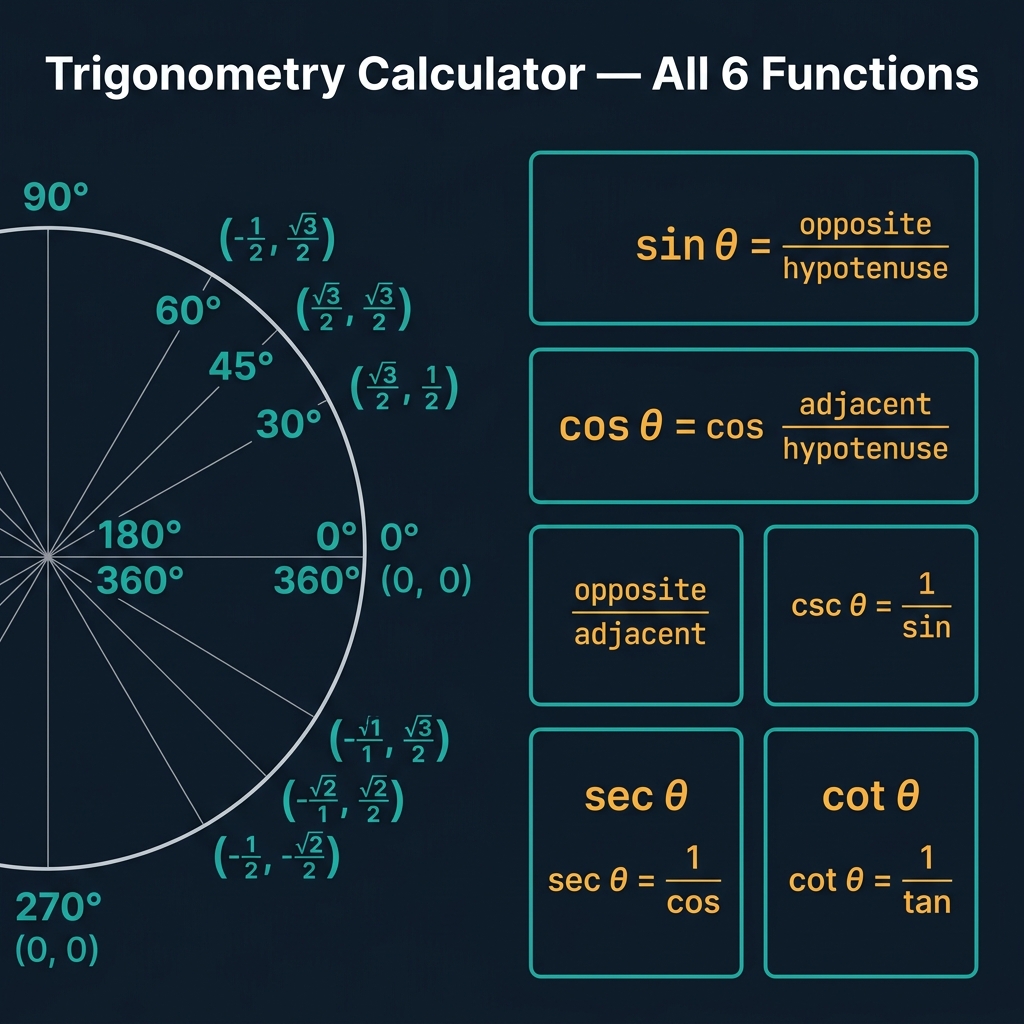
All six trigonometric functions are defined from right-triangle ratios and extended to all angles via the unit circle:
- Sine (sin θ): Opposite leg ÷ Hypotenuse. On the unit circle, sin θ = y-coordinate of the point at angle θ. Range: [−1, 1]. Positive in Quadrants I and II.
- Cosine (cos θ): Adjacent leg ÷ Hypotenuse. On the unit circle, cos θ = x-coordinate. Range: [−1, 1]. Positive in Quadrants I and IV.
- Tangent (tan θ): Opposite ÷ Adjacent = sin θ / cos θ. Range: (−∞, +∞). Undefined where cos θ = 0 (at 90°, 270°, …). Positive in Quadrants I and III.
- Cosecant (csc θ): Reciprocal of sine: 1/sin θ. Range: (−∞, −1] ∪ [1, +∞). Undefined where sin θ = 0 (at 0°, 180°, …).
- Secant (sec θ): Reciprocal of cosine: 1/cos θ. Range: (−∞, −1] ∪ [1, +∞). Undefined where cos θ = 0.
- Cotangent (cot θ): Reciprocal of tangent: cos θ / sin θ. Range: (−∞, +∞). Undefined where sin θ = 0.
The mnemonic SOH-CAH-TOA (Sine=Opposite/Hypotenuse, Cosine=Adjacent/Hypotenuse, Tangent=Opposite/Adjacent) covers the primary three functions for right triangles.
The Unit Circle and Exact Values
The unit circle (radius = 1) provides exact values at the standard angles. Every point on the circle has coordinates (cos θ, sin θ):
- 0° (0 rad): (1, 0) → sin 0° = 0, cos 0° = 1, tan 0° = 0
- 30° (π/6): (√3/2, 1/2) → sin 30° = 1/2, cos 30° = √3/2, tan 30° = 1/√3 = √3/3
- 45° (π/4): (√2/2, √2/2) → sin 45° = cos 45° = √2/2, tan 45° = 1
- 60° (π/3): (1/2, √3/2) → sin 60° = √3/2, cos 60° = 1/2, tan 60° = √3
- 90° (π/2): (0, 1) → sin 90° = 1, cos 90° = 0, tan 90° = undefined
- 180° (π): (−1, 0) → sin 180° = 0, cos 180° = −1, tan 180° = 0
- 270° (3π/2): (0, −1) → sin 270° = −1, cos 270° = 0, tan 270° = undefined
- 360° (2π): (1, 0) → same as 0°
All other quadrant values follow by symmetry: for an angle θ in Quadrant II, sin θ = sin(180° − θ), cos θ = −cos(180° − θ). The ASTC rule (All Students Take Calculus) identifies which functions are positive in each quadrant: All (I), Sine (II), Tangent (III), Cosine (IV).
Essential Trigonometric Identities
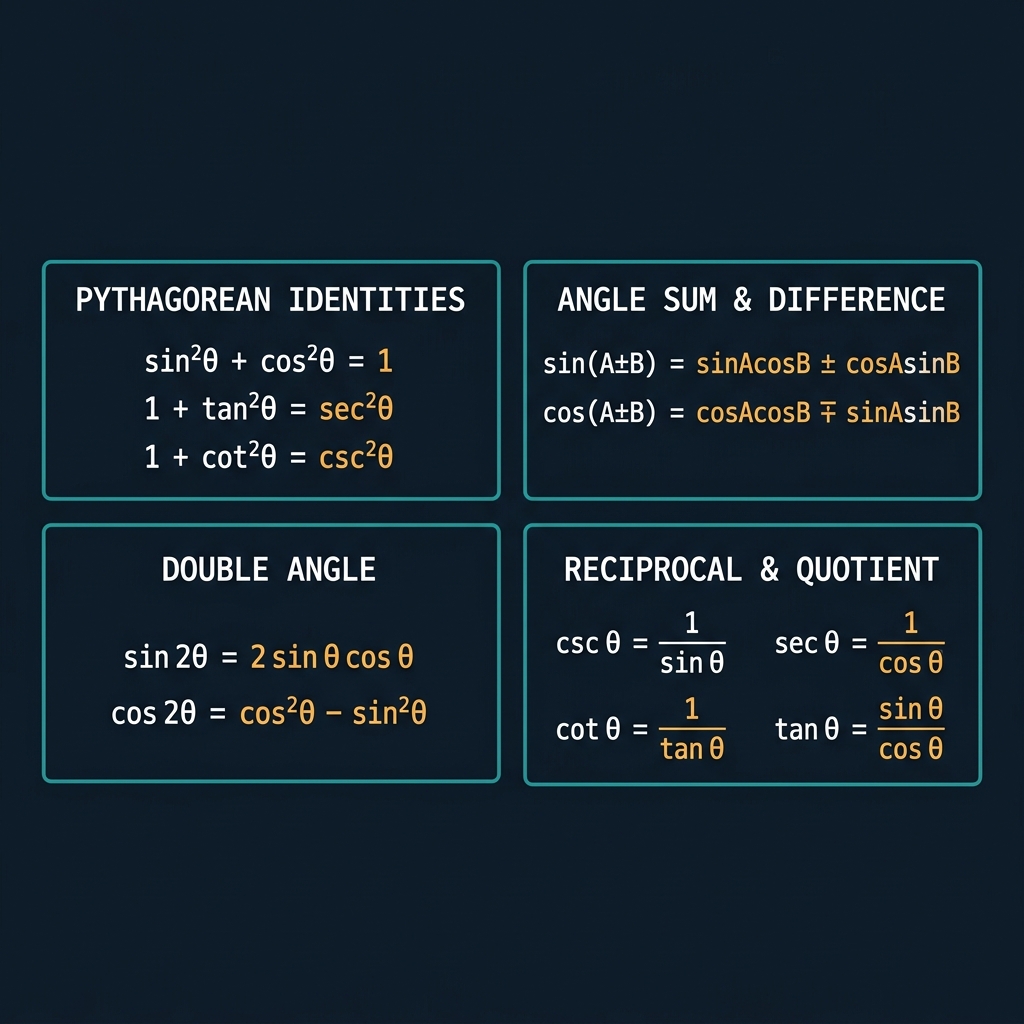
Trig identities are equations that hold for all valid values of θ:
- Pythagorean Identities: sin²θ + cos²θ = 1 (fundamental). Divide by cos²θ: tan²θ + 1 = sec²θ. Divide by sin²θ: 1 + cot²θ = csc²θ. These follow directly from the unit circle equation x² + y² = 1.
- Angle Sum/Difference: sin(A ± B) = sin A cos B ± cos A sin B. cos(A ± B) = cos A cos B ∓ sin A sin B. tan(A ± B) = (tan A ± tan B) / (1 ∓ tan A tan B).
- Double Angle: sin 2θ = 2 sin θ cos θ. cos 2θ = cos²θ − sin²θ = 2cos²θ − 1 = 1 − 2sin²θ. tan 2θ = 2 tan θ / (1 − tan²θ).
- Half Angle: sin(θ/2) = ±√[(1 − cos θ)/2]. cos(θ/2) = ±√[(1 + cos θ)/2]. Sign depends on the quadrant of θ/2.
- Product-to-Sum: sin A sin B = ½[cos(A−B) − cos(A+B)]. cos A cos B = ½[cos(A−B) + cos(A+B)]. Useful for integrating products of trig functions.
Law of Sines and Law of Cosines
These laws extend trigonometry beyond right triangles to any triangle with sides a, b, c opposite angles A, B, C:
- Law of Sines: a/sin A = b/sin B = c/sin C = 2R (where R = circumradius). Use when you know: (1) AAS or ASA — two angles and any side; (2) SSA — two sides and an angle opposite one of them (beware the ambiguous case).
- Law of Cosines: c² = a² + b² − 2ab cos C. Rearranged: cos C = (a² + b² − c²) / (2ab). Use when you know: (1) SAS — two sides and the included angle; (2) SSS — all three sides. Note: when C = 90°, cos C = 0 and the law reduces to the Pythagorean theorem.
- Ambiguous Case (SSA): Given sides a, b and angle A (not the included angle). The triangle can have 0, 1, or 2 valid solutions depending on whether a < b sin A (no triangle), a = b sin A (right triangle), b sin A < a < b (two triangles), or a ≥ b (one triangle).
- Area from trig: Area = ½ ab sin C. This allows calculating triangle area from any two sides and their included angle — no altitude needed.
Inverse Trigonometric Functions
Inverse functions answer "what angle has this trig value?" They have restricted domains to remain functions:
- arcsin (sin⁻¹): Domain [−1, 1], range [−90°, 90°] or [−π/2, π/2]. Example: arcsin(0.5) = 30°. Note that sin(30°) = sin(150°) = 0.5, so the general solution is θ = 30° + 360°n or θ = 150° + 360°n.
- arccos (cos⁻¹): Domain [−1, 1], range [0°, 180°] or [0, π]. Example: arccos(0.5) = 60°.
- arctan (tan⁻¹): Domain (−∞, +∞), range (−90°, 90°) or (−π/2, π/2). Example: arctan(1) = 45°. The four-quadrant version atan2(y, x) correctly handles all quadrants.
For engineering and navigation, the two-argument arctangent (atan2) is preferred because it uses both signs of the coordinates to determine the correct quadrant, whereas the standard arctan only returns values in (−π/2, π/2).
Real-World Applications of Trigonometry
- Engineering and Surveying: Theodolites measure horizontal and vertical angles. A surveyor measuring a building from 50m away at a 25° elevation angle computes height = 50 × tan(25°) = 23.3m. See our Right Triangle Calculator for side-and-angle solving in construction problems.
- Navigation: Bearing problems use trigonometry. A ship traveling on bearing 042° for 80 km has moved 80 sin(42°) = 53.5 km east and 80 cos(42°) = 59.5 km north. GPS systems use spherical trigonometry on the Earth's surface.
- Physics — Waves: Sound, light, and electromagnetic waves are modeled as sinusoids. A wave with amplitude A, frequency f, and phase φ: y(t) = A sin(2πft + φ). Fourier analysis decomposes any periodic signal into a sum of sine and cosine waves.
- Architecture: Roof pitch, staircase angles, and arch design all use trigonometric ratios. A 7:12 pitch (7 inches rise per 12 inches run) corresponds to arctan(7/12) = 30.26°. Use our Slope Calculator to convert pitch ratios to angles.
- Computer Graphics: 3D rotation matrices are built from sin and cos. Rotating a point (x, y) by angle θ: x' = x cos θ − y sin θ, y' = x sin θ + y cos θ. Every 3D game, animation, and rendering engine relies on this.
- Astronomy: Parallax measurements use small-angle approximations (sin θ ≈ θ for small θ in radians). The Earth-Sun distance can be measured using transit of Venus times and sine of the observed parallax angle.
Degrees vs. Radians
There are two primary angle units used in trigonometry:
- Degrees: A full circle = 360°. Most familiar from everyday geometry, navigation, and construction. Calculators often default to degree mode. Each degree = 60 minutes (60'), each minute = 60 seconds (60").
- Radians: A full circle = 2π radians ≈ 6.2832 rad. Radians are the natural unit for calculus because the derivative of sin x = cos x only when x is in radians. One radian ≈ 57.2958°. Conversion: radians × (180/π) = degrees; degrees × (π/180) = radians.
- Gradians (gon): A full circle = 400 gradians. Used in surveying (especially in Europe). 100 gradians = 90°.
- Turns: A full circle = 1 turn. 0.25 turns = 90°. Sometimes used in physics and computer programming for clarity.
Key radian values: π/6 = 30°, π/4 = 45°, π/3 = 60°, π/2 = 90°, π = 180°, 3π/2 = 270°, 2π = 360°. Always check your calculator's angle mode before computing — using radians instead of degrees (or vice versa) is among the most common errors in physics and engineering calculations.
Related Math Calculators
- Right Triangle Calculator — Solve any right triangle given two known measures (sides or angles). Uses sin, cos, tan internally and shows which trig function applies to each computation. The ideal companion for right-triangle trig problems.
- Slope Calculator — Slope (rise/run) and angle are related by tan θ = slope. Convert between slope percentage, angle in degrees, and rise:run ratio. Directly applies arctan to find the angle from a known slope.
- Circumference Calculator — Arc length = r × θ (θ in radians). Sector area = ½r²θ. These formulas rely on radian measure of angles — understanding trig makes these formulas intuitive.
- Significant Figures Calculator — Trig results like sin(27°) = 0.45399... should be rounded to the appropriate number of significant figures matching your input precision. Use this tool to properly round trig results for lab reports and engineering calculations.
- Percentage Calculator — Express trig results as percentages for efficiency calculations (e.g., efficiency of a force component at angle θ = cos θ × 100%). Combine trig with percentage arithmetic for physics and engineering applications.