Area of a Circle Calculator
Free Area of a Circle Calculator: compute circle area from radius, diameter, or circumference; reverse-calculate radius from area; support for 10 units...
Formule utilis�e
The Area of a Circle Formula: A = πr²
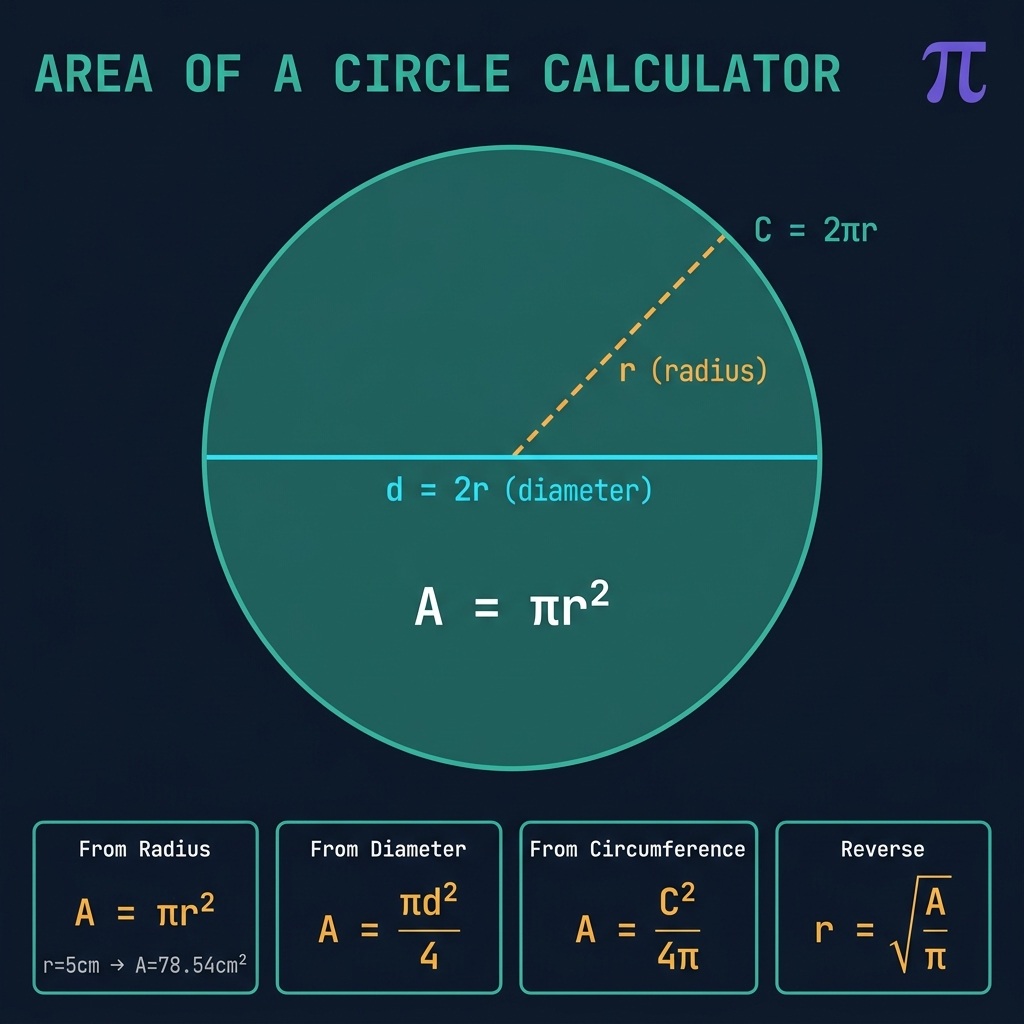
The area of a circle is the total region enclosed within the circle's boundary. The fundamental formula, discovered by Archimedes around 250 BC, is:
A = π × r²
where A is the area, r is the radius (the distance from the center to any point on the boundary), and π (pi) is the mathematical constant approximately equal to 3.14159265358979…. This formula tells us that the area grows with the square of the radius — doubling the radius quadruples the area. That non-linear relationship is the most important fact to internalize about circle geometry.
- Why π appears: π is the ratio of a circle's circumference to its diameter (C/d = π). When Archimedes inscribed and circumscribed polygons around a circle (the method of exhaustion), he proved that the area equals exactly πr². The modern proof uses calculus: integrating thin annular rings from r = 0 to r = R gives ∫₀ᴿ 2πr dr = πR².
- Exact vs. approximate: For a circle of radius 5 cm, the exact area is 25π cm² ≈ 78.5398 cm². Leaving the answer in terms of π is mathematically exact and often preferred in theoretical work.
Calculating Area from the Radius
Given the radius r, the area formula is straightforward. Step-by-step:
- Square the radius: Compute r² = r × r. For r = 7 m, r² = 49 m².
- Multiply by π: A = π × 49 = 3.14159265 × 49 ≈ 153.938 m².
- Round appropriately: For engineering contexts, 153.94 m² (4 significant figures). For pure mathematics, 49π m² is exact.
Common examples:
- r = 1 cm → A = π cm² ≈ 3.1416 cm²
- r = 5 cm → A = 25π cm² ≈ 78.540 cm²
- r = 10 m → A = 100π m² ≈ 314.159 m²
- r = 1 mile → A = π mi² ≈ 3.1416 mi²
The area grows quadratically with radius. A circle with r = 10 m has 100 times the area of one with r = 1 m, not 10 times. This quadratic scaling is why large circular structures (stadiums, roundabouts, craters) have far more area than intuitively expected.
Area from Diameter: A = πd²/4
The diameter d = 2r is often easier to measure physically (you measure across the full width rather than from center to edge). Substituting r = d/2 into A = πr²:
A = π(d/2)² = πd²/4
Examples:
- d = 10 cm → A = π × 100/4 = 25π ≈ 78.540 cm²
- d = 6 ft → A = π × 36/4 = 9π ≈ 28.274 ft²
- d = 1 m → A = π/4 ≈ 0.7854 m²
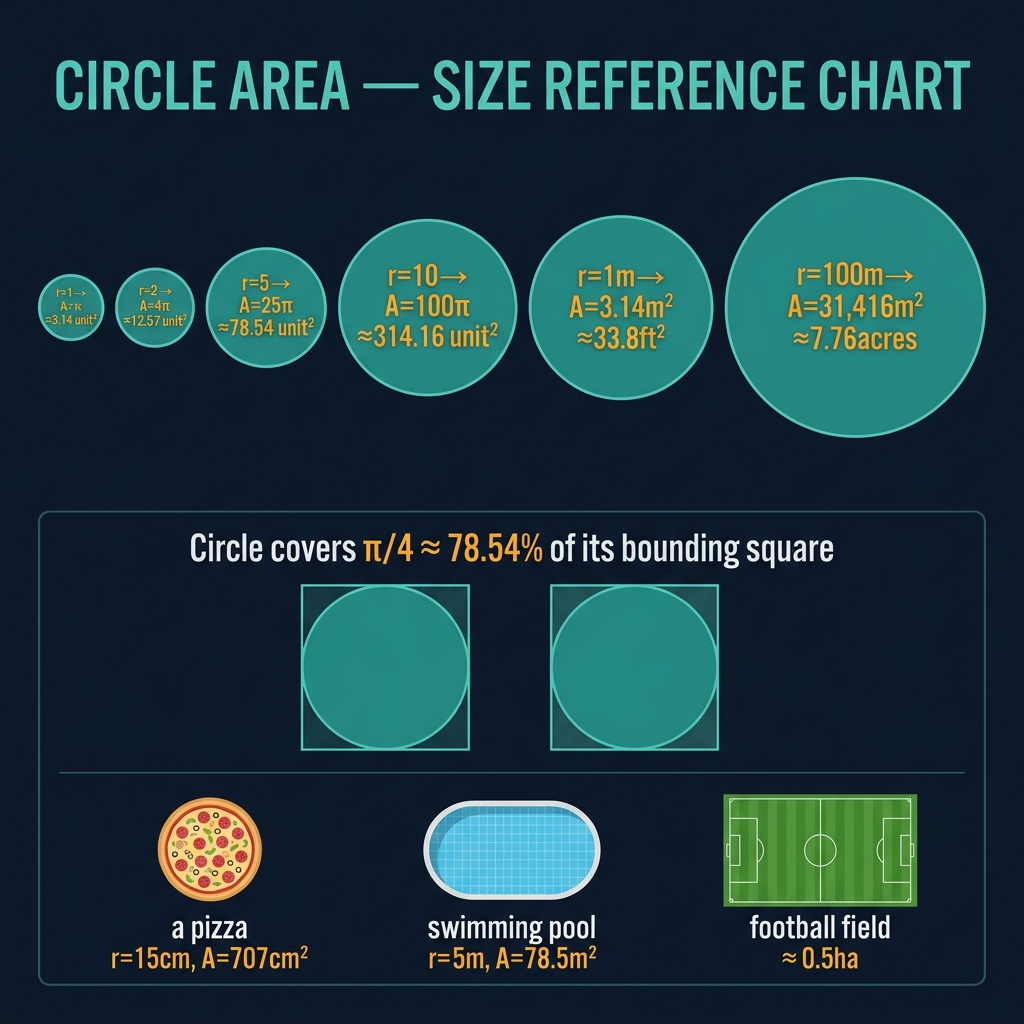
Note that A = πd²/4 = (π/4)d². The factor π/4 ≈ 0.7854 is the ratio of the circle's area to its bounding square (a square with side = diameter). In other words, a circle always covers exactly 78.54% of the square that tightly circumscribes it — a beautiful geometric constant that holds for any circle size, as related to our Pythagorean Theorem Calculator which explores the geometric relationships between shapes.
Area from Circumference: A = C²/(4π)
When you know the perimeter (circumference) of a circle rather than its linear dimensions, substitute C = 2πr → r = C/(2π) into A = πr²:
A = π × (C/(2π))² = π × C²/(4π²) = C²/(4π)
Examples:
- C = 31.416 m (≈ 10π) → A = (31.416)²/(4π) = 987.0/12.566 ≈ 78.54 m²
- C = 100 ft → A = 10,000/(4π) = 10,000/12.566 ≈ 795.77 ft²
- C = 1 km → A = 1/(4π) km² ≈ 0.07958 km²
This formula is used when only the boundary is measurable, such as estimating the area of a circular lake from its shoreline perimeter, or computing the cross-section of a cylindrical pipe from its outer circumference. The Circumference Calculator handles the forward direction (radius → circumference); this formula is the inverse path.
Reverse Calculation: Find Radius from Area
Given a known area A, you can reverse-calculate the radius and all other circle dimensions:
- Radius: r = √(A/π)
- Diameter: d = 2r = 2√(A/π)
- Circumference: C = 2πr = 2π√(A/π) = 2√(πA)
Step-by-step example: A circular garden has area 200 m². Find its radius and boundary fence length.
- Divide by π: A/π = 200/3.14159 ≈ 63.6620 m²
- Take the square root: r = √63.6620 ≈ 7.979 m
- Diameter: d = 2 × 7.979 ≈ 15.958 m
- Circumference (fence): C = 2π × 7.979 ≈ 50.133 m of fencing needed
The reverse calculation is essential in land planning, hydraulics (pipe sizing from flow area), and structural engineering (column cross-section from load-bearing area requirements).
Area Units and Conversions
Our calculator supports 10 area units for output and 8 length units for input. Key conversion factors:
- 1 m² = 10,000 cm² = 1,000,000 mm²
- 1 km² = 1,000,000 m² = 100 hectares = 247.105 acres
- 1 hectare (ha) = 10,000 m² (100 m × 100 m square)
- 1 acre = 4,046.856 m² ≈ 0.4047 ha (approximately a football field)
- 1 ft² = 0.0929 m², 1 m² ≈ 10.764 ft²
- 1 in² = 6.4516 cm², 1 cm² ≈ 0.155 in²
For practical examples, a standard pizza (r = 15 cm) has area = 225π ≈ 706.86 cm² ≈ 0.0707 ft². A circular swimming pool (r = 5 m) has area = 25π ≈ 78.54 m² ≈ 845.5 ft². A 2-acre circular plot has area = 8,093.7 m², so r = √(8,093.7/π) ≈ 50.76 m ≈ 166.5 ft.
For high-precision results, our Significant Figures Calculator helps you correctly round results that depend on the precision of your radius measurement — a critical step in scientific reporting.
Advanced Circle Formulas: Sectors, Annuli, and Ellipses
- Sector area: A sector is a "pizza slice" with central angle θ (in degrees). A_sector = (θ/360°) × πr². For θ = 90°: A_sector = πr²/4 (quarter circle). For θ = 180°: A_sector = πr²/2 (semicircle).
- Annulus (ring) area: The region between two concentric circles with radii R (outer) and r (inner). A_annulus = π(R² − r²) = π(R + r)(R − r). For a pipe wall with outer r = 5 cm and inner r = 4 cm: A = π(25 − 16) = 9π ≈ 28.27 cm².
- Semicircle area: A_semi = πr²/2. Perimeter of semicircle = πr + 2r = r(π + 2) ≈ 5.1416r.
- Ellipse area: For a stretched circle with semi-major axis a and semi-minor axis b, A_ellipse = πab. When a = b = r, this reduces to πr² (circle). This connects circle area to the more general conic section family.
The Triangle Area Calculator complements circle area: many complex shapes (stadium tracks, circular segments) combine circle sectors with triangles, and the combined area is simply the sum of each component's area.
Real-World Applications of Circle Area
- Architecture and Construction: Circular floor plans, dome cross-sections, spiral staircases. A circular room of radius 4 m has floor area = 16π ≈ 50.27 m². Knowing the area guides material selection, heating/cooling load, and occupancy calculations.
- Land Use and Agriculture: Center-pivot irrigation systems use circular fields. A pivot arm of length 400 m (¼ mile) irrigates A = π × 400² ≈ 502,655 m² ≈ 50.27 ha ≈ 124.2 acres. Multiple overlapping pivots require computing intersection areas using circular segment formulas.
- Pipe Flow (Hydraulics): Flow rate Q = v × A where A = πr² is the pipe's cross-sectional area. A 6-inch (r = 3 in = 7.62 cm) pipe has A = π × (0.0762)² ≈ 0.01824 m². At water velocity 2 m/s, Q = 0.0365 m³/s ≈ 3,650 L/min.
- Optics and Telescope Apertures: Light-gathering power ∝ aperture area = πr². A telescope with 200 mm (r = 100 mm) aperture gathers (100/50)² = 4× more light than a 100 mm telescope. This quadratic gain is why large telescopes dramatically outperform small ones.
- Pizza and Food: A 16-inch pizza has area = π × 8² ≈ 201.06 in². A 12-inch pizza has area = π × 6² ≈ 113.10 in². The 16-inch pizza provides 201/113 ≈ 1.78× more food, but may cost only 1.3× more — making larger pizzas better value, a real-world application of the quadratic area formula.
- Astronomy: The angular diameter of the Sun is ≈ 0.5°. From Earth, the Sun's projected disk area ≈ π × (6.957 × 10⁸ m)² ≈ 1.521 × 10¹⁸ m². Our Antilog Calculator is useful when computing these exponential-scale astronomical quantities, since 6.957 × 10⁸ = antilog(8.8423).
- Statistics (Standard Normal / Circular Error): The 2D normal distribution's probability within radius r is P = 1 − e^(−r²/2σ²). The "Circular Error Probable" (CEP) in missile accuracy is the radius r₅₀ within which 50% of impacts fall — computed by solving 1 − e^(−r²/(2σ²)) = 0.5, giving r₅₀ = σ√(2 ln 2). The circle's area drives probability calculations.
The Isoperimetric Inequality: Circles Maximize Area
The isoperimetric inequality states that among all closed curves with a given perimeter P, the circle encloses the maximum possible area: A ≤ P²/(4π), with equality if and only if the shape is a circle. This is why:
- A circular field of perimeter 100 m has area = 100²/(4π) ≈ 795.77 m²
- A square of perimeter 100 m has side 25 m, area = 625 m² (only 78.5% of the circle's area)
- A regular hexagon of perimeter 100 m has area ≈ 721.7 m² (closer to circle, but still less)
This principle has profound consequences: soap bubbles form spheres (3D analog) to minimize surface energy, cell membranes trend circular in cross-section, and optimal tank designs use cylindrical shapes. The Pythagorean relationship a² + b² = c² (see Pythagorean Theorem Calculator) and the circle area formula A = πr² are the two most fundamental area formulas in geometry.
Related Calculators
- Circumference Calculator — Computes C = 2πr and all related circle metrics (arc length for any angle, sector perimeter, chord length). Since A = C²/(4π), any circumference result can be immediately converted to area using our formula cards. The circumference calculator is the natural companion for complete circle analysis.
- Pythagorean Theorem Calculator — The relationship between a circle and its inscribed or circumscribed right triangle is fundamental. For a right triangle inscribed in a circle (diameter = hypotenuse by Thales' theorem): if the hypotenuse is d, the circle's radius r = d/2 and area A = πd²/4. The Pythagorean theorem gives all three sides from which the circumscribed circle can be computed.
- Triangle Area Calculator — Complex shapes (circular segments, stadium tracks, arch windows) combine circle sectors with triangles. A circular segment is the area between a chord and the arc: A_segment = A_sector − A_triangle = (θ/360°)πr² − (r²/2)sin(θ). Both circle and triangle area formulas are needed simultaneously for these calculations.
- Antilog Calculator — Very large or very small circle areas (astronomical or nanoscale) are expressed in scientific notation as a × 10^n. The antilog computes 10^x instantly for interpreting logarithmic area scales. For example, a circular asteroid of radius 500 km has area = π × (5×10⁵)² ≈ 7.854 × 10¹¹ m² = antilog(11.895) m².
- Significant Figures Calculator — When the radius is measured with limited precision (e.g., r = 3.5 cm with 2 sig figs), the area A = π × (3.5)² = 38.48... cm² should be reported as 38 cm² (2 sig figs), not 38.48 cm². The significant figures rule for multiplication: the result has the same sig figs as the least-precise input. This calculator ensures your circle area reporting meets scientific precision standards.