Trigonometry Calculator
Free online Trigonometry Calculator: compute all 6 trig functions (sin, cos, tan, csc, sec, cot) in degrees or radians, solve trig equations, explore the...
Formule utilis�e
How to Use the Trigonometry Calculator
This calculator provides five distinct tools in one interface. Select the tab that matches your problem:
- All 6 Functions: Enter any angle in degrees or radians, and the calculator computes all six trigonometric functions simultaneously — sin, cos, tan, csc, sec, and cot — with exact values for common angles (0°, 30°, 45°, 60°, 90°) and decimal approximations for all others.
- Inverse Functions: Enter a value and solve for the angle. Computes arcsin (sin⁻¹), arccos (cos⁻¹), and arctan (tan⁻¹) with results in both degrees and radians. Shows all equivalent angles (principal value plus supplementary/co-terminal solutions).
- Law of Sines: Given two angles and one side, or two sides and an angle, solve for all missing sides and angles in any triangle using the Law of Sines (a/sin A = b/sin B = c/sin C).
- Law of Cosines: Given three sides (SSS) or two sides and the included angle (SAS), solve completely for all sides and angles using the Law of Cosines: c² = a² + b² − 2ab cos C.
- Angle Converter: Convert between degrees, radians, gradians, and turns with full precision. Displays equivalent values on the unit circle and in common fraction-of-π notation.
All results include step-by-step working, exact values where applicable, and an interactive unit-circle position indicator showing where the angle falls on the circle.
The Six Trigonometric Functions
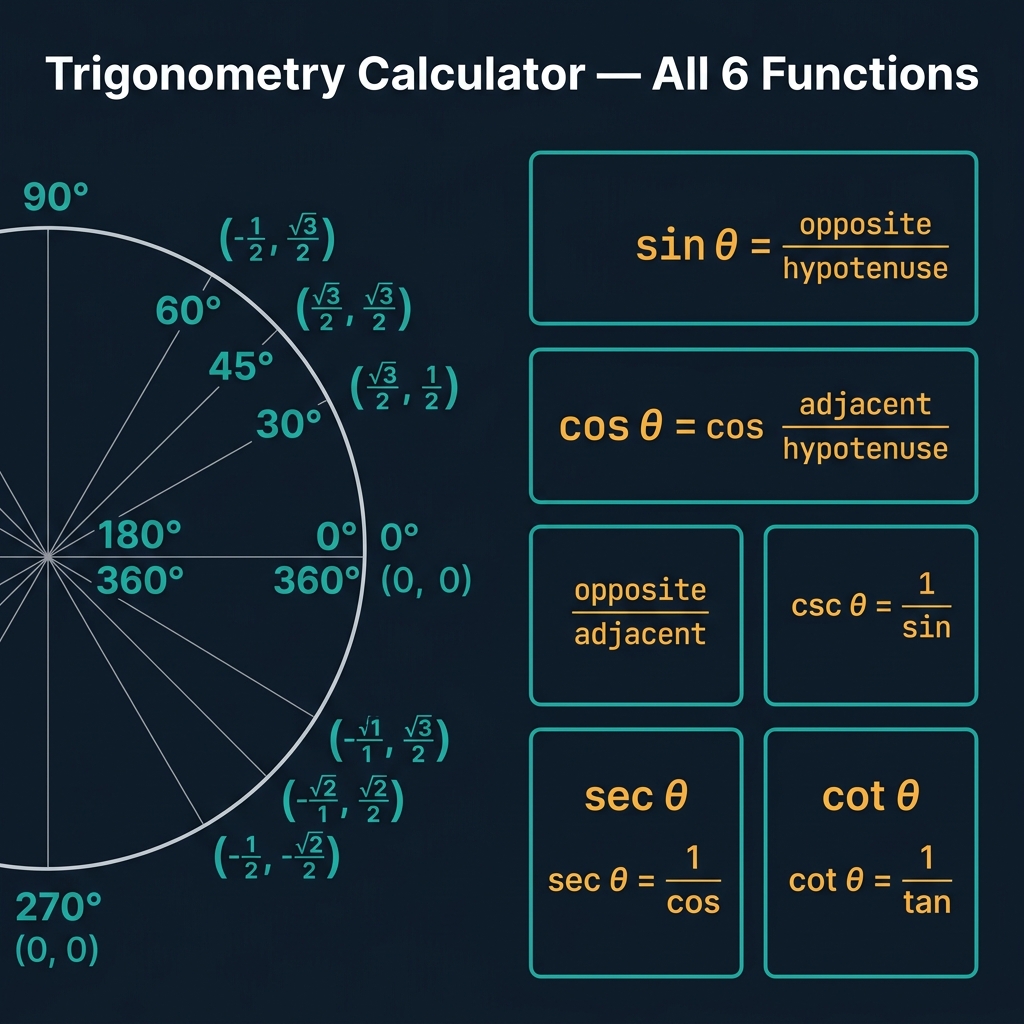
All six trigonometric functions are defined from right-triangle ratios and extended to all angles via the unit circle:
- Sine (sin θ): Opposite leg ÷ Hypotenuse. On the unit circle, sin θ = y-coordinate of the point at angle θ. Range: [−1, 1]. Positive in Quadrants I and II.
- Cosine (cos θ): Adjacent leg ÷ Hypotenuse. On the unit circle, cos θ = x-coordinate. Range: [−1, 1]. Positive in Quadrants I and IV.
- Tangent (tan θ): Opposite ÷ Adjacent = sin θ / cos θ. Range: (−∞, +∞). Undefined where cos θ = 0 (at 90°, 270°, …). Positive in Quadrants I and III.
- Cosecant (csc θ): Reciprocal of sine: 1/sin θ. Range: (−∞, −1] ∪ [1, +∞). Undefined where sin θ = 0 (at 0°, 180°, …).
- Secant (sec θ): Reciprocal of cosine: 1/cos θ. Range: (−∞, −1] ∪ [1, +∞). Undefined where cos θ = 0.
- Cotangent (cot θ): Reciprocal of tangent: cos θ / sin θ. Range: (−∞, +∞). Undefined where sin θ = 0.
The mnemonic SOH-CAH-TOA (Sine=Opposite/Hypotenuse, Cosine=Adjacent/Hypotenuse, Tangent=Opposite/Adjacent) covers the primary three functions for right triangles.
The Unit Circle and Exact Values
The unit circle (radius = 1) provides exact values at the standard angles. Every point on the circle has coordinates (cos θ, sin θ):
- 0° (0 rad): (1, 0) → sin 0° = 0, cos 0° = 1, tan 0° = 0
- 30° (π/6): (√3/2, 1/2) → sin 30° = 1/2, cos 30° = √3/2, tan 30° = 1/√3 = √3/3
- 45° (π/4): (√2/2, √2/2) → sin 45° = cos 45° = √2/2, tan 45° = 1
- 60° (π/3): (1/2, √3/2) → sin 60° = √3/2, cos 60° = 1/2, tan 60° = √3
- 90° (π/2): (0, 1) → sin 90° = 1, cos 90° = 0, tan 90° = undefined
- 180° (π): (−1, 0) → sin 180° = 0, cos 180° = −1, tan 180° = 0
- 270° (3π/2): (0, −1) → sin 270° = −1, cos 270° = 0, tan 270° = undefined
- 360° (2π): (1, 0) → same as 0°
All other quadrant values follow by symmetry: for an angle θ in Quadrant II, sin θ = sin(180° − θ), cos θ = −cos(180° − θ). The ASTC rule (All Students Take Calculus) identifies which functions are positive in each quadrant: All (I), Sine (II), Tangent (III), Cosine (IV).
Essential Trigonometric Identities
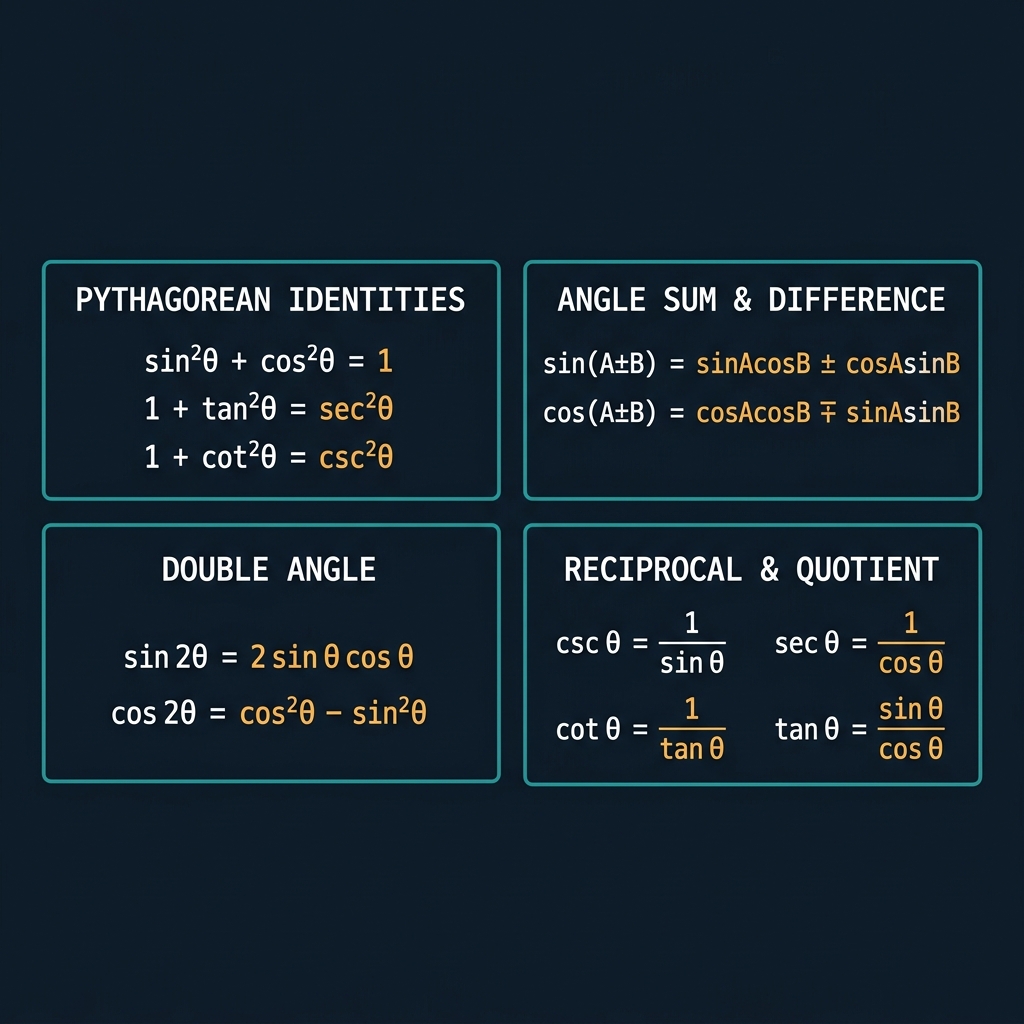
Trig identities are equations that hold for all valid values of θ:
- Pythagorean Identities: sin²θ + cos²θ = 1 (fundamental). Divide by cos²θ: tan²θ + 1 = sec²θ. Divide by sin²θ: 1 + cot²θ = csc²θ. These follow directly from the unit circle equation x² + y² = 1.
- Angle Sum/Difference: sin(A ± B) = sin A cos B ± cos A sin B. cos(A ± B) = cos A cos B ∓ sin A sin B. tan(A ± B) = (tan A ± tan B) / (1 ∓ tan A tan B).
- Double Angle: sin 2θ = 2 sin θ cos θ. cos 2θ = cos²θ − sin²θ = 2cos²θ − 1 = 1 − 2sin²θ. tan 2θ = 2 tan θ / (1 − tan²θ).
- Half Angle: sin(θ/2) = ±√[(1 − cos θ)/2]. cos(θ/2) = ±√[(1 + cos θ)/2]. Sign depends on the quadrant of θ/2.
- Product-to-Sum: sin A sin B = ½[cos(A−B) − cos(A+B)]. cos A cos B = ½[cos(A−B) + cos(A+B)]. Useful for integrating products of trig functions.
Law of Sines and Law of Cosines
These laws extend trigonometry beyond right triangles to any triangle with sides a, b, c opposite angles A, B, C:
- Law of Sines: a/sin A = b/sin B = c/sin C = 2R (where R = circumradius). Use when you know: (1) AAS or ASA — two angles and any side; (2) SSA — two sides and an angle opposite one of them (beware the ambiguous case).
- Law of Cosines: c² = a² + b² − 2ab cos C. Rearranged: cos C = (a² + b² − c²) / (2ab). Use when you know: (1) SAS — two sides and the included angle; (2) SSS — all three sides. Note: when C = 90°, cos C = 0 and the law reduces to the Pythagorean theorem.
- Ambiguous Case (SSA): Given sides a, b and angle A (not the included angle). The triangle can have 0, 1, or 2 valid solutions depending on whether a < b sin A (no triangle), a = b sin A (right triangle), b sin A < a < b (two triangles), or a ≥ b (one triangle).
- Area from trig: Area = ½ ab sin C. This allows calculating triangle area from any two sides and their included angle — no altitude needed.
Inverse Trigonometric Functions
Inverse functions answer "what angle has this trig value?" They have restricted domains to remain functions:
- arcsin (sin⁻¹): Domain [−1, 1], range [−90°, 90°] or [−π/2, π/2]. Example: arcsin(0.5) = 30°. Note that sin(30°) = sin(150°) = 0.5, so the general solution is θ = 30° + 360°n or θ = 150° + 360°n.
- arccos (cos⁻¹): Domain [−1, 1], range [0°, 180°] or [0, π]. Example: arccos(0.5) = 60°.
- arctan (tan⁻¹): Domain (−∞, +∞), range (−90°, 90°) or (−π/2, π/2). Example: arctan(1) = 45°. The four-quadrant version atan2(y, x) correctly handles all quadrants.
For engineering and navigation, the two-argument arctangent (atan2) is preferred because it uses both signs of the coordinates to determine the correct quadrant, whereas the standard arctan only returns values in (−π/2, π/2).
Real-World Applications of Trigonometry
- Engineering and Surveying: Theodolites measure horizontal and vertical angles. A surveyor measuring a building from 50m away at a 25° elevation angle computes height = 50 × tan(25°) = 23.3m. See our Right Triangle Calculator for side-and-angle solving in construction problems.
- Navigation: Bearing problems use trigonometry. A ship traveling on bearing 042° for 80 km has moved 80 sin(42°) = 53.5 km east and 80 cos(42°) = 59.5 km north. GPS systems use spherical trigonometry on the Earth's surface.
- Physics — Waves: Sound, light, and electromagnetic waves are modeled as sinusoids. A wave with amplitude A, frequency f, and phase φ: y(t) = A sin(2πft + φ). Fourier analysis decomposes any periodic signal into a sum of sine and cosine waves.
- Architecture: Roof pitch, staircase angles, and arch design all use trigonometric ratios. A 7:12 pitch (7 inches rise per 12 inches run) corresponds to arctan(7/12) = 30.26°. Use our Slope Calculator to convert pitch ratios to angles.
- Computer Graphics: 3D rotation matrices are built from sin and cos. Rotating a point (x, y) by angle θ: x' = x cos θ − y sin θ, y' = x sin θ + y cos θ. Every 3D game, animation, and rendering engine relies on this.
- Astronomy: Parallax measurements use small-angle approximations (sin θ ≈ θ for small θ in radians). The Earth-Sun distance can be measured using transit of Venus times and sine of the observed parallax angle.
Degrees vs. Radians
There are two primary angle units used in trigonometry:
- Degrees: A full circle = 360°. Most familiar from everyday geometry, navigation, and construction. Calculators often default to degree mode. Each degree = 60 minutes (60'), each minute = 60 seconds (60").
- Radians: A full circle = 2π radians ≈ 6.2832 rad. Radians are the natural unit for calculus because the derivative of sin x = cos x only when x is in radians. One radian ≈ 57.2958°. Conversion: radians × (180/π) = degrees; degrees × (π/180) = radians.
- Gradians (gon): A full circle = 400 gradians. Used in surveying (especially in Europe). 100 gradians = 90°.
- Turns: A full circle = 1 turn. 0.25 turns = 90°. Sometimes used in physics and computer programming for clarity.
Key radian values: π/6 = 30°, π/4 = 45°, π/3 = 60°, π/2 = 90°, π = 180°, 3π/2 = 270°, 2π = 360°. Always check your calculator's angle mode before computing — using radians instead of degrees (or vice versa) is among the most common errors in physics and engineering calculations.
Related Math Calculators
- Right Triangle Calculator — Solve any right triangle given two known measures (sides or angles). Uses sin, cos, tan internally and shows which trig function applies to each computation. The ideal companion for right-triangle trig problems.
- Slope Calculator — Slope (rise/run) and angle are related by tan θ = slope. Convert between slope percentage, angle in degrees, and rise:run ratio. Directly applies arctan to find the angle from a known slope.
- Circumference Calculator — Arc length = r × θ (θ in radians). Sector area = ½r²θ. These formulas rely on radian measure of angles — understanding trig makes these formulas intuitive.
- Significant Figures Calculator — Trig results like sin(27°) = 0.45399... should be rounded to the appropriate number of significant figures matching your input precision. Use this tool to properly round trig results for lab reports and engineering calculations.
- Percentage Calculator — Express trig results as percentages for efficiency calculations (e.g., efficiency of a force component at angle θ = cos θ × 100%). Combine trig with percentage arithmetic for physics and engineering applications.